Saturday, 7 December 2019

Abandoned Alaska child, 5, carries toddler a half-mile in sub-zero temps in socks, light clothes: police

https://www.foxnews.com/us/deserted-alaska-child-5-carries-toddler-half-mile-in-below-freezing-temps-in-only-socks-light-clothes-after-power-goes-out


A 5-year-old child in a remote Alaskan village carried a toddler a half-mile to a neighbor’s house in bitter sub-zero temperatures after they were left home alone, police said Friday.
The older child was frightened after the power went out at the home, so wearing only socks and light clothing, he picked up the younger child and started walking through temperatures that dipped 31 degrees below zero in the village of Venetie, Alaska, according to state troopers.
Both children suffered cold-weather injuries, according to an Alaska Department of Safety news release.

Julie Peter, 37, left the 5-year-old and 18-month-old home alone and has been arrested on suspicion of endangering a minor, authorities said. Her relationship to the children was not immediately known.
Once the children reached another home, the residents there called authorities and troopers arrived Tuesday to check on the children in the village of 175 people.
Like other interior Alaska communities during late autumn, Venetie -- located 155 miles north of Fairbanks -- regularly reaches 40 degrees below zero or lower.

The troopers chartered an airplane to reach the village. It’s unclear how long the children had been on their own; all authorities could say is that the older child decided to leave the house because he was scared when the home lost power, troopers said.

Climate Change: Not to Worry (Obama)

Obamas Officially Purchase $11.75 Million Waterfront Mansion in Martha’s Vineyard

obama-marthasvineyard-house
Courtesy LandVest
3:44
The Obamas are owners of an $11.75 million waterfront mansion in Martha’s Vineyard, officially purchasing the Edgartown Estate this week.
Rumblings of the Obamas multimillion-dollar purchase surfaced in August, but they officially closed the deal this week, joining the elite Martha’s Vineyard community in a nearly 7,000 square foot home that sits on roughly 29 acres, facing the Edgartown Great Pond. The Dukes County Registry of Deeds recorded the $11.75 million price on Wednesday afternoon, per the Vineyard Gazette. The compound was originally listed for sale in 2015 for $22.5 million and dropped to $14.85 million in July 2019.
The listing details the property’s “long and winding driveway, sprawling lawn and incredible water views” and notes that the main residence is “finished with the finest details,” including “multiple seating and entertaining spaces, a modern Chef’s kitchen, and a formal circular dining room surrounded by a wall of windows overlooking the grounds.” It is also equipped with a jacuzzi located off the second-floor balcony.
“There are two guest wings and an impressive master suite with fireplace, private sun deck and spectacular water views,” the listing boasts.
“Your summer days can be spent poolside in a garden-like setting with the sounds of the waves lapping in the distance, or exploring the expansive Great Pond and outer barrier beach for a full day on the water,” it adds.
“The buyer is a nominee trust representing the former First Family. The sellers are Wycliffe Grousbeck and Corinne Basler Grousbeck. Mr. Grousbeck is a private equity investor and owner of the Boston Celtics basketball team,” the Gazette reported.
Additionally, the waterfront home reportedly features “seven bedrooms, eight and a half baths, and several stone fireplaces,” along with a “detached barn and a pool.”
As the Gazette notes, the Obamas have long admired the island, visiting it prior to Barack Obama’s presidency and spending time in the area during his tenure in office. They reportedly rented the Martha’s Vineyard property last summer.
The purchase comes in addition to the $8.1 million home the Obamas purchased in 2017 in Washington, DC’s Kalorama neighborhood. They also own a 6,243-square-foot home in Chicago’s South Side Kenwood neighborhood.
Their latest purchase, however, has called into question the validity of their climate change concerns, as the Edgartown Estate is, in fact, a waterfront property.
As Breitbart News’s John Nolte observed in August:
Regardless of his age, if Global Warming were real, this would be a terrible investment under any circumstance. As this dumb 12-year deadline counts down, it should be property along the coastlines that lose the most value, while inland property rates skyrocket due to overcrowding by leftists fleeing to safety… right?
But leftists are not leaving the coast, and the value of coastline property continues to rise.
If you want to know what people truly believe, don’t listen to what they say they believe… No, you have to watch what they actually do… And the very same people who are bullying us to give up our cars and beef and grills — because if we don’t, the oceans will rise and destroy the coasts!! —  are the very same people living on … the coast.
The purchase follows Michelle Obama lamenting “white flight” during an appearance at the Obama Foundation Summit in Chicago in October:
But unbeknownst to us, we grew up in the period — as I write — called ‘white flight.’ That as families like ours, upstanding families like ours … As we moved in, white folks moved out because they were afraid of what our families represented.
Martha’s Vineyard is just short of 95 percent white. It has less than a two percent black population.

Friday, 6 December 2019

Privacy gets top billing in Firefox moves

DECEMBER 5, 2019, by Nancy Cohen , Tech Xplore

Credit: CC0 Public Domain

Tech watchers were discussing Mozilla this week over its new moves, new plans, new Firefox features.

Ample attention was given, for one, regarding a decision to remove four extensions. Anthony Spadafora in TechRadar said Mozilla promptly marched to the beat of quelling snooping concerns in its removal of four Firefox extensions by Avast and subsidiary AVG.

Mozilla removed Avast Online Security, AVG Online Security, Avast SafePrice and AVG SafePrice.

It is with irony that one can trace an article from TechRepublic in July last year in its well-intentioned innocence which said that "If you use the Firefox browser, you might want to include a handy extension from Avast that helps protect you from phishing and malware sites." The article went on to say that "This little extension by Avast will go a long way toward protecting your Firefox web browsing experience."

The key personality behind the recent research that led to the removals is AdBlock Plus' creator Wladimir Palant. He sent his report to Mozilla.

Why was Palant concerned? Avast Online Security and AVG Online Security were both considered ways to get warning signs of suspicious sites. Palant found that they were both collecting additional data including user browsing history.

Collecting a user's browsing history is prohibited by Mozilla, said TechRadar.

Avast SafePrice and AVG SafePrice showed deals and compared prices. Palant revealed that the Avast SafePrice and AVG SafePrice extensions were also collecting unnecessary data.

Catalin Cimpanu, ZDNet security reporter, discussed reactions from Avast and its subsidiary AVG. ZDNet was told they were working with Mozilla to resolve the issue.

How did Avast explain the collection of user URLs? An Avast spokesperson, said Cimpanu, talked about the Online Security extension, saying "It is necessary for this service to collect the URL history to deliver its expected functionality. Avast does this without collecting or storing a user's identification."


Furthermore, Avast had already implemented some of Mozilla's requirements, according to the response, and intended to release further updated versions. The versions would be "fully compliant and transparent per the new requirements," and were to be available in the near future on the Mozilla store.

There was also a question about Google in the extensions issue, and stories on the matter pointed to Palant's blog posting on Dec. 3. What will Google do?

Palant had reported on the four extensions to Mozilla and to Opera and also to Google. Mozilla promptly disabled the extension listings; Opera likewise unpublished the extensions from its store.

And what about Google? As of Palent's post on Dec. 3, Google had not removed the extensions.

With his last article on Dec. 4, Martin Brinkmann in ghacks.net also reported that "The extensions are still available for Google Chrome at the time of writing."

Pierluigi Paganini on Dec. 4 also reported in Security Affairs that the extensions were still available on the Google Chrome Store.

Cimpanu in ZDNet said Google was expected to remove the four, however. Cimpanu's reasoning: "the browser maker has historically cracked down on extensions that collect user browsing records."

Meanwhile, Mozilla made news this week for more reasons than just extensions. Tech watchers also talked about its Firefox Private Network (FPN). This will allow users to encrypt Firefox connections.

The news is that it is in an extended beta. TechCrunch said this followed a few months of testing in the Firefox Test Pilot program. Not everyone can jump in. TechCrunch said the beta was available to users in the U.S. and time to spend on it was limited. The service was restricted to 12 hours of encrypted surfing on Firefox's desktop version. A Firefox account would be needed to use the extension.

Firefox users can expect to have a more fully-featured device-level VPN service for encrypting surfing and app usage across Windows 10 devices with other platforms coming too, said ExtremeTech. This new service is accepting invitations.

Ryan Whitwam in ExtremeTech: "You can sign up to be notified when Mozilla launches the full Firefox Private Network service. If you're worried about who to trust in the VPN world, Mozilla seems like a safe bet." There will be an introductory price per month.

The next news about Firefox especially drew notes of praise and gratitude from tech-watching sites. in the latest update to the browser, Mozilla is introducing picture-in-picture mode for videos.

From the Dec. 3 Mozilla blog came the announcement that Picture-in-Picture was available with the new Firefox browser release.

"Picture-in-Picture allows a video to be contained in a separate and small window, and still be viewable whether you switch from tab-to-tab or outside the Firefox browser. To see if Picture-in-Picture is available to you, hover your mouse over the video to see a small blue "Picture in Picture" option. Once you click the option, the video will pop into its own and will always stay as the top window, allowing you to continue to watch the video even if you switch tabs."

Picture-in-Picture is available on Windows OS but the blog said that it will be on MacOS and Linux in the next browser release in January.


Recommend this post and follow TCW

Study finds BPA levels in humans dramatically underestimated

DECEMBER 5, 2019, by Washington State University

3D chemical structure of bisphenol A. Credit: Edgar181 via Wikimedia Commons

Researchers have developed a more accurate method of measuring bispehnol A (BPA) levels in humans and found that exposure to the endocrine-disrupting chemical is far higher than previously assumed.

The study, published in the journal the Lancet Diabetes & Endocrinology on Dec. 5, provides the first evidence that the measurements relied upon by regulatory agencies, including the U.S. Food and Drug Administration, are flawed, underestimating exposure levels by as much as 44 times.

"This study raises serious concerns about whether we've been careful enough about the safety of this chemical," said Patricia Hunt, Washington State University professor and corresponding author on the paper. "What it comes down to is that the conclusions federal agencies have come to about how to regulate BPA may have been based on inaccurate measurements."

BPA can be found in a wide range of plastics, including food and drink containers, and animal studies have shown that it can interfere with the body's hormones. In particular, fetal exposure to BPA has been linked to problems with growth, metabolism, behavior, fertility and even greater cancer risk.

Despite this experimental evidence, the FDA has evaluated data from studies measuring BPA in human urine and determined that human exposure to the chemical is at very low, and therefore, safe levels. This paper challenges that assumption and raises questions about other chemicals, including BPA replacements, that are also assessed using indirect methods.

Hunt's colleague, Roy Gerona, assistant professor at University of California, San Francisco, developed a direct way of measuring BPA that more accurately accounts for BPA metabolites, the compounds that are created as the chemical passes through the human body.

Previously, most studies had to rely on an indirect process to measure BPA metabolites, using an enzyme solution made from a snail to transform the metabolites back into whole BPA, which could then be measured.

Gerona's new method is able to directly measure the BPA metabolites themselves without using the enzyme solution.

In this study, a research team comprised of Gerona, Hunt and Fredrick vom Saal of University of Missouri compared the two methods, first with synthetic urine spiked with BPA and then with 39 human samples. They found much higher levels of BPA using the direct method, as much as 44 times the mean reported by the National Health and Nutrition Examination Survey (NHANES). The disparity between the two methods increased with more BPA exposure: the greater the exposure the more the previous method missed.

Gerona, the first author on the paper, said more replication is needed.

"I hope this study will bring attention to the methodology used to measure BPA, and that other experts and labs will take a closer look at and assess independently what is happening," he said.

The research team is conducting further experiments into BPA measurement as well as other chemicals that may also have been measured in this manner, a category that includes environmental phenols such as parabens, benzophenone, triclosan found in some cosmetics and soaps, and phthalates found in many consumer products including toys, food packaging and personal care products.

"BPA is still being measured indirectly through NHANES, and it's not the only endocrine-disrupting chemical being measured this way," Gerona said. "Our hypothesis now is that if this is true for BPA, it could be true for all the other chemicals that are measured indirectly."


Recommend this post and follow TCW

Transition to renewable energy needs to consider global threat to species

DECEMBER 5, 2019, by University of Southampton

Credit: CC0 Public Domain

A new study has shown the extent to which countries drive biodiversity loss overseas through their demand for electric power. For some countries more than half of the impact on species is overseas. While the study found that the shift towards renewable electric needed to combat climate change would likely reduce the impacts on biodiversity, the overseas impact makes it difficult to understand how "green" our electric really is.

The researchers, led by Dr. Robert Holland, a senior research fellow at the University of Southampton are calling for countries to enact strong regulations to ensure that energy transitions are done in such a way as to protect biodiversity, and to consider both the local and global impacts of steps taken to combat global warming.

The scientists, analysed the impact of fossil and renewable power sectors on nearly 4000 threatened birds, mammals and amphibians. For each species they traced the threats these species faced from the electric sector along global supply chains. This included the obvious bits of infrastructure that we see around us such as wind turbines or power stations. But the researchers also examined the impacts on biodiversity of all the materials and components that go into building our electricity infrastructure.

In some countries, the demand for electric power shifts much of its impact on biodiversity to other countries as threats are displaced along international supply chains. The region with the largest international impact was Europe with more than half the total biodiversity impact associated with its electric demand being displaced overseas.

The UK was in the top five countries to pass on much of its risk to other countries along with Japan, China, the United States and India. This contrasts with other countries and regions where far more of the biodiversity impacts are going to meet demand for electric in other countries. For example, a quarter of the biodiversity threat in Latin America is driven by demand for electric in Europe and North America. In the case of countries such as Colombia and Indonesia the threats embodied in exports to meet global demand for electric are greater than the threats associated with their own electric demands.
The researchers advise that future energy policy must consider these unequal international impacts to identify the best routes to decarbonisation.

To reach their findings, they studied the International Union for Conservation of Nature (IUCN) Red List which represent the most comprehensive resource on threats to species globally. They then combined this with a model of the global economy that describes trade between all countries to determine where the impacts on biodiversity associated with the electricity sector occurred.

Solar and wind power were found to have the least impact on biodiversity globally, with coal having the highest impact. As the size of the solar and wind sectors increases over the coming decades, driven by our need to decarbonise society, the impact that these renewable sources will have on biodiversity will also likely increase. At the moment it is impossible to predict the implications of such an energy transformation. As such governments must work to properly understand all the options that they have for decarbonisation—it is unlikely that there is an easy fix. For example while deserts such as the Sahara are often seen as perfect places for large scale solar arrays the biodiversity in this area is extremely fragile and could be lost if adequate care is not taken.

Dr. Holland said "Much of our thinking around the climate change focuses on ways to reduce greenhouse gas emissions and does not consider the wider environmental implication of our choices. What this study shows is that there are ways to address climate change while at the same time delivering benefits for global biodiversity. Given that recent studies have highlighted the loss of species globally, identifying such win-wins is essential for government to act to address the two most pressing challenges of our time".

Kate Scott from the University of Manchester who led the economic analysis says "Major energy transitions are being planned around the world to keep average global warming to well below 2 degrees. Countries are currently debating how to do this at the COP25 in Madrid. Our study shows that countries like the UK that rely on imports to develop its clean energy infrastructure will drive environmental impacts in other, often less economically developed, parts of the world. I think it's imperative that the UK government takes steps to address these ecologically unequal trade exchanges."

Professor Gail Taylor from the University of Southampton and UC Davis says "'The U.S. is identified in this study as one of the nations where the electric sector has a significant impact on biodiversity, outside of territorial boundaries. As such, we should be mindful of this and any future policy initiatives that exacerbate this situation further. On the other hand, we can afford to be optimistic that as the deployment of new renewable technologies accelerates, the US is in a strong position to minimize any adverse consequences on global biodiversity."

The study, published in the Proceedings of the National Academy of Sciences, was a collaboration between the University of Southampton, Manchester University and UCL in the UK, and UC Davis in the U.S., as part of the UK Energy Research Centre. It sought to understand how decisions that we are currently making about pathways to decarbonisation will impact biodiversity.


Recommend this post and follow TCW

Recipes - Big Country Breakfast Frittata

Big Country Breakfast Frittata 

How To Make a Frittata 

TheWolfePit  By Larry Wolfe,  Thursday, March 5, 2015

http://www.thewolfepit.com/2015/03/big-country-breakfast-frittata-how-to.html

The Wolfe Pit shows you how to make a Big Country Breakfast Frittata! Country sausage, home fries, bell pepper, onion, eggs topped with Sharp Cheddar Cheese and Baked to perfection. This Frittata is ideal to feed a crowd for breakfast, lunch, brunch or dinner!  


Ingredients 
  • 12 - Eggs (well beaten)
  • 1 lb - Breakfast Sausage
  • 3 - Russet Potatoes (peeled and cut into bite size pieces)
  • 1 Cup - Yellow Onion (diced)
  • 1 Cup - Bell Pepper (diced)
  • 1 tsp - Salt
  • 1 tsp - Pepper
  • 1 tsp - Granulated Garlic
  • 1 Cup - Shredded Cheddar Cheese
  • 1/4 Cup - Olive Oil


Directions
  • In a large skillet brown sausage (drain excess grease if necessary)

  • Add onions and bell peppers and saute 2 minutes.

  • Remove mixture from skillet and set aside,

  • Turn the heat to medium high, add olive oil and potatoes to the skillet.

  • Let sit five minutes before turning, continue until the potatoes are tender and golden.

  • Add salt, pepper, garlic, sausage, peppers and onion and mix well until the mixture is heated through.

  • Turn the heat off and mix in eggs.

  • Top with the shredded cheese and bake in a 325º oven for 30 minutes or until the eggs are cooked through and the cheese is golden brown.

  • Let sit 5 minutes before serving.
Makes 8 BIG servings

Enjoy!

Watch the video for more directions
🌽🍆🍅🍍🍠🍤🍗🧀🍔🍟🍕 🍏🍎🍐🍊Please recommend this page & be sure to follow the Coconut Whisperer which continues the traditions of Cheese the top Food and Recipe channel on Disqus 2017-2019 🌽🍆🍅🍍🍠🍤🍗🧀🍔🍟🍕🍏🍎🍐🍊


Blames Others, Not Trump, for..

Blame Others, 

Not Trump, 

for NATO's Divisions

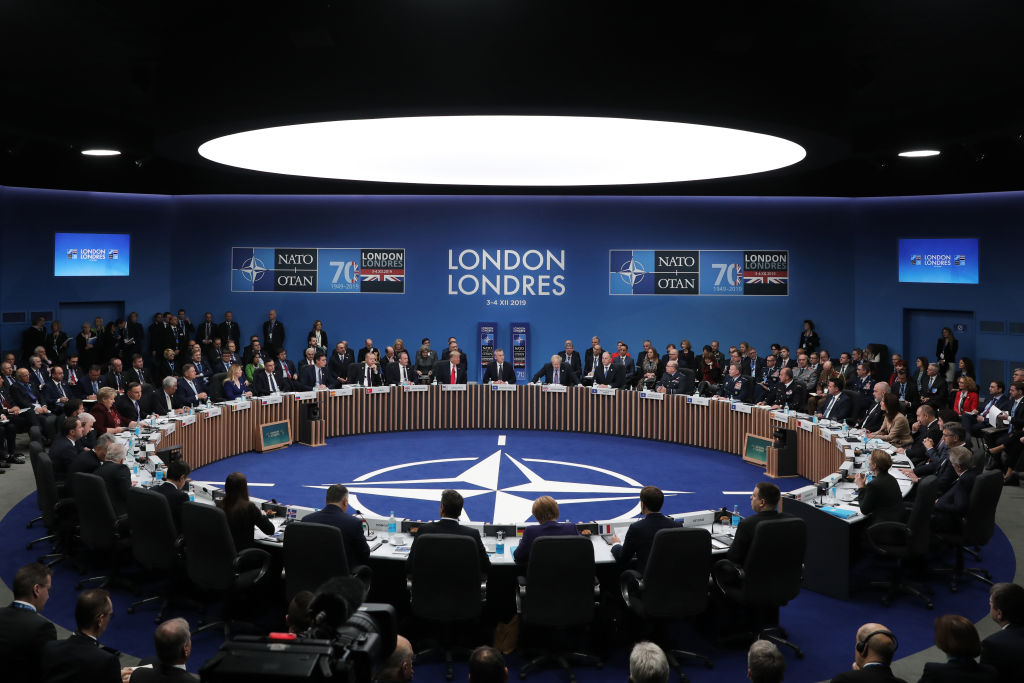
If there is one clear lesson to be drawn from the NATO summit just held in London to mark the alliance's 70th anniversary, it is that the Europeans, and not Donald Trump, are to blame for many of the divisions that exist between the NATO's 29-member states. Pictured: NATO leaders at the summit on December 4, 2019. (Photo by Dan Kitwood/Getty Images)

If there is one clear lesson to be drawn from the NATO summit just held in London to mark the alliance's 70th anniversary, it is that the Europeans, and not Donald Trump, are to blame for many of the divisions that exist between NATO's 29-member states.

Prior to the summit, during which leaders of the alliance attended glitzy receptions at Buckingham Palace and Downing Street, much of the focus centred on the American president and persistent fears that he might carry out his threat to withdraw the US from the alliance.

Mr Trump's unhappiness with NATO is well-documented, and dates back to the NATO summit in Brussels in July 2018 when, during a testy exchange over the failure of most European member states to pay their fair share towards NATO's running costs, Mr Trump made a direct threat to withdraw the US from the organisation.

It still remains the case that, despite Mr Trump's hectoring on the subject, a significant number of European powers -- most notably Germany, Italy and Spain -- fail miserably to meet the defence spending target of 2% of GDP, which is the minimum requirement for NATO membership. In all three cases, their contributions are just above 1%, which lends credence to Mr Trump's accusation that American taxpayers are footing the bill to ensure the security of feckless Europeans.

Mr Trump's campaign to shame the Europeans into paying more does, though, appear to have had some impact, to the extent that Jens Stoltenberg, NATO's Secretary General, was able to announce in London that recent increases in defence expenditure by Canada and some European states, such as Britain, had so far added an extra $130 billion to NATO's defence budget, with the figure set to rise by $400 billion by 2024, a significant increase by anyone's standard.

As Mr Stoltenberg remarked when announcing the increases, Mr Trump deserved credit for "showing leadership on defence spending" that was having a real impact.

That is not to say Mr Trump has relaxed his attitude on the continuing failure of other European members of the alliance to meet their spending obligations. At a press conference held prior to the commencement of the summit, Mr Trump accused countries that failed to meet their spending obligations as being "delinquent", and complained: "It's not right to be taken advantage of on NATO and also then to be taken advantage of on trade, and that's what happens. We can't let that happen."

While getting NATO's finances in order clearly remains a pressing priority for the Trump administration, the real divisions at the summit have been caused by the conduct of the Europeans, most notably France and Turkey.

Mr Trump was particularly incensed by French President Emmanuel Macron's recent comment, made in an interview with the Economistmagazine, that NATO was "strategically brain dead", a remark made in reference to Mr Trump's decision in October to withdraw US forces from northern Syria without first informing his other NATO allies. The American withdrawal allowed Turkish forces to launch a military offensive against Syrian Kurds who had formerly been key allies in the US-led coalition to defeat ISIS.

Turkey's recent decision to purchase Russia's S-400 anti-aircraft missile system, which was designed specifically to shoot down NATO warplanes, has been another serious bone of contention at the summit.

Turkey's important geographical location means that NATO leaders have previously been reluctant to sanction Ankara for its increasingly pro-Russian outlook, which is very much at odds with NATO's position that Russia poses the most significant threat to the alliance's security.

Many NATO countries, however, believe that Turkish President Recep Tayyip Erdogan's decision to buy sophisticated military hardware from Moscow is a step too far, that NATO should respond by imposing measures against the Turks.

The deepening divisions within the alliance have certainly taken the gloss off of the 70th anniversary celebrations in London, to the extent that countries like Russia, that actively desire NATO's demise, will be rubbing their hands with glee.
Con Coughlin is the Telegraph's Defence and Foreign Affairs Editor and a Distinguished Senior Fellow at Gatestone Institute.