South Africa Farms: Taxation on ‘unused land’ and ANC’s transformation agenda
TLU SA
Farms: Taxation on 'unused land' and ANC's transformation agenda
TLU SA takes note of the ANC’s legotla idea of taxation on unused land, to make more land available for its transformation agenda – but at the same time calls on the ANC to explain what it means by unused land.
“Perhaps the ANC is referring to the land that it recognised in terms of its land transfer programmes, 95% of which went out of production? When a farmer rests certain camps in a rotation programme, it is far from unused and scientific sustainability has been built in there,” explains Mr. Henry Geldenhuys, TLU SA President.
“Distributing land is of no value if it does not consider the other factors of production in a particular synergy. Land on its own is not wealth, but if an entrepreneur (farmer) manages it with expertise together with the other factors in a dynamic production process to be profitable, he has the chance to create wealth.”
Mr. Geldenhuys adds: “The ANC must decide whether it wants food security in the country or not. With his policy, he is putting our country’s food production under the wrong kind of pressure. This approach of trying to get hold of land can at best be seen as a way of getting votes. Over the years, TLU SA and others have repeatedly made economically oriented proposals on how new entrants can enter the agricultural environment and have the chance of success, provided of course that they will accept the responsibility it takes to be able to farm.”
Mr. Geldenhuys further asks the question of what still needs to be explained about how the economy works and the only mechanism that determines whether there is economic success or not, namely the market power principles.
“Let’s try again. The entrepreneur or entrepreneur as one of the factors of production is the person who takes the risk of combining with his or her relevant knowledge the other factors of production, namely raw materials, capital, and labour, in a business. With the rapid development of technology and mechanisation, it could be seen as a fifth factor of production also in the sense that it can replace labour. Something the unions may need to take note of.
“It may be necessary for the ANC to learn how to feed people with an ideology, because with cadre deployment, self-enrichment and almost no economic outcomes, it may be all that will be left over in time to feed people with,” warns Mr. Geldenhuys.
A farm in the US that hired only white South Africans is being sued by black locals
Business Insider SA
Sep 10, 2021, 08:33 AM
(Getty)
In 2014, a major farm in Mississippi started hiring South Africans – always white – for seasonal work, according to a new US lawsuit.
The South Africans replaced local black workers, in a predominantly black area, and were paid more than those locals, the plaintiffs say.
Now six black workers are demanding compensation for discrimination.
Pitts Farms, a very large producer of cotton, soybeans, and corn in Mississippi used to have a largely black workforce, drawn from an area that is more than 70% black, according to a complaint filed with a US district court this week.
Then, in 2014, it started using imported labourers from South Africa. They were always white and, say the plaintiffs in the suit, better paid than were the local black workers – who in some instances trained them.
The South Africans were paid a standard state rate that started at $9.87 per hour in 2014 and rose to $11.83 (the equivalent of around R170 at current exchange rates) in 2020, the complainants say. At the same time the black locals were lucky to make $9 per hour for driving heavy trucks, while ordinary labourers got $7.25 per hour, and an extra dollar per hour for work on weekends.
The farm "intentionally paid its Black workforce less than its white foreign workers for the same or similar work. The white foreign workers were also given other benefits not provided to Plaintiffs and other Black domestic workers," says the complaint.
While some black workers were charged for using accommodation on the farm, the white South Africans lived rent free, in better housing.
Workers also say their supervisor on the farm "frequently used racial slurs, including the n-word, when speaking to or about" black workers.
According to the complaint, the South Africans were formally hired as "agricultural equipment operators" between roughly February and November every year, with duties that included driving tractors and repairing farm equipment. Some delivered water around the farm, or drove trucks to auction sites.
If you think organic food is expensive, try cancer
By Lin Sampson
20 August 2021
For two years running South Africa has been named as the most unhealthy country in the world. And Angus McIntosh (Farmer Angus) is determined to do something about it.
Farmer Angus McIntosh has the intense look of someone with a single dream like skateboarding to the South Pole. He wears a slightly ingenuous expression, as if he has just been born into a new world and finds everything curious and a bit disturbing.
With a background as a trader for Goldman Sachs in London, there is a hint of cufflinks and striped shirt in his farmerish attire and smooth talk. However, his verbal spritz no longer sprouts derivatives and hedge funds but involves a passion for environmentally friendly farming.
And boy do you need passion. In a world where farming is a big industry (visiting a farm in the USA is hazardous because of free floating poisons), following a dream of clean food is a kind of madness.
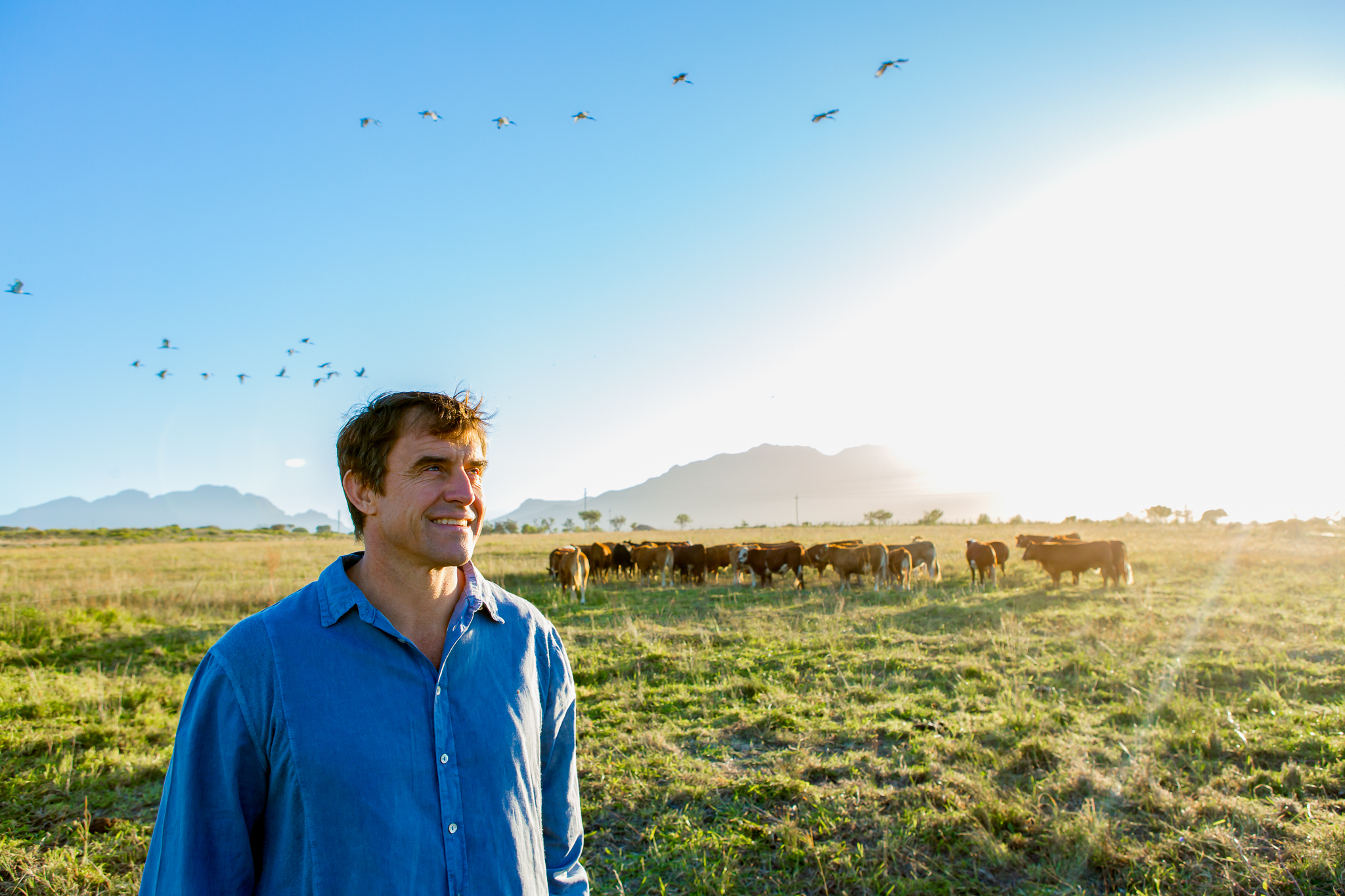
Farmer Angus’ farm is situated on 126 hectares of irrigated pasture at Spier Wine Estate near Stellenbosch. It is a place that ignites the heart with its well cared for animals, green pastures, vegetable gardens and on site butchery. A friend calls it “fairyland”.
The farm arguably hosts the Cape’s best non-industrial food production. The eggs are yolky and delicious and the meat which can be ordered online is clean and tastes like meat used to taste. Remember? Before feedlots, pesticides and hormones.
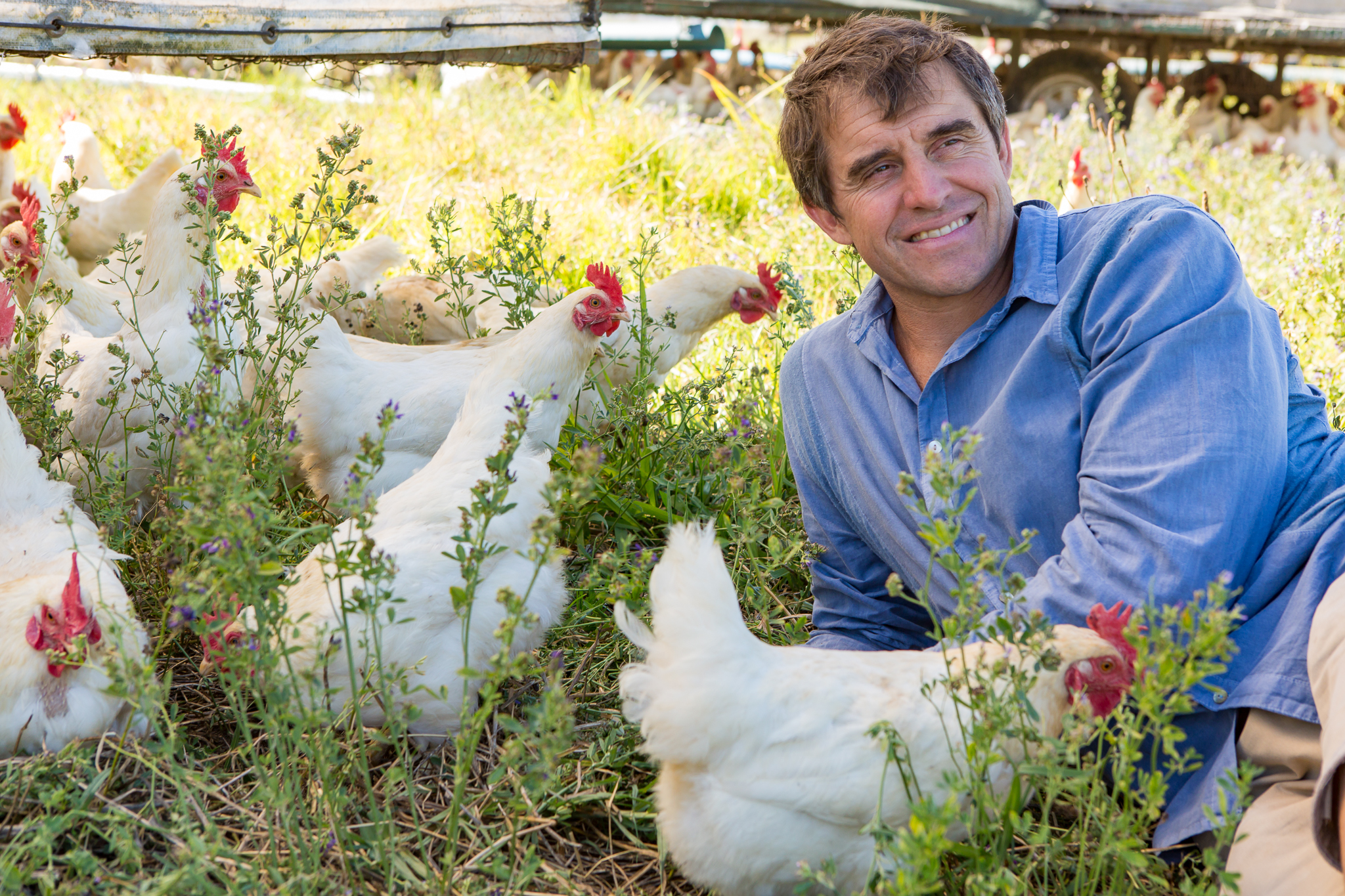
About six years ago I discovered his eggs by chance, astonished by their creamy innards and thick marigold coloured yokes. Investigating their origin, I came across Farmer Angus, moving his egg laying hens in “eggmobiles” to new outdoor pasture.
He told me then, “The biggest lie in agriculture is free range eggs. They live in barns, they don’t range outside. On commercial egg farms, chickens live and never leave a space equivalent to an A4 piece of paper.”
(Photo: Supplied)
And it is not only the animals that are benefitting. His egg company is now 80% owned by his staff and the eggs get better and better. “I am only a 15% shareholder but it’s got my name on it,” he says.
Over the years McIntosh has developed biodynamic and regenerative agricultural practices in the raising of the farm’s animals which include cattle, pigs, chickens and laying hens, as well as vegetables and wine.
His pastured livestock and poultry are moved frequently to new pastures where they can perform basic needs such as dustbathing and flapping their wings.
Often in the past in butcheries or so-called organic groceries, I have asked about provenance. So far I have never met a retailer who has even taken the trouble to see where the food (particularly labelled as “organic”) they sell comes from.
Farmer Angus encourages people to visit the farm and see where their food is produced. Caring for the animals properly is a high priority. More and more restaurant owners around the world are keeping their own herds for the simple reason that cared for cattle produces not only the healthiest but the tastiest meat.
With farming there is so much wonkery – what irony that the salt of the earth, the food we eat is as about as full of corruption as the Zuma Cabinet.
His desire is for people from all walks of life to be able to eat better and more nutritiously and to understand what they put in their bodies. On the face of it it is a modest dream but in South Africa it is as difficult as climbing Everest in a pair of Jimmy Choos.
The challenge of agricultural sustainability has become more intense in recent years with climate change, water scarcity, degradation of ecosystem services and biodiversity, the sharp rise in the cost of food, agricultural inputs and energy, as well as the financial crisis hitting hard on South Africa.
He reels off stats with an almost cult-like enthusiasm.
“A well looked after Jersey cow that has grown up on pasture should give you 50 lactations. Do you know what the average lactation in South Africa is? Two point one. They are treated as monogastrics and fed a heavy corn diet three times a day. As a result the milk is so high in pus that they are forced to homogenise it.
(Photo: Supplied)
“Of course people are going to be allergic to it.”
I have always wondered why so many people are “allergic to dairy”.
South Africa should be the land of milk and honey; instead it is the land of cheap chemicalised food. “We have the highest obesity rate in the world. The rural Africans understood the value of milk, a whole food, but they lost the tradition when they came to the cities to work.”
Personally, says Farmer Angus, “I think that consumers have to think about food differently and eat differently. They need to be conscious that behind a kilo of tomatoes lies a lot of work. They need to know where their food comes from and what goes into it.
“People are living on more and more processed foods, so the body is craving nutrients. The only thing that the people in agriculture agree on is that the nutrient content of food has been in decline for 120 years. The carrots your grandmother ate and the ones you eat might look the same but on a nutritional level they are entirely different.
“Most of us can grow our own vegetables, we can all make our own worm compost which is the best fertiliser of all. South Africa has got a million unemployed people. Why are they not growing their own food? Here’s why. There is a stigma attached to farmers which is why so few guys grow their own food in a place like Khayelitsha. They want to wear zoot suits and drive Beemers.”
McIntosh’s new project is producing first grade grass fed, pesticide free food at an affordable price. Last week, wandering the aisles of Checkers, I came across such usually unaffordable products as pancetta, coppa, prosciutto at a price within my budget.
Let us give thanks for the pig.
Pancetta made from the belly, coppa from the neck and prosciutto from the leg and Black Forest ham to die for from the loin, a real feast.
But not a feast for pigs, especially in South Africa. “I only know two farmers who do not cage their pigs,” says McIntosh. The European Parliament’s Agriculture Committee has recently called on the European Commission to propose a revision of the EU directive on farmed animals with the objective of phasing out the use of cages in animal farming.
McIntosh’s move to supermarket selling is not only significant because people like me can afford to buy it but it is the first time that grass-fed beef is being sold at the same price as feedlot products.
“But more important,” says Farmer Angus, “this is a truly costed item. The beef you buy in a shop is not really costed, the antibiotic resistance is not costed, the inflammatory diseases you get are not costed. There is a whole lot of stuff that is not in the price, so true cost accounting is another thing that has to be on the table in order to keep any ethical enterprise going.”
“This stuff has been outdoors reared, it is not imported and most important it has been cured without adding nitrates or nitrites plus the chemical arsenal that fires up most commercial foods. Our charcuterie, made by Gastro Foods, is the only charcuterie in South Africa cured without added nitrates or nitrites.
“We have the space, we have the weather, all we need is the absolute desire for better nutrition.
“And there are rewards. The carbon in our soil has increased and we get paid credit for that. What people don’t realise is that the vegan diet that everyone is trying to ram down our throats is destructive to the ecology. Whereas this is generative to the ecology. In the vegan utopia there are no animals, so how do they make the food for the plants? They can’t make animal based fertiliser or compost so they have to use chemicals.
“Actually, we have no choice. We go the ethical route or we die.”
As Joel Saliton, a farmer in the USA famous for his ethical practices, says, “If you think organic food is expensive, try cancer.”
South African pumpkin of 867kg smashes record. It took only 100 days to grow
Business Insider SA
Apr 07, 2021, 06:13 AM
The giant pumpkin had to be lifted very carefully, before it was transported from a farm near Mossel Bay to be weighed at a competition in Heidelberg in the Western Cape. Photo: Netwerk24
South Africa has a new record pumpkin: a 867.5kg behemoth from a farm near Mossel Bay.
The pumpkin itself developed in 100 days, its owner says.
The new record holder beat a 860kg pumpkin named SA's biggest last year.
The new title-holder was cultivated by Willem le Grange, manager of a farm near Mossel Bay, and won a giant pumpkin competition recently at an agricultural festival in Heidelberg in the Western Cape.
Willem le Grange, with his giant pumpkin. (Photo supplied, via Landbou.com)
It beat the previous record-holder: a 860kg pumpkin from Riversdale in the Western Cape, which took the title last year.
Le Grange told Landbou.com that it took 50 days to grow the pumpkin plant, and then a further 100 days for the pumpkin itself to develop into its giant shape.
When the pumpkin grows at full speed, its weight can increase by 25kg a day. Le Grange told Netwerk24 that special machinery was needed to lift the pumpkin from its patch and transport it to the competition in Heidelberg.
Recently, a Gauteng pumpkin - a 790kg behemoth called Johanna - was named the heaviest ever cultivated north of the Orange River.
Wykus Lamprecht of Meyerton in Gauteng grew the pumpkin from a seed planted in October last year, Landbou.com reported.
The fast-growing pumpkin required at least 200 litres of water a day, Lamprecht told Landbou.com. Some days, this would run up to as much as 700 litres.
The pumpkin was nurtured under a gazebo to protect it against the sun and rain, and a fan kept its stem dry. (A moist stem can cause decay.) Johanna was also wrapped in blankets at times to shield it against the elements.
According to The Guardian, the world record for the heaviest pumpkin is 1,190.49kg, held by Belgian farmer Mathias Willemijns and set in 2016.
There are many chicken products today, but the labels can often be
misleading. The programme Talking Point investigates the meaty issues
here, like how important it is to go antibiotic-free.
SINGAPORE: Earlier this year, Benjamin Ang started rearing his own
chickens at a community space on Henderson Road; he wanted fresh eggs
and premium chickens bred in what he feels are humane conditions.
Valued for their superior meat, the French chickens he rears — poulet de Bresse — are among the world’s most expensive chickens.
A frozen Bresse costs between S$50 and S$70 each, compared with about
S$4 for a regular frozen grill chicken that one can find at a
supermarket.
“(Bresse) chicken has been described as the queen of
poultry and the poultry for kings. They’ve been bred specifically for
their flavour and texture of the meat,” said Ang.
“If you’re
looking at the quality of the meat or the experience of something
different, then I’d say it’s definitely worthwhile.”
resse chickens command
premium prices as they require more personal space, and a third of their
diet consists of naturally foraged earthworms, insects and grass.
These
days, chickens come with many labels, such as corn-fed, free-range and
organic, with each variety promising to be environmentally friendlier,
healthier and tastier than your average chicken.
But all these
labels may lead you to wonder what “antibiotic-free” or “probiotics-fed”
really means. And how do these varieties affect the meat’s nutritional
value? The programme Talking Point finds out six things you should know when buying chicken.
1. WHAT DO THE LABELS MEAN?
100 per cent organic: To be certified, these poultry
must be reared with no antibiotics, provided with 100 per cent organic
feed and given access to the outdoors.
For example, Ryan’s Grocery co-founder Wendy Foo
said the organic chickens it sells are from Australia, and when they are
sick, essential oils are administered to them, instead of antibiotics.
Antibiotic residue-free:
Antibiotics have been administered to these chickens but are removed
from their feed a few days before they are slaughtered, so that there is
no residue left in the meat when it is processed.
Probiotics-fed:
Instead of antibiotic growth promoters, said Kee Song Food Corporation
(Singapore) head of business development James Sim, these chickens are
fed with probiotics.
In the case of the company’s flagship product, Lacto Chicken, they are fed on lactobacillus to enhance their immune system.
WATCH: Is it safe to eat chicken reared with antibiotics? (2:31)
Free-range:
The United States Department of Agriculture (USDA) generally permits
this term to be used if the chickens have access to the outdoors for at
least some part of the day.
The USDA has no provision, however, for the duration spent outside or the amount of space provided.
As
for kampung chickens, they are a breed of chickens, Foo points out.
Originally free-range, they are now highly likely to be farmed in cages.
Factory-farmed:
Although not labelled as such, these are the most common chickens sold
in supermarkets. Known as broilers, they are bred for meat production.
Kept
in cages where the living conditions are typically “not as hygienic”,
they are fed with antibiotics “so that they stay healthy”, said Foo.
2. WILL THE ANTIBIOTICS HARM ME?
Antibiotics
are used globally by the livestock industry to prevent and treat
infectious bacterial diseases, the Singapore Food Agency (SFA) said on
its website.
Nonetheless, poultry treated with antibiotics “may
not be processed for food until a specified withdrawal period has been
observed to allow antibiotic residues to be sufficiently cleared from
the system”.
The SFA prescribes maximum residue levels (MRLs) “so
that we know that the chicken we buy is safe for consumption”, said
William Chen, the director of Nanyang Technological University’s food
science and technology programme.
There is a strict inspection scheme to ensure that drug residues do not exceed those levels, the professor added.
Just last month, the SFA suspended the import of
live chickens from a farm in Malaysia after detecting drug residues
exceeding MRLs in samples collected from a consignment of the farm’s
chickens.
All imported and local food products are subject to regular inspections and sampling, including for harmful bacteria.
The
chances of antibiotic-resistant bacteria going into chicken flesh are
also “very low”, as these bacteria are typically found in the bird’s
digestive system, said Chen.
“When we cook the chicken, the
bacteria — whether they’re antibiotic-resistant or not — will be killed
off. So consumers shouldn’t be overly worried about eating chicken
bought from the supermarket or wet market.”
3. HOW DOES THE CHICKEN’S DIET AFFECT ITS MEAT?
The
texture of the meat depends on the feed, said Foo. For example, meat
from chickens fed with bromelain, a digestive enzyme extracted from
pineapples, is leaner and firmer as well as lower in fat and
cholesterol, she cited.
What an animal eats has an effect on its
fat. “That’s where you’re getting a lot of flavour from,” Annie King,
from the Department of Animal Science at the University of California,
Davis, told the magazine Popular Science.
But not all flavours the
animal eats will be carried over into the meat, as some compounds will
be metabolised before they make it to the fat, the magazine reported.
4. DOES THE FEED AFFECT THE NUTRITIONAL VALUE?
Regardless of what the chickens eat, the formulation of the feed is such that it provides certain amounts of nutrition.
Farmers
would calculate the proportions of raw materials to provide, say, the
energy levels the chickens “require for their functional maintenance”,
said poultry health expert Lynn Tan.
Some chickens are fed with
grains such as brown rice or quinoa, as these ingredients’ “purported
health benefits” are well known to consumers.
“This could trigger a
positive psychological effect in the consumer,” said the veterinary
practitioner. “But in actual fact, it doesn’t increase the fibre content
of chicken meat … It’s just a marketing aspect that people need to be
aware of.”
She added that she “wouldn’t pay that much more” for
chickens fed on brown rice, corn and soya, “because I know that.
ultimately, the nutritional formulation will be the same as a typical
commercially-fed chicken”.
5. WHY ARE PREMIUM CHICKENS COSTLIER?
A
Bromelain-fed chicken costs about S$19 per kilogramme, while a
cage-free corn-fed and soya-fed chicken costs about S$23. A 100 per cent
free-roaming, organic chicken costs S$42/kg.
They cost a premium
because antibiotic growth promoters are usually not administered to
them, so they take longer to reach the ideal size for slaughter.
For
example, it takes at least 56 days for a free-range chicken and 81 days
for an organic one, compared to 40-odd days for a broiler chicken.
Then
there is the amount of space given. Organic chickens get the most
space, at about 10 chickens per square metre; free-range chickens at
about 12 chickens per sq m; and conventional broilers at about 17
chickens per sq m.
Some premium chickens are also fed with slightly more premium feeds, like corn, soya, organic feed, brown rice and probiotics.
6. WHAT IS THE FUTURE OF POULTRY FARMING?
There
is a growing number of poultry farmers in Singapore, Malaysia and other
Southeast Asian countries who are switching to farming without the use
of antibiotic growth promoters, and on a larger scale, said Sim.
This is to give consumers a healthier choice “in terms of good-quality protein”.
His chickens even roam in barns with piped music, namely classical music.
“It’s
a way to promote a calmer and … less stressful environment. If they
don’t feel so much stress, they grow up healthier and their meat is a
bit tenderer,” he said.
It’s not easy being a cow living among African lions in Botswana. After all, there’s always the threat you could soon be a big cat’s meal.
UNSW conservationists have found an effective, low-cost way to protect cattle from their predators and help lions coexist with livestock and farmers.
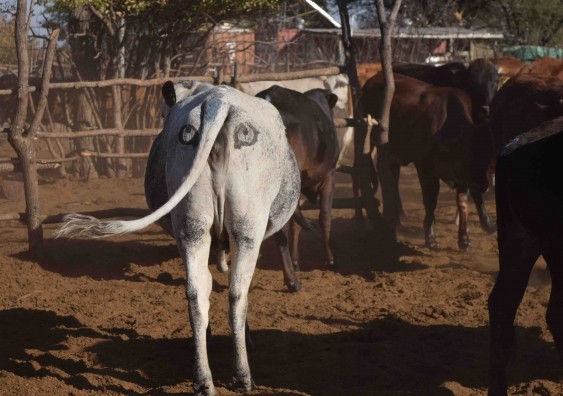
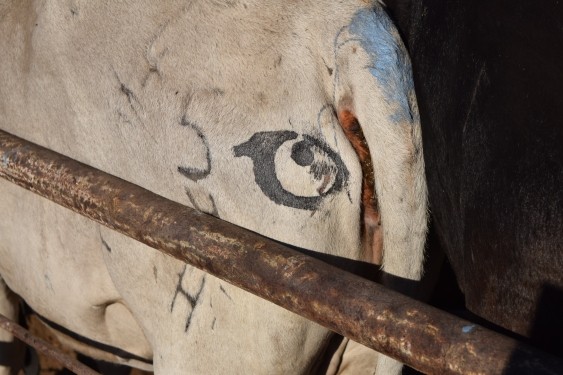
In a piece of “psychological trickery,” scientists have trialled painting eyes on local cattle butts.
The idea is that the intimidating eyes will trick the lions into thinking they’ve been spotted, causing them to abandon the hunt.
“As protected conservation areas become smaller, lions are increasingly coming into contact with human populations, which are expanding to the boundaries of these protected areas,” says Dr Neil Jordan, a conservation biologist from UNSW’s Centre for Ecosystem Science.
The lions eat livestock, such as cattle, which negatively impacts the livelihood of the subsistence farmers living in these rural areas. With no non-lethal way to prevent the attacks, the farmers often turn to deadly force, shooting or poisoning the lions in retaliation.
Dr Jordan says these human-animal conflicts have resulted in populations of African lion—a threatened species—“draining away.”
Dr Jordan’s idea of painting eyes onto cattle rumps came about after two lionesses were killed near the village in Botswana where he was based. While watching a lion hunt an impala, he noticed something interesting:
“Lions are ambush hunters, so they creep up on their prey, get close and jump on them unseen. But in this case, the impala noticed the lion. And when the lion realized it had been spotted, it gave up on the hunt,” he says.
A Strategy Derived From Nature
In nature, being ‘seen’ can deter predation. For example, patterns resembling eyes on butterfly wings are known to deter birds. In India, woodcutters in the forest have long worn masks on the back of their heads to ward-off man-eating tigers.
Jordan’s idea was to hijack this mechanism. Last year, he collaborated with the BPCT and a local farmer to trial the innovative strategy, which he’s dubbed “iCow”.
The researchers stamped painted eyes onto one-third of a herd of 62 cattle, and each night counted the returning cows. The effectiveness of the eyes essentially comes down to relative survival rates: are painted cows less likely to be attacked and killed than unpainted cows?
In mid-July, he’ll return to Botswana for three months to further test and validate the tool. He’s raised more than A$8000 on the science crowdfunding platform Experiment.com to purchase 10 cattle GPS loggers, and one GPS radio collar, which will be fitted to a wild lion under anaesthetic.
Dr Jordan’s team, involving a UNSW PhD student and researchers from the BPCT, will paint roughly half the cattle in a herd of 60. They’ll use the GPS devices to monitor the movements of cows and lions, and to determine when and where they meet.
“This will give us information about the exposure of painted and unpainted cows to predation risks, and where the conflict hotspots are,” says Dr Jordan.
If the tool works, it could provide farmers in Botswana–and elsewhere–with a low-cost, sustainable tool to protect their livestock, and a way to keep lions safe from retaliatory killing. That’s good news all around.