Thursday, 7 November 2024

Rare 1678 Book on Golden Age of Piracy goes up for Auction


Dutch book that accused Welsh-born Pirate Henry Morgan of using nuns and monks as human shields is set to fetch up to £70,000 at auction

Using nuns and monks as human shields does sound like a tactic of Johnny Depp's swashbuckler Captain Jack Sparrow.

But this was no Hollywood storyline, it was what famed Welsh-born pirate Captain Henry Morgan was accused of in the foundational text for the Pirates of the Caribbean.

Now, an 'extremely rare' complete copy of De Americaensche Zee-Roovers, by Alexandre Olivier Exquemelin, which was published in 1678, has emerged for sale.

The Dutch book, which is expected to sell for up to £70,000 when it comes up for auction at Bonhams, is regarded as the first witness report of life on board a pirate ship.

However, the work led to a high-profile libel trial that pitted Exquemelin against his former ship mate Morgan, who was furious at the author's depiction of him as a torturer.

An extremely rare complete copy of the foundational text of the Pirates of the Caribbean has emerged for sale. In De Americaensche Zee- Roovers, author Alexandre Olivier Exquemelin accused English pirate Henry Morgan of using nuns and monks as human shields
The book's depiction of Morgan

An extremely rare complete copy of the foundational text of the Pirates of the Caribbean has emerged for sale. In De Americaensche Zee- Roovers, author Alexandre Olivier Exquemelin accused English pirate Henry Morgan of using nuns and monks as human shields. Above: The book; right, its depiction of Morgan

Morgan successfully sued the publishers of the English edition, and the passage about him having used nuns and monks as human shields in what is now Panama were removed.

But Exquemelin's book still sparked a fascination with pirates that still endures to this day.

The hugely popular Pirates of the Caribbean film franchise, which starred Depp and began in 2003, was the ultimate culmination of that interest.

De Americaensche Zee- Roovers was also the main text that revealed the so-called Golden Age of Piracy to the world.

The copy being sold in London is the first to appear for 130 years. Only a handful of Dutch editions are held by institutions around the world.

The Dutch book, which is expected to sell for up to £70,000 when it comes up for auction at Bonhams, is regarded as the first witness report of life on board a pirate ship

The Dutch book, which is expected to sell for up to £70,000 when it comes up for auction at Bonhams, is regarded as the first witness report of life on board a pirate ship

Matthew Haley, managing director of Bonhams, said: 'The image of a pirate with a Johnny Depp-like moustache and goatee beard and the whole myth of a pirate really comes from this book.'

He added: 'The author was on board buccaneering ships in the Caribbean, so it is an eyewitness account.

'While copies of the other editions and other translations have come up for auction, we haven't been able to find this edition coming up in more than 130 years.

'There are a handful in public libraries but it is an extremely rare book.'

Exquemelin's book sparked a fascination with pirates that still endures to this day

Exquemelin's book sparked a fascination with pirates that still endures to this day

Although he was regarded as a pirate in the Caribbean, Morgan was working for the English Commonwealth to facilitate British trade.

He led buccaneer missions to take over Spanish strongholds in the Caribbean, but fell out of favour with King Charles II when he attacked Panama in 1671, in defiance of a peace treaty.

But he soon regained the monarch's affections and was later appointed as Lieutenant Governor of Jamaica, where he died in 1688.

The copy of De Americaensche Zee-Roovers is being sold by a US-based seller via Bonhams in London on November 20. 

https://www.dailymail.co.uk/news/article-14047843/Pirates-Caribbean-Dutch-book-Henry-Morgan.html

A 1681 painting by Flemish painter Laureys a Castro depicting a sea battle between European ships and Barbary corsairs

A 1681 painting by Flemish painter Laureys a Castro depicting a sea battle between European ships and Barbary corsairs

An illustration shows enslaved Christians seized by corsairs arriving in the port of Algiers to be ransomed

An illustration shows enslaved Christians seized by corsairs arriving in the port of Algiers to be ransomed

Pictured: The coins Odyssey found on board the 1804 wreck of the Nuestra Señora de las Mercedes, a Spanish warship. These coins are on display in a Spanish museum following a long court battle between Odyssey and the Spanish government over who had the rightful claim

The coins found on board the 1804 wreck of the Nuestra Señora de las Mercedes

A ship belonging to notorious pirate Blackbeard (pictured) who terrorised the high seas 300 years ago has featured in a modern-day US Supreme Court battle over copyright piracy

A ship belonging to notorious pirate Blackbeard (pictured) who terrorised the high seas 300 years ago

The ironic case came about over footage of the remains of the Queen Anne's Revenge - the vessel the Bristol pirate used to terrorise the high seas. Pictured: The anchor being salvaged

Queen Anne's Revenge was the vessel the Bristol pirate used to terrorise the high seas. Pictured: The ship's anchor being salvaged 

Research and salvage company Intersal began work to salvage the contents of the ship - including its 3,000-pound anchor (pictured)

The 3,000-pound anchor (pictured)

Many pirates either started off or ended up being 'privateers', pirates sent by the kings or governments of countries to plunder foreign shipping. It was only when the likes of Blackbeard (pictured) decided to go it alone that piracy was seen as a problem

Many pirates either started off or ended up being 'privateers', pirates sent by the kings or governments of countries to plunder foreign shipping.

Walking the plank: A privateer similar to the Port-au-Prince targets Spanish ships, as the historic boat did before heading to the Pacific to meet its end

A privateer targets Spanish ships

Find: Historians believe they have raised England's only surviving 'state pirate ship' from the bottom of the Thames estuary after 400 years. The wreck (pictured) was found 10 years ago with few clues to its identity
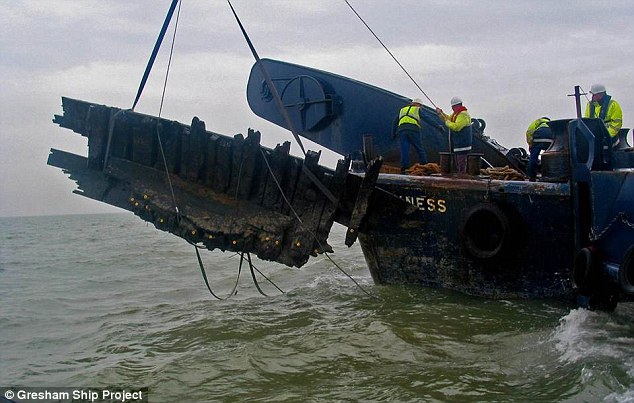
Raising England's only surviving 'state pirate ship' from the bottom of the Thames estuary after 400 years. 

Historic: The wreck was rediscovered in the Thames estuary near Herne Bay, Kent, and is believed to have sunk during a fierce storm in 1603 as it left London fully-laden with goods to trade with the rest of the world

The wreck was rediscovered in the Thames estuary near Herne Bay, Kent, after sinking during a fierce storm in 1603 as it left London
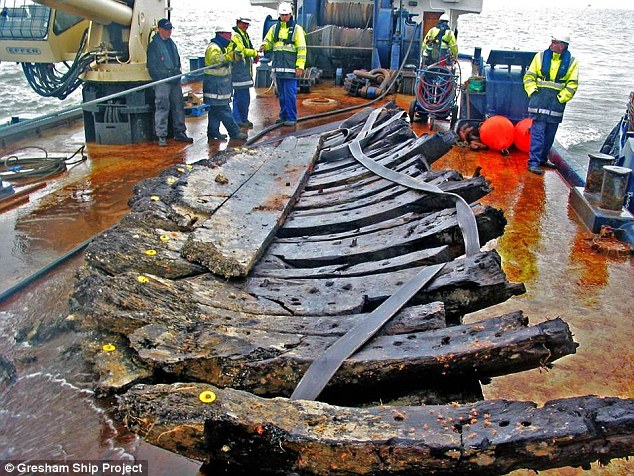
Huge: The ship was left in pieces but originally weighed 160 tons and measured 80ft long and 25ft wide

The ship was left in pieces but originally weighed 160 tons and measured 80ft long and 25ft wide

Dr Gustav Milne said the ship likely 'led the double-life of honest trader and ruthless privateer'

The ship 'led a double-life of honest trader and ruthless privateer'

Reign: The Cherabin was one of 70 'privateers' - state pirate ships - which stole £97,000 under Elizabeth I

One of 70 'privateers' - state pirate ships under Elizabeth I
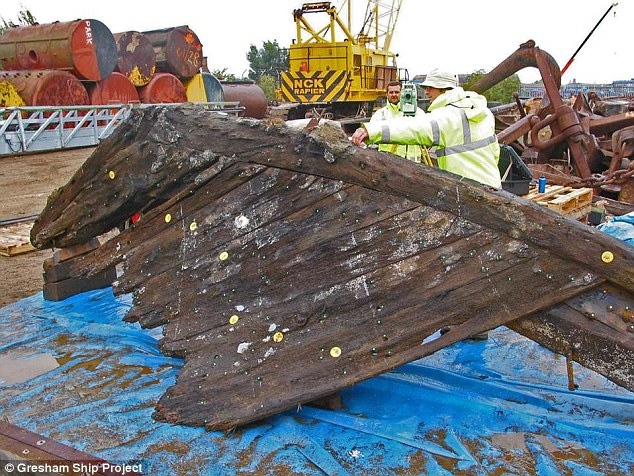
Study: Divers helped raise the ship's skeleton from the murky waters around Girdler Sand near Herne Bay, Kent, and brought it to Portsmouth before samples were sent to be studied in Denmark and London

Divers helped raise the ship's skeleton from the murky waters around Girdler Sand near Herne Bay, Kent, and it was brought to Portsmouth
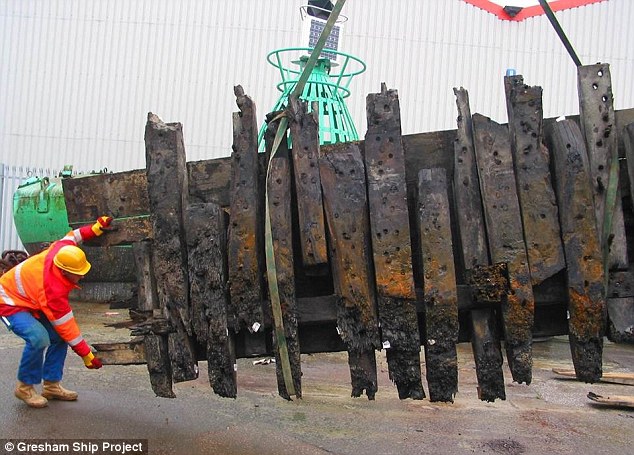
Big job: A workman carefully unloads one of the huge sections which was raised from the Thames estuary

A workman carefully unloads one of the huge sections which was raised from the Thames estuary

Fragile: The wreck could not be kept out of the water for long because it would begin to decay in the air

The wreck could not be kept out of the water for long because it would begin to decay in the air

Significant: Historians described the find as the biggest since the raising of the Mary Rose (pictured), the flagship of Henry VII's fleet which sank in the Solent in 1545. But it was much more typical of ships of the time
The Mary Rose (pictured), the flagship of Henry VII's fleet which sank in the Solent in 1545. 

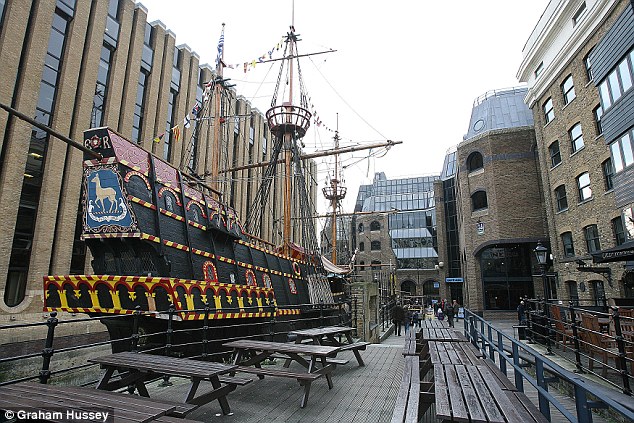
Similarities: Researchers said the ship was similar to Sir Francis Drake's Golden Hinde (replica shown)

Replica of Sir Francis Drake's Golden Hinde

Heritage: One of the ship's 7ft cast iron guns is lowered into a trough to help protect it from the elements

A ship's 7ft cast iron gun is lowered into a trough to help protect it from the elements

In this undated photo released on Monday Feb. 28, 2011 by Panamaís Institute of Culture

Decayed cannons from fearsome bucaneer Henry Morgan's ship, the Satisfaction, which sank in Panama in 1671

Notorious pirate Henry Morgan. Weird fact of the day: Notorious pirate Henry Morgan was so offended by a book that described him as 'bloodthirsty' and, much worse, a former servant, he sued the publisher for libel.

Morgan was born in a small Welsh village and went on to become a notorious pirate

The Whydah (pictured) was a state of the art ship built in 1715 in England. It weighed 300 tonnes, was 102 feet long and loaded with 18 cannons

The Whydah, a state of the art Pirate ship built in 1715 in England. It weighed 300 tonnes, was 102 feet long and loaded with 18 cannons

Treasure chests filled with silver pieces - replicas of the trinkets found by Whydah investigators - have been displayed at the National Geographic Society in Washington

Treasure chests filled with silver pieces found by Whydah investigators

Battered gold coins were among the trinkets found after the wreck was discovered in 1984

Battered gold coins were among the trinkets found after the wreck was discovered


Wednesday, 6 November 2024

Remember, remember, the 5th of November (Guy Fawkes Day)


Guy Fawkes' Gunpowder Plot: The huge blast radius had he succeeded

It was 419 years ago today that one of the most catastrophic episodes in English history was only narrowly averted.

In the early hours of November 5th, 1605, Guy Fawkes was caught under London's House of Lords with a box of matches and 36 barrels of gunpower.  

Along with his fellow Catholic conspirators, Fawkes was found guilty of trying to blow up Parliament and assassinate James I of England. 

But he disastrous blast was foiled, and Fawkes was tortured on the rack before being tried for high treason in January 1606.

Ever since, the question persists – what would have happened had the Gunpowder Plot been successful?

The Gunpowder Plot would have razed everything to the ground within a radius of about 130 feet, while up to 360 feet away buildings would have been at least partially destroyed. 

In what became known as the Gunpowder Plot, Catholic conspirators led by Robert Catesby (depicted above with Guy Fawkes and other plotters) fatefully planned to kill James I by blowing up Parliament in 1605

In what became known as the Gunpowder Plot, Catholic conspirators led by Robert Catesby (depicted above with Guy Fawkes and other plotters) planned to kill James I by blowing up Parliament in 1605

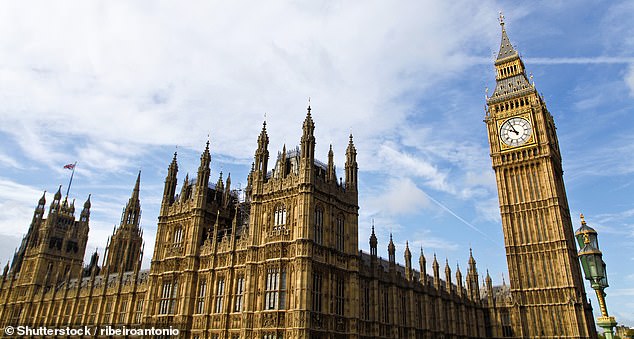
The explosion would have destroyed Westminster Hall and Westminster Abbey, the Houses of Parliament and more. 

Jewel Tower, part of the Palace of Westminster from the 14th century, would have been partially damaged, as well as Whitehall - the site of Downing Street today. 

Within a radius of about 130 feet, everything would have been razed to the ground, while up to 360 feet away buildings would have been at least partially destroyed. 

Up to around 3,000 feet, some windows would have been blown out and Londoners would have felt the force of the blast. 

The cellar beneath the House of Lords, as illustrated in 1799, where Guy Fawkes was found with the gunpowder, thought to no longer exist. It was described as 77 feet long, 24 feet and 4 inches wide, and 10 feet high

The cellar beneath the House of Lords, as illustrated in 1799, where Guy Fawkes was found with the gunpowder

Fawkes was just one of 13 co-conspirators; he is most famous because he was the one caught as he was guarding the explosives, not because he was the ringleader

Fawkes was just one of 13 co-conspirators; he is most famous because he was the one caught as he was guarding the explosives, not because he was the ringleader 

Fawkes was an expert in explosives and if he had the powder well packed in barrels, it would have an equivalent blast radius to modern TNT.

In all, 36 barrels of gunpowder totaling 2,500kg were stored in a cellar underneath the House of Lords.

The intention had been to detonate them during the State Opening of Parliament on November 5, when James I, the Queen and his heir would also be present.

The plot was hatched by Robert Catesby when it had become clear that King James I, who came to power in 1603, was going to continue the persecution of Catholics carried out by his predecessor Queen Elizabeth I.

It's known that Fawkes – an explosives expert who had served in the Spanish army – used substantially more gunpowder than he needed. 

In 2005, to mark the 400th anniversary of the Gunpowder Plot, a full-size replica of the House of Lords was built and destroyed with barrels of gunpowder at RAF Spadeadam in Cumbria, England

In 2005, to mark the 400th anniversary of the Gunpowder Plot, a full-size replica of the House of Lords was built and destroyed with barrels of gunpowder at RAF Spadeadam in Cumbria, England 

Originally from York, Fawkes' job was to light the fuse and escape across the Thames – but with hours to go he was found during a royal search following a tip-off. 

An anonymous letter of warning was sent to William Parker, 4th Baron Monteagle, a Catholic member of Parliament, who immediately showed it to the authorities. 

An extract reads: 'They shall receive a terrible blow this parliament and yet they shall not see who hurts them'. 

Royal guards searched The House of Lords and in the early hours of November 5, Fawkes was found in the cellars, with a fuse, a small lamp, a box of matches and 36 poorly-hidden barrels of gunpowder. 

After Fawkes's arrest, Catesby and the other plotters fled the 80 miles from London back to Ashby St Ledgers in Northamptonshire in seven hours.

Catesby died two days later in a shootout as he attempted to resist arrest at Holbeach House in Staffordshire.

His head was later cut off and taken to London, where it was stuck on the roof Parliament.

Fawkes and fellow conspirators Thomas Wintour, Ambrose Rookwood and Robert Keyes were hanged, drawn and quartered in the Old Palace Yard, opposite Parliament at Westminster.

Fawkes's death came after he was subjected to three months of interrogation and torture.

His signature on the confession he made on November 9 was barely legible, demonstrating the impact of the torture.

https://www.dailymail.co.uk/sciencetech/article-14042523/Guy-Fawkes-Gunpowder-Plot-Interactive-map.html

Bonfire night has a well-told history which we are reminded of each year: 'Remember, remember the fifth of November. Gunpowder, treason and plot.'

The most notorious member of the 1605 plot was Guy Fawkes, who was infamously found guarding the gunpowder under the Houses of Parliament which was there to kill King James I. 

But did you know that Guy - full name Guido - Fawkes was not the true mastermind behind the plan? And were you aware that one of the plotters themselves is to blame for the idea's failure?

The King's guards arrested the infamous plotter underneath the House of Lords

The King's guards arrested the infamous plotter underneath the House of Lords

Robert Catesby led the plot

Fawkes was one of 13 plotters, brought in as an explosives expert to look after and light the 36 barrels of gunpowder in the cellar they had rented underneath the House of Lords.

The ringleader-in-chief was Robert Catesby - a Catholic upset by the Protestant King's increased hostility towards Catholics. 

One of the plotters gave the game away

The conspirators were likely betrayed by a traitor - or someone who lost their nerve.

On October 26, Lord William Parker, the 4th Baron Monteagle received a letter warning him not to go to the state opening of parliament - when the monarch is in attendance every year - on November 5.

The anonymous letter was passed on to the King, who ordered a search of the area in the days before, leading to Fawkes' capture.

One theory is that one of the plotters who was a relative of Lord Parker sent the letter, but many historians argue that the Lord's politics were too clear to expect him to keep the letter a secret, making a deliberate scuppering of the plot more likely.

Fawkes was actually caught on November 4

We celebrate the day that the plot was expected to come to fruition, rather than when it was thwarted.

The King's guards discovered Fawkes in the cellar the day before the better-recognised date when he was using the pseudonym John Johnson. 

After his arrest, Fawkes was tortured in the Tower of London, eventually giving up his real name and those of his co-conspirators, with his signature barely legible - presumed to be a sign of the extend of his torture - on a confession dated November 9. 

Fawkes evaded capital punishment

Fawkes' accomplices had fled to the Midlands by the time Fawkes confessed, but were captured on the morning of November 8.

Robert Catesby, Cristopher and John Wright, and Thomas Percy were all shot dead and the others were taken to the Tower of London.

Those left alive, including Fawkes, were sentenced to death on January 31, 1606, by being hung, drawn and quartered for treason.

However, according to some accounts as Fawkes made his way up the gallows he either jumped or fell before putting his head through the noose.

The fall was enough to break his neck and he died, but his body was still quartered and sent to the four corners of the kingdom as a warning to any other plotters.

King Henry VII's wedding which united the warring York and Lancaster families was the setting for the UK's first-ever fireworks display

King Henry VII's wedding which united the warring York and Lancaster families was the setting for the UK's first-ever fireworks display

King Henry VII held the first-ever fireworks display

The wedding of King Henry VII in January 1486 played host to the first-ever recorded fireworks display in Britain.

The landmark event united the two warring families of houses of York and Lancaster.

The site where Fawkes was found no longer exists

The conspirators leased a cellar and passageway under the House of Lords in March 1605, after their plans to tunnel underneath the building had proven unfeasible. 

It remained for over two centuries after Fawkes was found there but was damaged by fire in 1834. 

When the Palace of Westminster was rebuilt in that century, the infamous cellar was destroyed. 

It was once illegal not to celebrate Bonfire Night in Britain

After the plot had failed, the King ordered that the day be celebrated.

Until 1959 it was illegal to not celebrate bonfire night in Britain, with the exception of during the World Wars, when no one was allowed to set off fireworks or light bonfire due to the risk of being spotted by enemy aircraft.

Instead, bonfire night was celebrated indoors to protect the people by not advertising where they were.

Fawkes'  former school do not celebrate bonfire night

Until 1959, there was only one place in the UK that refused to celebrate the failed plot.

St Peter’s School in York were granted an exemption from burning pictures of its former pupil - Guy Fawkes - as was customary elsewhere.

Guards still check the cellars underneath the Houses of Parliament every year 

The Yeoman of the Guard checking the Houses of Parliament's cellars has become a ceremonial tradition before the state opening of parliament every year.

Those with a taste for reliving history can rent the gatehouse of the manor where the Gunpowder Plot was planned in 1605. Above: The property in Ashby St Ledger,

Those with a taste for reliving history can rent the gatehouse of the manor where the Gunpowder Plot was planned in 1605. Above: The property in Ashby St Ledger

The three-bed property, available for £300 a night, is just yards from the room in the ten-bed Ashby Manor House where the men met in the days leading up to November 5, 1605

The three-bed property, available for £300 a night, is just yards from the room in the ten-bed Ashby Manor House where the men met in the days leading up to November 5, 1605

Along with the original gatehouse, the 32-acre estate boasts barns and dovecotes. Above

Along with the original gatehouse, the 32-acre estate boasts barns and dovecotes

Glasgow lights up against the backdrop of fireworks commemorating 5 November

Glasgow lights up against the backdrop of fireworks commemorating 5 November

Bonfire societies parade through the streets during traditional Bonfire Night celebrations

Bonfire societies parade through the streets during traditional Bonfire Night celebrations

The procession also remembers a two-year martyrdom known as the Marian Persecutions

The procession also remembers a two-year martyrdom known as the Marian Persecutions

Bloody Mary infamously ordered the burning of 288 Protestants and 17 were killed in Lewes between 1555 and 1557

Bloody Mary infamously ordered the burning of 288 Protestants and 17 were killed in Lewes between 1555 and 1557

Lewes in East Sussex has been dubbed the bonfire capital of the world for its procession

Lewes in East Sussex has been dubbed the bonfire capital of the world

People marched through the town dressed in 17th century clothing reminiscent of what Guy Fawkes would have worn when he plotted to blow up Parliament on November 5, 1605

People marched through the town dressed in 17th century clothing reminiscent of what Guy Fawkes would have worn when he plotted to blow up Parliament on November 5, 1605

Seven per cent of young people think Fawkes invented the fork while six per cent believed he was an MP

Seven per cent of young people think Fawkes invented the fork