Copper cable thefts bring key Spanish rail route to a standstill
Thousands of rail passengers in Spain faced delays after copper cables used in the signalling system of a high-speed line travelling south from Madrid to Seville were stolen at five locations, authorities said.
The theft, which happened late Sunday, affected dozens of trains travelling between Madrid and the southern Andalusian cities of Seville, Malaga and Granada as many people were returning home to Spain's capital after a holiday weekend.
Copper prices are high on global markets, meaning criminals stand to collect big sums of cash from selling the material.
Many travellers crowded Madrid's Atocha station seeking information about their trains from rail employees and screens with updated departure times.
By 9am, Alberto Valero and his family had spent hours at the station because of delays on services to Seville, where they were headed. Mr Valero was on holiday in Spain from Mexico, and expressed frustration about the lack of information.
'We're here with tourists from everywhere - France, Portugal,' Mr Valero said. 'Everyone is at a loss for what to do because of the total disarray.'
The cable theft took place at five points on the high-speed line in Toledo in central Spain. Spain's national police force is investigating the incident.
People board metros following a huge outage that hit Spain and Portugal
Travelers sit as they prepare to spend the night at the Atocha train station, following a massive power cut affecting the entire Iberian peninsula and the south of France
Travelers pull their luggage as they arrive to spend the night at the Atocha train station, following a massive power cut affecting the entire Iberian peninsula and the south of France
Spain's high-speed rail network has expanded rapidly and travels through large stretches of the country's little-populated countryside.
The incident came a week after a blackout in Spain and Portugal saw high-speed train traffic in Spain grind to a halt, stranding many passengers for several hours.
Described as 'catastrophically bad', the outage grounded flights, sent roads into gridlock as traffic lights failed, and left entire cities without power or telecommunications.
The outage caused a frenzy across the Spain, with the interior ministry deploying 30,000 police officers countrywide to maintain security in an evening of darkness.
Huge queues formed outside shops and banks as residents, with tourists desperately seeking to stockpile essentials and take out cash.
Stranded train passengers spend the night at Atocha railway in Madrid, following a massive power outage that affected Spain and Portugal
Sants train station in Barcelona was evacuated after a widespread power outage struck Spain and Portugal
Passengers wait for Barcelona's Sants railway station to reopen
Rows of cars were pictured lining up at petrol stations as people hoped to fill up their vehicles and fuel cans, with expats detailing how they have turned to power generators to keep their homes going.
The partly state-owned grid operator's chief of operations told reporters last week that grid instability caused the Spanish and French electricity interconnection through the Pyrenees mountains to split, resulting in a general collapse of the Spanish system.
Sanchez said that the country had lost 15 GW of electricity generation in five seconds - equivalent to 60 per cent of national demand.
Experts say the blackout is due to a combination of factors including Spain's reliance on green energy.
Two burglaries in August 2023, in which first cabling in a voltage room on the site was taken and then cabling was stolen from transformers on the site, causing damage of approximately £500,000
Footage captured by the trap camera showed metal thieves spending hours carrying bags of copper cabling, which was also loaded onto orange trolleys
Romanian Alexandru Parole was part of the group of metal thieves. His accomplices remain on the loose.
Five professional burglars filmed themselves laughing while they ransacked industrial units and factories, stealing £1.6 million metals and such
The criminals sold the metal to unscrupulous scrap dealers
Police seize stolen BT cables from a warehouse in Bolton. Officers believe the surge in thefts is being driven by Romanian gangsters
A Romanian gypsy child begs from cars on a London street
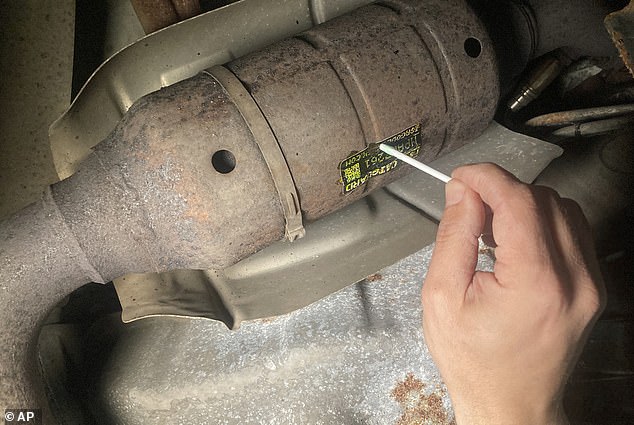
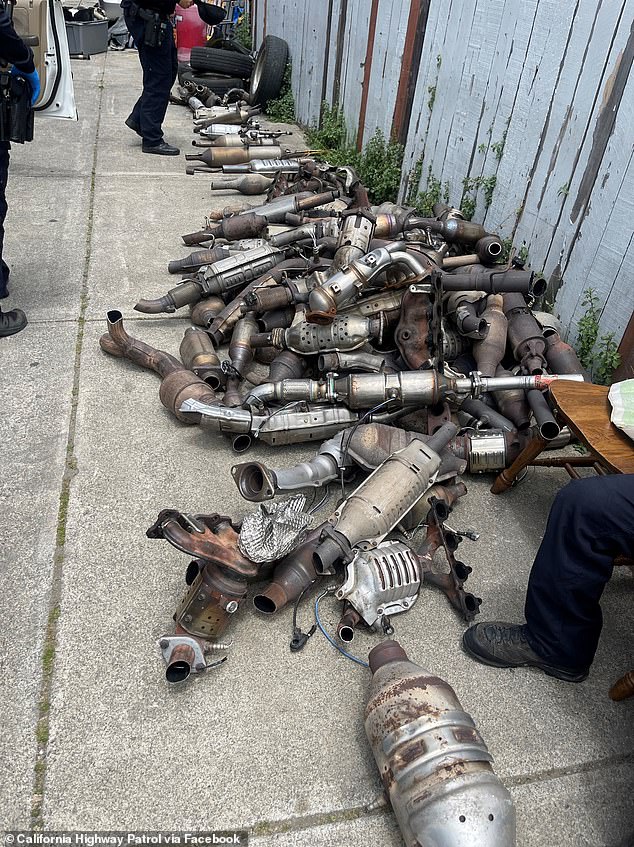
Motorists are losing around 600,000 catalytic converters to thieves each year
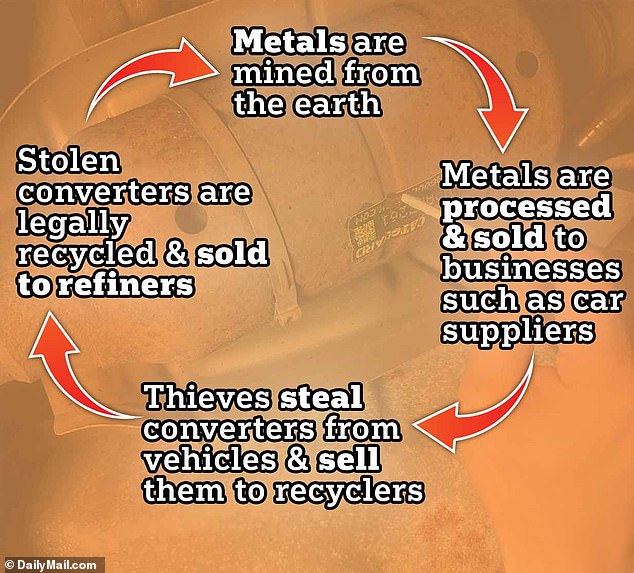
Catalytic converters are stolen by crime rings, recycled and sold back to the very people who produce the devices for carmakers
More than a third of the catalytic converters stolen in the USA are taken from cars in California
One of the thieves shows a mobile-phone picture of a haul they sold to gypsies for £5,700
Copper thieves typically work in darkness, in remote areas and close to open fields where a vehicle can be parked to take away the load (pictured: two copper thieves in Nuneaton)
Many of the cables are ripped up in the dead of night from the sides of railways. Mainly copper, some are on huge coils waiting to be fitted; most are in the ground, but redundant; others are live
Police and industry experts search for stolen metal in a scrapyard.
Israel carried out a wave of airstrikes on the Houthi airport in Yemen today in a revenge attack for a Houthi assault on an Israeli airport.
The IDF said it had struck multiple Houthi targets including several major power stations, adding that the international airport in Sanaa was at a 'complete standstill'.
'The airport ... is used by the Houthi terrorist organization for the transfer of weapons and operatives, and is continuously operated by the Houthi regime for terrorist purposes,' an IDF spokesperson claimed.
'In addition, several central power stations in the Sana'a area were also attacked, which the Houthi terrorist regime exploits as a significant electricity supply infrastructure for the terrorist regime,' they added.
Eyewitnesses in the capital reported four strikes on Tuesday, following an attack on the Houthi's terrorist port of Hodeidah on Monday.
Israel noted the attacks followed Sunday's Houthi attack on Ben Gurion Airport, an assault that injured six and caused airlines to cancel flights.
Smoke billows after an Israeli airstrike on Houthi infrastructure, in Sana'a, Yemen May 6, 2025
Israel attacked Sanaa airport in Yemen after the Houthis launched a weekend missile attack on Ben Gurion airport in Israel
Smoke billowing following Tuesday's airstrikes on the Houthi airport
Israel had vowed a tough response against Iran and the Houthis after Ben Gurion airport was hit
Tensions have escalated between Israel and Yemen's Houthi rebels as the Iran-aligned group continues to launch attacks against Israel.
Israel had vowed a tough response for both the Houthis and Iran after Ben Gurion airport was struck on Sunday.
At least six people were injured in the weekend Houthi attack. The Yemeni terrorist group said they had attacked the airport with a hypersonic missile.
Israeli hit back with strikes on Monday and Tuesday. Houthi media claimed that the US had joined Israel in the Tuesday assault, though provided no evidence.
Washington did not immediately comment on the strikes.
The Israeli military published a map of the area surrounding Sanaa International Airport, telling residents: 'Not evacuating puts you in danger.'
Casualties from the strikes were not immediately clear.
'The attacks were carried out in a targeted manner, taking precautions to the extent possible to minimize harm to civilians and civilian property,' the IDF spokesperson added.
Strikes in the vicinity of Hodeidah on Monday killed four people and injured 39, according to the Houthi-run health ministry.
In a video published on Telegram, Israeli prime minister Benjamin Netanyahu said Israel will 'act in the future' against the Houthi rebels.
'It will not happen in one bang, but there will be many bangs,' he added.
The Houthis have been firing at Israel and shipping in the Red Sea since the beginning of the war between Israel and Hamas in Gaza.
Smoke rises as huge fire erupted at a cement factory in Yemen after the Israeli military carried out airstrikes on Monday
Firefighters work as huge fires erupted around Hodeidah Port and its vicinity, on Monday
Strikes in the vicinity of Hodeidah on Monday
The Houthis had said previously that they would impose an 'aerial blockade' on Israel by targeting its airports.
Yemen's Houthi terrorists attacked Israel's airport with a hypersonic missile on Sunday
Smoke billowing after the attack. Several people were wounded
Iran supplied the missiles used in the attack on Israel
Iran terror suspect held over plot on British soil 'very well connected to Tehran regime': Police 'warned dissidents of threats days before raids'
Arrested Iranian suspects were ‘hours away’ from ‘major attack’ on UK synagogue
A suspected Iranian terrorist accused of plotting a deadly attack in Britain was last night claimed to be ‘very well-connected’ to the regime in Tehran.
The man, one of five arrested on Saturday during co-ordinated raids, is also connected to prominent businesses in Iran via his family, The Telegraph reported.
The alleged use of Iranian nationals, rather than proxies, to carry out an overseas terror attack suggests a change in tactics by the hostile state.
It may also be indicative of the significance of the purported plot. However, police have refused to say whether the alleged plan to target an unnamed premises was ‘state-sponsored’.
Counterterrorism officers also visited Iranian dissidents just days before the two plots were foiled, warning them of the threat posed by Tehran.
Mohamad Khoshbayan - a former Shia cleric who preached in Iran but has been granted asylum in the UK after supporting Tehran's opposition - was told to improve his home security, mix up his daily routine and highlighted the risk of violence.
Officers arrested the five suspected terrorist in raids in west London, Rochdale, Manchester, Stockport and Swindon.
Undercover police officers swooped on a suspected Iranian terrorist in Swindon after posing as customers in a café and ordering coffees and donuts
Witnesses in Swindon yesterday told of their shock at seeing six officers, who had been posing as customers of a town centre Costa cafe in jeans and hoodies, pounce on one of the suspects – moments after they were seen ordering drinks and doughnuts.
The first four men were arrested on suspicion of preparation of a terrorist act, contrary to section 5 of the Terrorism Act 2006, and the fifth was detained under the Police and Criminal Evidence Act.
The arrested were a 29-year-old man in the Swindon area, a 46-year-old man in west London, a 29-year-old man in the Stockport area, a 40-year-old man in the Rochdale area and a 24-year-old man in the Manchester area.
Police were granted warrants of further detention last night, giving them until Saturday to question four of the men ‘on suspicion of preparation of a terrorist act’. These suspects are understood to be Iranian.
The fifth, the 24-year-old whose nationality has not been established, who was arrested under the Police and Criminal Evidence Act, has been released on bail.
Commander Dominic Murphy, head of the Met’s Counter Terrorism Command, said the investigation was ‘highly complex’.
He added that one was a terrorist plot to attack a specific premises (a synagogue), while the other was a national security issue.
Police have also been given more time to quiz three other Iranians held in London on suspicion of carrying out spy-related activity but are not treating the two cases as linked.
Members of the SAS supported counter terrorism police during the operation to storm the alleged terror cell in Rochdale over the weekend
It was part of a series of busts across England. Pictured are a group of Counter Terrorism Specialist Firearms Officers outside a home in Rochdale during another raid on Saturday
These three suspects, aged 39, 44 and 55, worked on behalf of Iran.
They are the first Iranians arrested under the relatively new National Security Act, established to counter hostile states' activities.
As part of the investigation, officers are searching a number of addresses in the Greater Manchester, London and Swindon areas.
Mr Khoshbayan, 42, published a piece last week criticising the Iranian regime, accusing them of antisemitism and insisting that holocaust victims should be respected.
The next day, he got a visit by counterterrorism police. The month before he had a threatening phone call 'because I am supporting the Iranian opposition and calling for solidarity with Jews'.
The grandson of prominent Iranian cleric said: 'I was one of them [the regime], but I managed to escape and I speak out against them. They do not like it.'
It comes as Home Secretary Yvette Cooper said on Sunday that the cases reflect the biggest counter state threat and counter terrorism operations in recent years.
Asked about possible links to the Iranian state, she said: ‘These are major operations and the ongoing investigation is immensely important, and, of course, it involves Iranian nationals in both investigations. But this reflects the complexity of the kinds of challenges to our national security we continue to face.’
Police were yesterday questioning four men 'on suspicion of preparation of a terrorist act' after co-ordinated raids on addresses in west London, Rochdale, Swindon, Manchester and Stockport on Saturday evening. Pictured: Police in Rochdale following the counter terrorism raid
Sources said the plot to target a UK premises was a ‘major attack’ that would have led to an imminent threat to life.
Mr Murphy said: 'Our officers and staff are progressing what is a significant and highly complex investigation, and we still have searches and activity under way at multiple addresses across the country.
'We are working incredibly hard, with public safety at the forefront of our ongoing efforts.
'We believe that a specific premises was the target of this suspected plot and Counter Terrorism Policing officers remain in close contact with the affected premises.
'At this time, we will not be providing further information about the suspected target for reasons of operational security and public safety.
'I would like to ask people to support my officers in this and not to speculate or share information that has not been confirmed by Counter Terrorism Policing. We have clear and critical reasons not to provide more detail at this time.
'The investigation is still in its early stages and we are exploring various lines of inquiry to establish any potential motivation as well as to identify whether there may be any further risk to the public linked to this matter.
'As always, I would ask the public to remain vigilant and if they see or hear anything that concerns them, then to contact us.
Commander Dominic Murphy, head of the Met's Counter-Terrorism Command, said the investigation was ‘highly complex’
MI5 chief Ken McCallum said his operatives have tackled 20 ‘potentially lethal’ plots backed by Tehran since 2022
'We are working closely with local officers in the areas where we made arrests on Saturday and I'd like to thank police colleagues around the country for their ongoing support.'
MI5 chief Ken McCallum disclosed last October that his operatives have tackled 20 ‘potentially lethal’ plots backed by Tehran since 2022 – mostly aimed at dissidents opposing the regime.
Elite soldiers from the Special Air Service joined counter-terror cops and MI5 in foiling a 'major terror attack' against Britain, experts have said.
Teams raided two suspected Iranian terror cells in a 'highly significant' operation to tackle growing activity by the hostile state in the UK.
Sources said the plot to target a UK premises was a 'major attack' that could have led to an imminent threat to life.
The suspected terror group was looking to hit a synagogue or another target linked to the Jewish community.
Members of the SAS's specialist counter-terror team - dubbed the 'special projects' unit - supported armed officers in the raids.
A former British spymaster added that given the threat posed by the radicals - who were reportedly hours away from staging a massacre - the British military played a supporting role in the busts.
The Ministry of Defence will never comment about special forces operations.
However, one former SAS operator told MailOnline a squad from the fearsome 'Who Dares Wins' regiment were involved in storming a property in Rochdale alongside counter-terror cops.
Soldiers were armed with explosives to blow open doors, with police supporting the operation, the expert said.
Pictures from the scene show men wearing military helmets and body armour, carrying suppressed C8 rifles - which are used by the SAS.
The officers in black uniforms are specialists from counter-terrorism police.
Officers are seen detaining one suspect while another officer covers the window of a building
Other images show a number of officers wearing black and grey tactical kit. These are highly trained Counter Terrorism Specialist Firearms Officers (CTSFOs).
Locals reportedly heard a series of loud bangs and men shouting before suspects were led out the property by counter-terrorism experts.
'There was a massive explosion and flame. It was officers using explosives to blow open the door,' one local said.
Images showing the aftermath of the security operation also reveal a ground-floor window in the home that was raided had been smashed in.
This was done in order to allow officers to toss in explosive flash-bang grenades before storming the alleged terror den.
In a second dramatic raid, plain-clothed officers were seen detaining a man in Swindon town centre. The former SAS veteran said these were counter-terror cops and not members of the special forces.
One eyewitness told the BBC that six undercover police entered a café the suspect was in and ordered coffee and donuts before they followed him out and 'jumped on him'.
Colonel Philip Ingram, who served in British military intelligence, said troopers from the SAS and its sister unit the Special Reconnaissance Regiment (SRR) were used in the strike operation, with locations across the UK hit simultaneously.
Given a national level of threat and with hostile state links - there would be SRR troops from a surveillance perspective and they would have brought in special forces operatives as a backup team for counter terror police.
Given the multifaceted nature of the threat counter terror was working with UK special forces.
Counter-terrorism police routinely train alongside members of the special forces, working on elite tactics to storm buildings. They are also kitted out with military-style weaponry.
Iran has a history of targeting those they believe are threatening the regime including by kidnap and assassination.
Their targets have included Iran International, a dissident TV station based in London, which was the subject of surveillance and an attack on a presenter on repeated occasions in 2022, 2023 and 2024.
They have also targeted Jewish and Israeli interests and there was a plot in Germany to attack a Jewish school and synagogue in Essen in 2023.
Often the Iranians use criminal proxies to carry out the attacks, utilising Chechen and Turkish organised crime gangs.
Hours earlier, counter-terrorism police had disrupted an alleged Iranian spy cell in London in a separate operation, arresting three men suspected of carrying out espionage activity for Iran. It was feared that news of police thwarting a suspected Iranian terror cell could spook others suspected of working for the enemy state in the UK.
The suspected plot was hours away from taking place, according to the Daily Telegraph.
Sir Ken McCallum, head of MI5, recently warned that Iran was plotting attacks at 'an unprecedented pace and scale', and said there was a risk that Iranian state aggression could 'broaden' due to conflict in the Middle East.
In the past year, MI5 investigations into hostile-state threats have risen by almost 50 per cent following a surge in assassination, kidnap, arson and sabotage plots.
In October, Sir Ken warned: 'We've seen plot after plot here.' Iran uses criminal proxies, from international drug traffickers to 'low-level crooks', to carry out its 'dirty work' in the UK, he added.
Warning those who collaborate with hostile states, the spymaster said: 'If you take money from Iran, Russia or any other state to carry out illegal acts in the UK you will bring the full weight of the national security apparatus down on you. It's a choice you'll regret.'
The earlier arrests in north-west and west London of three alleged spies aged 39, 44, and 55 was the first time Iranian suspects have been held in the UK under a new espionage law, the National Security Act, designed to target those working secretly in the UK for hostile states.