Friday, 14 February 2020

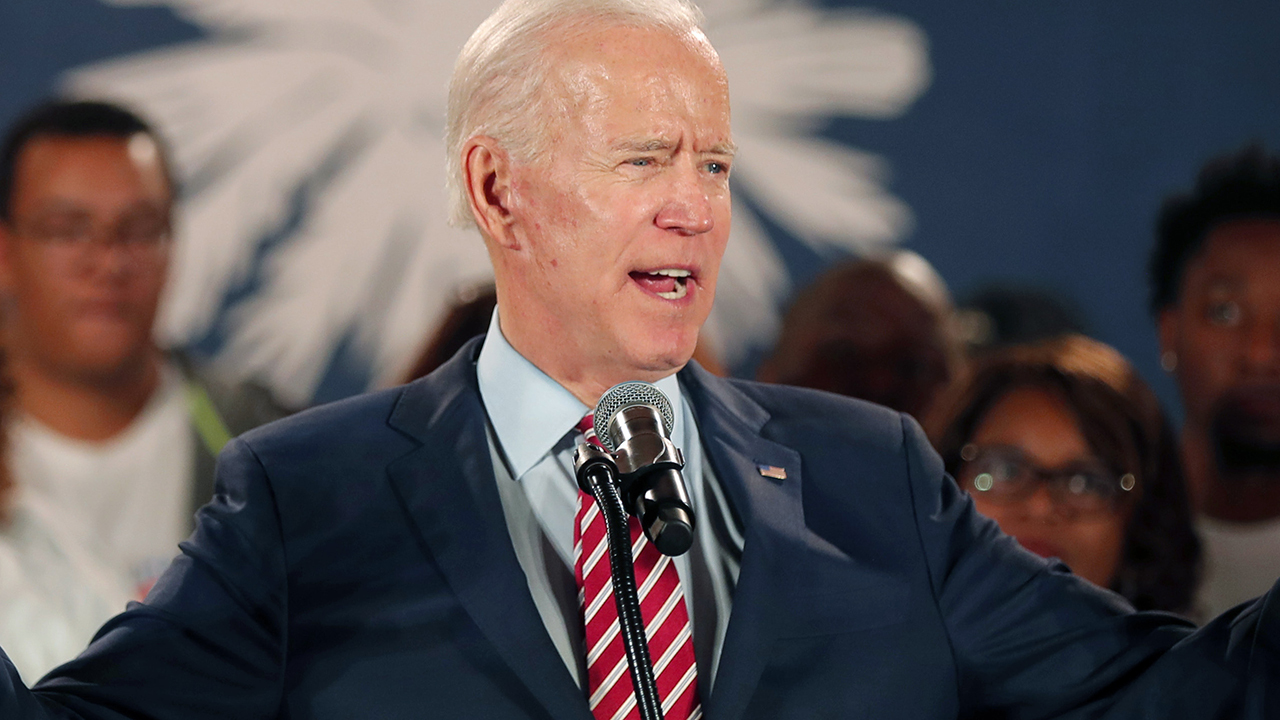
Biden faces NYC protesters chanting ‘Drop out, Joe!’

https://www.foxnews.com/politics/biden-faces-nyc-protesters-chanting-drop-out-joe

As if his poor results in Iowa and New Hampshire weren’t enough, Joe Biden was met with chants of “Drop out, Joe!” on Thursday night as he left a campaign fundraiser in New York City, according to reports.
Other protesters from the group New York Communities for Change held a mock “funeral” for Biden’s candidacy, featuring a black coffin decorated with Biden 2020 stickers.
“The campaign is pretty much done,” one “mourner” said. “The people have spoken. Young people have spoken.”


Earlier this week, the former vice president’s struggles to connect with voters, despite being deemed the Democratic Party’s front-runner for its 2020 presidential nomination, prompted him to leave New Hampshire early, before the primary results were in, so he could focus on the Feb. 22 Nevada caucuses and Feb. 29 South Carolina primary.
Biden, 77, told supporters in South Carolina on Tuesday that he wasn’t anywhere close to giving up on the race.
“It is important that Iowa and New Hampshire have spoken, but we need to hear from Nevada and South Carolina and Super Tuesday and beyond,” he said. “We haven’t heard from the most committed constituents in the Democratic Party – the African-American community – or the fastest-growing segment of the party, the Latino Americans.”
Biden went on to describe the importance of the African-American and Latino votes, saying that you “can’t be the Democratic nominee and you can’t win the Democratic nomination as a Democrat unless you have the support of black and brown voters.”
On Thursday night Biden was in midtown Manhattan, courting Wall Street figures as he hoped to raise at least $1 million, the New York Post reported.
Attendees at the Wayfarer restaurant event were scheduled to include former Morgan Stanley CEO John Mack, Centerview Partners executive Alan Hartman, Citigroup exec Ray McGuire, Blackstone operating chief Jonathan Gray, Snap chairman Michael Lynton and former Obama economic adviser Jeffrey Zients, according to a list obtained by CNBC.

Biden’s fourth-place finish in the Feb. 3 Iowa caucuses and even worse fifth-place finish in Tuesday’s New Hampshire primary reportedly had some backers concerned about the future of his campaign
A recent Quinnipiac University poll showed Sen. Bernie Sanders leading the Democratic Party field nationally, with support from 25 percent of Democratic voters, with Biden garnering only 17 percent.

Fire, explosion recorded at California homeless camp; 'packed full' 2 days later

https://www.foxnews.com/us/fire-explosion-recorded-at-california-homeless-camp


A fire broke out Monday at a homeless encampment in California on Monday, resulting in an explosion.
The blast produced a mushroom cloud underneath a Los Angeles I-10 that nearly engulfed a man who appeared to be moving debris from the fire, according to a video posted by a passerby later that morning.

"After things starting exploding, I was outta there," the driver said. "I often fear that I could possibly see a tragedy like this."

Authorities cleaned up the encampment later that day, but two days later the driver said it was "packed full with new homeless."
He hoped the video could show how "fragile and dangerous" the homeless situation is getting in the city.
LANCASTER, CA - JANUARY 28: Derrick Chambers checks out a homeless encampment in an open area of Southern part of Lancaster while documenting their number in the area. (Photo by Irfan Khan/Los Angeles Times via Getty Images)

Fire authorities said it's not their protocol to investigate what caused the blaze because it didn't result in injuries or damage any property.

The driver was reportedly the first to alert authorities around 6:30 a.m. that morning.

Investors from five countries eye Mexico’s nascent lithium market

Reuters | February 13, 2020 Battery Metals Intelligence Latin America Lithium

Landscape at Bacanora Minerals’ Sonora lithium project in northern Mexico. Source: Bacanora Minerals

Investors from at least five countries have expressed interest in Mexico’s nascent lithium extraction and production industry, said Francisco Quiroga, the undersecretary for mining, after a promising find in the north of the country.

The find is still in the exploration phase. If initial estimates of lithium deposits are confirmed, Mexico could emerge as one of the world’s largest players in a thriving sector.

In January, the mine’s two foreign operators estimated that it could contain 8.8 million tonnes of lithium. This would put Mexico on a par with Bolivia or Chile, whose mines have large known deposits.

IN JANUARY, THE MINE’S TWO FOREIGN OPERATORS ESTIMATED THAT IT COULD CONTAIN 8.8 MILLION TONNES OF LITHIUM

Quiroga told reporters during an mining industry event in Mexico City that he had already met with investors from Canada, Germany, Japan, the United Kingdom and the United States to discuss potential opportunities.

“There’s a lot of interest in participating,” said Quiroga, adding that Mexico would seek out opportunities beyond simply extracting the metal, which is used to produce batteries for electric cars.

“What we’re offering is more than the promotion of mining – but instead mining complimented by activities along the entire production chain, including manufacturing – and there’s been a lot of interest.”

Quiroga said there were still several operational, commercial and financial challenges, without giving details. British operator Bacanora Lithium and its Chinese partner Ganfeng plan to start production in 2021.

Two private companies are exploring other possible lithium deposits in the northern border state Baja California and the area straddling the central states San Luis Potosi and Zacatecas.

Elsewhere, the Mexican Geological Service has already registered possible deposits in the northern state Sonora and the central states Jalisco and Puebla.


Recommend this post and follow TCW

North Korea 'clearly lying' about coronavirus cases, expert says

https://www.foxnews.com/health/north-korea-clearly-lying-coronavirus-cases-expert


The coronavirus has infected more than 60,000 people across 26 countries after first being discovered in China’s Hubei Province, and yet North Korea, which shares a border with the country where more than 59,000 of those cases and over 1,360 deaths have been reported, claims it does not have a single illness.
Unverified reports about a quarantined person allegedly being executed by the country after visiting a public bath have emerged, as well as a potential first confirmed case, but the government remains steadfast in denying that the virus has reached its borders, which many experts have cast doubt on.

“There is no way that North Korea is not being impacted by the coronavirus — they are clearly lying as they don’t want to show any weakness or that there is any threat to the regime,” Harry Kazianis, director of Korean Studies at the Center for National Interest, told Fox News. “Considering how there are many porous sections of the North Korea-China border — and how the Kim regime depends on illegal trade to survive — it is clear the virus has come to North Korea.”
Last week, health ministry official Song In Bom told state media that there are no cases of the virus — which has been named COVID-19 by the World Health Organization (WHO) — in the country, but that they would be prepared in the event that the outbreak spread.
In this undated photo distributed by the North Korean government, North Korean Premier Kim Jae Ryon, right top, has a meeting at the emergency anti-epidemic headquarter in Pyongyang, North Korea. The content of this image is as provided and cannot be independently verified.
In this undated photo distributed by the North Korean government, North Korean Premier Kim Jae Ryon, right top, has a meeting at the emergency anti-epidemic headquarter in Pyongyang, North Korea. The content of this image is as provided and cannot be independently verified. (Korean Central News Agency/Korea News Service via AP)
“Just because there is no case of the new coronavirus in our country, we should not be too relieved, but have civil awareness and work together for prevention,” he said, according to Reuters.
But Nagi Shafik, former project manager for WHO in Pyongyang, told the South China Morning Post that the country would be ill-equipped to deal with such an outbreak, and would likely lack proper safety gear and medical equipment.

“I presume there are more items needed, especially when it comes to cleaning and sterilization,” he told SCMP.com. “May I remind as well that many women and children suffer from malnutrition; these are factors that affect the immunity system and render humans more susceptible to infection.”
Kazianis also said that the country’s fragile health care system would be overwhelmed if the outbreak swept through the nation, and that “millions of everyday citizens would be essentially left to die.”

“North Korea’s health care system is devoid of the most basic treatments for any sort of medical problem,” he said. “Things like antibiotics, any sort of preventative care are unheard of in the countryside or rural areas and only reserved for the party elite in Pyongyang.”
So far, North Korea has banned all tourists and cut off transportation links with China in an effort to stave off the illness. It’s also enacted a 30-day quarantine period and said “all the institutions and fields of the state and foreigners staying in the DPRK should obey it unconditionally.”
But cutting the country off from the rest of the world is dangerous, as is withholding the truth about the virus in order to preserve Kim’s reputation, Kazianis said.
“The real danger is if the situation were to spiral out of control and some sort of government collapse occurred,” he said. “While I would say the chances are remote, this is the real danger that we must worry about when it comes to North Korea. If the Kim regime did collapse, from coronavirus or something else, who controls their nuclear weapons? What about their chemical or biological weapons? Who feeds the 25 million North Koreans?”

“North Korea will always be a threat, and if the state collapsed we would be dealing with a crisis of epic proportions not seen since WW2,” Kazianis said. “And that is terrifying.”

Islam’s Role in the Transatlantic Slave Trade

Exposed: Islam’s Role in the Transatlantic Slave Trade

Even in this “exclusively” European enterprise, the hidden hand of Islam lurks in the background.
 

0

Raymond Ibrahim is a Shillman Fellow at the David Horowitz Freedom Center.
Islam’s history with the West has been one of unwavering antagonism and seismic clashes, often initiated by the former.  By the standards of history, nothing between the two civilizations is as well documented as this long war.  Accordingly, for more than a millennium, both educated and not so educated Europeans knew—the latter perhaps instinctively—that Islam was a militant creed that for centuries attacked and committed atrocities in their homelands, all in the name of “holy war,” or jihad.
These facts have been radically “updated” in recent times. According to the dominant narrative—as upheld by mainstream media and Hollywood, pundits and politicians, academics and “experts” of all stripes—Islam was historically progressive and peaceful, whereas premodern Europe was fanatical and predatory.
Whatever else can be said about such topsy-turvy claims—and there is much—they beg the question:  if such a formerly well-known, well-documented and atrocity-laden history could be revised in a manner that presents its antithesis as the truth—with little objection or challenge—what then of Islam’s more subtle but also negative influences on history, the sort that, unlike the aforementioned centuries of violence vis-à-vis Europe, are not copiously documented or readily obvious but require serious historical investigation?
Take Islam’s role in facilitating the transatlantic slave trade—which otherwise is almost always presented as an exclusively European enterprise.
Slavery is, of course, as old as humanity.  Centuries before the coming of Islam, Europeans—Athenians, Spartans, Romans—were fully engaged in the slave trade.  With the coming of Christianity, and as it spread all throughout the Roman and post-Roman empire (circa. fourth-seventh centuries), the institution of slavery was on its way to becoming extinct. 
Then Islam came.  While hardly the first to exploit human flesh, it was the best at perfecting and thriving on it in the post classical, medieval, premodern, and even modern eras—with untold millions of non-Muslims enslaved throughout the centuries (one source indicates that 15 million Europeans were alone enslaved).
As usual, it was only natural for those near and in constant contact with Islam to be infected by the same vice of dehumanizing—and thus taking advantage of—the “other.”  After all, the few instances of Christians in Europe buying and selling slaves are largely limited to the long war with Islam.  Malta’s Knights of Saint John, for instance, responded to Islamic slave raids by enslaving the raiders and other Muslims.  Similarly, those Europeans who first became involved in the African slave trade, the Spanish and Portuguese, also just so happened to be the ones who for centuries lived side by side with—often in violence and themselves enslaved to—Muslims (those of al-Andalus).
Islamic slave raids into Africa began in the mid to late seventh century; then, according to Muslim records, astronomical numbers of Africans—in the millions—were enslaved in the name of jihad.  By the time seafaring Europeans reached the coasts of West Africa, the Islamic slave trade was bustling.
While most Western historians are aware that it was African “tribesmen” who captured and sold enemy tribesmen to Europeans, left unmentioned is that the “tribal” differences often revolved around who was and was not Muslim.
As John Alembillah Azumah, an African academic and author of The Legacy of Arab-Islam in Africa, explained in an interview:
Slavery was a very important part of Islamic expansion in West Africa, and in fact in the Sudan, and from the very earliest period of Islamic penetration of Africa.  … Slavery was a very endemic part of Islamic interaction with Africa.  And in West Africa, the jihad’s period of the eighteenth and nineteenth centuries involved massive slave raiding and slave trading; and many of the slaves that were captured and sold and sent to the transatlantic slave trade [were captured by Muslims]; most of those who were doing the slaving at the time were Muslim communities (emphasis added).
A look at historic maps seems to confirm this: the western coast of Africa, where captives were enslaved and sold to Europeans, were hotbeds of jihadi slave raids.  The populations from Senegal to Angola—the regions where arguably most African-Americans trace their bloodlines—were roughly half Islamic, half pagan between the sixteenth and nineteenth centuries.
More to the point, if today, when slavery has been formally abolished around most of the world, Muslim groups are still subsisting on the slave trade all throughout Africa—“Slavery Prevalent in Africa 400 Years After Transatlantic Trade Began” is a recent headline—the role Muslims played in facilitating the transatlantic slave trade should be evident. 
Unfortunately, however, and as mentioned, if the obvious things of Islamic history—such as more than a millennium of unprovoked jihadi attacks on Europe—have been revised in a manner that presents the antithesis as truth, surely Islam’s more insidious or subtle role throughout history, such as its facilitation of the transatlantic slave trade, will remain unheard of.
As such, here is a general rule of thumb to help cut through all fake, pro-Islamic histories: to know what Islam did in the past, simply look to what it is doing in the present, which includes a thriving underground—and of course aboveground—slave market.
Meanwhile, Europeans/Christians—who were actually the ones to outlaw slavery internationally—will continue to be the blame all for this tragic episode of history.


Thursday, 13 February 2020

Recipes - Ground Beef Tacos

Ground Beef Tacos

Updated June 13, 2019

  • Prep25 MIN
  • Total30 MIN
  • Ingredients12
  • Servings6
This taco recipe is the classic Tex-Mex-style version of tacos that many Americans grow 
up with: seasoned ground beef stuffed in a crispy taco shell with additional fillings like 
lettuce, cheese, tomatoes and sour cream. Even better, these ground beef tacos can 
be on the table in just 25 minutes.


Ingredients

1
lb lean ground beef
1
medium onion, chopped
1
teaspoon chili powder
1/2
teaspoon salt
1/2
teaspoon garlic powder
1
can (8 oz) tomato sauce
12
Old El Paso™ crunchy taco shells
1 1/2
cups shredded Cheddar cheese (6 oz)
2
cups shredded lettuce
2
medium tomatoes, chopped
3/4
cup Old El Paso™ Thick 'n Chunky salsa
3/4
cup sour cream, if desired

Steps

1  Heat oven to 250°F. In large skillet, brown ground beef and onion over medium heat for 

    8 to 10  minutes or until beef is thoroughly cooked, stirring frequently. Drain.

2  Stir in chili powder, salt, garlic powder and tomato sauce. Reduce heat to low; cover 

    and simmer 10 minutes.

3  Meanwhile, place taco shells on ungreased cookie sheet. Heat at 250°F. for 5 minutes.

4  To assemble tacos, layer beef mixture, cheese, lettuce and tomatoes in each taco shell. 

    with salsa; top with sour cream.


For more directions watch the video  which is featured on the page bellow 


🍅🍠🍤🍗🧀 Please recommend this page & be sure
 to follow the Coconut Whisperer which continues the 
traditions of Cheese the top Food and Recipe channel 
on  Disqus 2017-2019 🍅🍠🍤🍗🧀