Showing posts with label Afghanistan. Show all posts

Friday, 5 November 2021

No Joke: Taliban Asks for International Aid to Help It Fight…Climate Change


No Joke: Taliban Asks for International Aid to Help It Fight…Climate Change

Playing leftist games.


Kyle Shideler, the Director/Senior Analyst for Homeland Security & Counterterrorism at the Center for Security Policy, said it best: “They may have a 7th-century law code, but they grift with the best of the 21st century.” The Taliban does indeed appear to have caught on to one of the most lucrative gravy trains of the first part of the 21st century and are eager to get in on the loot; the jihad terror group has issued a call for aid from international organizations to help it fight the scourge of climate change.

Apparently, the Taliban would have us believe that in between executing allies of the United States, confiscating guns, setting women on fire and making sure they don’t work or go to school, and persecuting Shi’ite Hazaras, their jihadis just really want to spend some time working on clean energy programs and making Afghanistan green.

Showing a fine grasp of how the game is played, Taliban spokesman Suhail Shaheen explained: “Afghanistan has a fragile climate. There is need for tremendous work.” Accordingly, “some climate change projects which have already been approved and were funded by Green Climate Fund, UNDP, Afghan Aid, should fully resume work.”

Would environmentalists be safe working in Afghanistan? Why, sure! The Taliban, said Shaheen, would make sure of that: “The Islamic Emirate of Afghanistan is committed to providing security and a safe environment for the work of NGOs and charity organizations.”

Of course. This is the group, mind you, that abducted and murdered five aid workers from Save the Children in April 2015. In May 2019, Taliban jihadis murdered five aid workers from the American organization Counterpart International because, they said, Counterpart was promoting women being in the proximity of men in public. Then in June 2020, the UN accused the Taliban of “deliberate attacks” against health care workers.

But now, of course, we have the kinder, gentler Taliban, the one that told the international media that it would be more moderate than it was before and was actually believed. These new claims will likely be believed as well. After all, climate change is an existential crisis, no? Someone was telling Joe Biden that on Monday as he dozed off. The UK’s Daily Mail reported Sunday that “relief agencies have warned that a drought in Afghanistan, which UN scientists say has been worsened by climate change, could force 22 million into ‘acute food insecurity.’”

Western humanitarian aid groups, always so very eager to be fooled, will likely fall for this preposterous notion hook, line, and sinker, and the money will flow to the Taliban in even greater quantities than it is already. The Voice of America reported Thursday that American taxpayers will now be “providing nearly $144 million in new humanitarian assistance to Afghanistan, where millions of people could face acute hunger this winter unless aid arrives soon.”

According to National Security Council spokesperson Emily Horne, “the U.S. assistance will be directed through independent organizations that provide support directly to more than 18.4 million vulnerable Afghans, including Afghan refugees in neighboring countries.” Horne explained: “Our partners provide lifesaving protection, shelter, livelihoods support, essential health care, winterization assistance, emergency food aid, water, sanitation, and hygiene services in response to the growing humanitarian needs exacerbated by health care shortages, drought, malnutrition, and the impending winter.”

Nor is that $144 million even close to all that we’re forking over for Afghanistan this year: “She noted that the additional funding brings the total U.S. humanitarian aid in Afghanistan and for Afghan refugees in the region to nearly $474 million in 2021, the largest amount of assistance from any nation.”

As Daniel Greenfield has noted, Biden’s handlers insist that this money will not go to the Taliban. Secretary of State Antony Blinken robotically echoed the same talking points that Horne was using, making it clear that all these responses are well-rehearsed. He claimed that “it will enable our partners to provide lifesaving protection, food security support, essential healthcare, winterization assistance, logistics, and emergency food aid in response to the growing humanitarian needs exacerbated by healthcare shortages, COVID-19, drought, malnutrition, and the impending winter.” Yes, we heard that before. And all this will be done while Taliban jihadis stand by impotently, unable to stop the beneficient Americans from aiding those whom General John Allen once memorably dubbed “the noble people of Afghanistan.” Blinken continued: “To be clear, this humanitarian assistance will benefit the people of Afghanistan and not the Taliban, whom we will continue to hold accountable for the commitments they have made.”
 

Sure. And how exactly will the U.S. ensure that Taliban jihadis don’t seize this aid? How will the U.S. hold the Taliban “accountable”? What will Biden’s handlers do if Taliban jihadis intercept the delivery of this assistance, or overpower those who do receive it and simply seize it all? This American money is going to the Taliban, and it would be naïve to assume otherwise.

But it isn’t enough. And so now the Taliban, knowing from twenty years of observing the Americans in Afghanistan how to tug on Western heartstrings and open Western checkbooks, is now pledging to fight climate change. It will almost certainly work. The capitals of North America and Western Europe are filled with fatuous philanthropists eager to bestow their largesse on the needy. And the Taliban knows just how to play this game.

Robert Spencer 

https://www.frontpagemag.com/fpm/2021/11/no-joke-taliban-asks-international-aid-help-it-robert-spencer/

Thursday, 7 October 2021

Taliban invited to Moscow for talks over future of Afghanistan in wake of American troop withdrawal, top Russian diplomat confirms


Taliban invited to Moscow for talks over future of Afghanistan in wake of American troop withdrawal, top Russian diplomat confirms

Taliban invited to Moscow for talks over future of Afghanistan in wake of American troop withdrawal, top Russian diplomat confirms
Russia has invited representatives of the Taliban to meet in Moscow as part of efforts to open diplomatic channels with Afghanistan’s de facto new government, President Vladimir Putin’s special envoy for the country has confirmed.

Speaking to journalists on Thursday, Zamir Kabulov, who also serves as the director of the second Asian Department at the Russian Foreign ministry, said that an invite had been extended to Taliban officials.

However, the precise details of a meeting and who might attend it have not yet been disclosed.

Despite the Taliban being designated as a terrorist organization and banned in Russia, representatives of its political branch were granted permission to attend talks in Moscow earlier this year in an effort to forge a peace deal. Since then, the Islamist militant group has taken control of almost all of Afghanistan following the withdrawal of US troops and their allies.

In July, just weeks before the Taliban took Kabul, Foreign Ministry Spokeswoman Maria Zakharova defended ongoing negotiations with its senior leaders. “The Taliban movement is prohibited in our country,” she said, adding that Moscow “reaffirms in every possible way its determination to fight against international terrorist activity.”

“There is a small and important nuance,” Zakharova went on. “The Taliban movement is part of the inter-Afghan dialogue. This is the very dialogue that the Security Council [at the UN] has called on all countries to facilitate.”

She said that by holding talks with all sides, Russia would continue to champion that process.

Any hopes for a peaceful settlement between the warring parties have since disappeared with the collapse of the US-backed government in August.

In past weeks, Taliban leaders have declared Afghanistan to be an Islamic Emirate and taken control of the state. However, no foreign nation has yet recognized the group as the country’s legitimate government.

Kabulov has previously hinted that Russia could grant recognition, while explaining that “we are in no hurry” and that such a move would be dependent on “how the new regime behaves.”

“If we compare how easy it is to negotiate as colleagues and partners, then the Taliban have seemed to me for a long time much more prepared for negotiations than the puppet government were,” he said in August.

According to the top diplomat, the former US-backed leadership was “doubtfully elected, ruled badly and ended shamefully.”

However, as well as opening diplomatic channels with the group, Moscow has also moved to shore up security in the region following the departure of American troops. Russian soldiers have staged a series of drills with forces from neighboring Uzbekistan and Tajikistan, insisting that the shared border will be protected.


https://www.rt.com/russia/536835-taliban-invited-to-moscow-for-talks/

Thursday, 23 September 2021

Two Afghans Brought to U.S. Charged with Child Sex Crimes, Strangling Wife While Living on WI Military Base


Two Afghans Brought to U.S. Charged with Child Sex Crimes, Strangling Wife While Living on WI Military Base


1:58

Two Afghan men, brought to the United States as part of President Joe Biden’s massive resettlement operation out of Afghanistan, have been charged with child sex crimes and domestic abuse while temporarily living at Fort McCoy in Wisconsin.

On Wednesday, the Department of Justice (DOJ) announced federal charges against Afghans Bahrullah Noori, 20-years-old, and Mohammad Haroon Imaad, 32-years-old.

According to prosecutors, Noori is accused of trying to forcefully engage in sexual acts with a minor while temporarily living at Fort McCoy since being brought to the U.S. with tens of thousands of other Afghans. Noori has also been charged with three counts of engaging in a sexual act with a minor and one count alleging the use of force.

An indictment against Noori states that his victims were under the age of 16 and were at least four years younger than him.

In a separate incident, Imaad is accused by prosecutors of strangling and suffocating his wife while temporarily living at Fort McCoy after arriving in the U.S. from Afghanistan. The alleged assault apparently took place on September 7.

Both Noori and Imaad appeared in court in Madison, Wisconsin, on September 16 to face the charges against them and are currently being detained at the Dane County Jail. Their immigration statuses, whether they arrived as refugees, Special Immigrant Visa-holders (SIVs), P-2 visa-holders, or parolees remains unclear.

Noori is facing a mandatory minimum of 30 years in prison and a maximum sentence of life in prison. Imaad is facing a maximum of 10 years in prison.


https://www.breitbart.com/politics/2021/09/22/two-afghans-brought-to-u-s-charged-with-child-sex-crimes-strangling-wife-while-living-on-wi-military-base/

Friday, 17 September 2021


US military admits it killed 10 civilians and targeted wrong vehicle in Kabul airstrike


Updated 1916 GMT (0316 HKT) September 17, 2021


 United States military investigation into a deadly Kabul drone strike in August has found that it killed 10 civilians and the driver and the vehicle targeted was likely not a threat associated with ISIS-K, Gen. Frank McKenzie, the top general of US Central Command announced at the Pentagon on Friday.

McKenzie told reporters at the Pentagon that the strike was a "mistake" and offered an apology.
"This strike was taken in the earnest belief that it would prevent an imminent threat to our forces and the evacuees at the airport, but it was a mistake and I offer my sincere apology," McKenzie said.
    McKenzie added that he is "fully responsible for this strike and this tragic outcome."
      The Pentagon had maintained that at least one ISIS-K facilitator and three civilians were killed in what Chairman of the Joint Chiefs Gen. Mark Milley had previously called a "righteous strike" on the compound on August 29. The investigation released Friday found that all of those killed in the residential compound were civilians.
      In the lead up to the strike, drone operators surveilled the courtyard for up to 4 to 5 minutes. In that time, a male driver left the vehicle. One child was parking the vehicle and other children were present in the car and the courtyard -- as CNN had been told by the Ahmadi family.
      The military based the strike on a reasonable certainty standard to launch the strike on the vehicle. Tragically, it was the wrong vehicle, a US military official familiar with the investigation told CNN earlier on Friday, adding that no reasonable certainty is not 100% certainty.
      Previously, US Central Command pointed to "significant secondary explosions" as evidence of a "substantial amount of explosive material" in the vehicle. On Friday, the US military source said that after reviewing footage from infra-red sensors, they would no longer characterize this as an explosion -- instead, it was more of a flare up.
        The US official said that in the time leading up to the strike, the US had at least 60 different intelligence reports about threat streams toward US forces at Hamid Karzai International Airport.
        https://edition.cnn.com/2021/09/17/politics/kabul-drone-strike-us-military-intl-hnk/index.html

        Wednesday, 15 September 2021

        Taliban discovers cache of Soviet-made BALLISTIC MISSILES in Panjshir Valley


        Taliban discovers cache of Soviet-made BALLISTIC MISSILES in Panjshir Valley (VIDEO)

        Taliban discovers cache of Soviet-made BALLISTIC MISSILES in Panjshir Valley (VIDEO)
        Taliban militants have found several old Soviet-made ballistic missiles in the Panjshir Valley while securing the region and defeating local resistance forces. However, the missiles appear to be in an inoperable condition.

        Militants found the missile cache lying on the bank of the Panjshir River, footage that has surfaced online shows. The Panjshir Valley was taken over by the Taliban last week following a short-lived conflict with local forces.

        Video shot by the militants shows around 10 Luna-M (NATO reporting name FROG-7) short-range and 10 R-17 Elbrus (NATO reporting name Scud B) medium-range ballistic missiles.

        The weapons have been apparently stored at the location for a long time, with the stash visible on satellite imagery. The munitions appear to be heavily weathered, with their body paint partially peeled off, the video shows.

        A handful of warheads – likely for FROG-7 missiles – can also be seen lying around. These have seemingly been kept in transport containers and appear to be in better condition. It is not immediately clear whether the missiles are fueled, though given their storage conditions the munitions are unlikely to be operational.

        Originally developed back in 1960s, Scud B is a medium-range ballistic missile, capable of delivering various warheads – including nuclear ones – to up to 300km. FROG-7 is a tactical short-range missile, with a maximum range of up to 70 km.

        The ballistic missiles were supplied by the Soviet Union to the socialist Afghan government in 1980s. After its collapse in early 1990s, the munitions ended up in the hands of various armed groups, including the Panjshir Valley resistance forces led by the late Ahmad Shah Massoud.

        https://www.rt.com/news/534934-taliban-panjshir-ballistic-missiles/

        Sunday, 12 September 2021

        Afghanistan: Taliban announce new rules for female students


        Afghanistan: Taliban announce new rules for female students

        Published
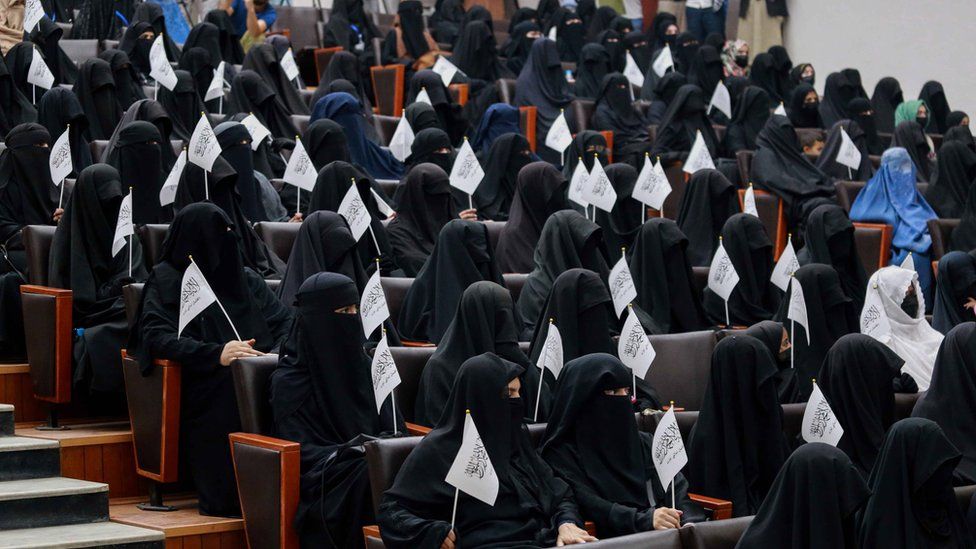
        Veiled students at the Shaheed Rabbani Education University in Kabul.IMAGE SOURCE,EPA
        image captionVeiled students attend a Taliban rally at the Shaheed Rabbani Education University in Kabul on Saturday.

        Afghan universities will be segregated by gender, and a new Islamic dress code will be introduced, the Taliban said on Sunday.

        Higher Education Minister Abdul Baqi Haqqani indicated women would be allowed to study, but not alongside men.

        He also announced a review of subjects taught.

        Women and girls were banned from schools and universities under Taliban rule between 1996 and 2001.

        The Taliban have said they will not prevent women from being educated or having jobs. But since they seized control on 15 August, they have asked all women, except those in the public health sector, to stay away from work, until the security situation improves.

        The announcement of the higher education policy comes a day after the Taliban raised their flag over the presidential palace, signalling the beginning of their administration. They seized control from the elected government a month ago.

        The policy marks a significant change from the accepted practice before the Taliban takeover. Universities were co-educational, with men and women studying side by side, and female students did not have to abide by a dress code.

        But Mr Haqqani was unapologetic about bringing an end to mixed classes. "We have no problems in ending the mixed-education system," he said. "The people are Muslims and they will accept it."

        Some have suggested that the new rules will exclude women from education because the universities do not have the resources to provide separate classes. However, Mr Haqqani insisted there are enough female teachers and that where they are not available alternatives will be found.

        "It all depends on the university's capacity," he said. "We can also use male teachers to teach from behind a curtain, or use technology."

        Girls and boys will also be segregated at primary and secondary schools, which was already common throughout Afghanistan.

        Women will be required to wear hijabs, however Mr Haqqani did not specify if additional face coverings would be made compulsory.

        The newly installed minister also said that the subjects taught in universities will be reviewed. He told reporters that the Taliban wanted to "create a reasonable and Islamic curriculum that is in line with our Islamic, national and historical values and, on the other hand, be able to compete with other countries".

        The announcement comes after a demonstration by women supportive of the Taliban's gender policies at Shaheed Rabbani Education University in Kabul yesterday.


        Hundreds of women, most of them wearing black niqabs and carrying small Taliban flags, listened to speeches that praised the new regime and attacked those involved in large demonstrations across the country demanding the protection of women's rights.

        The new government has also replaced the Women's Affairs Ministry with the Ministry of Vice and Virtue.

        The much feared department was responsible for deploying religious police to the streets to enforce Sharia law during the Taliban's previous spell in power. It became known for beating women for infractions such as dressing immodestly and being outside without a male guardian.

        Many prominent professional women fled Afghanistan in anticipation of the group's stifling rule. The country's biggest pop singer Aryana Sayeed left the country on a US cargo plane and the famed film director Sahraa Karimi was evacuated to Ukraine.


        https://www.bbc.com/news/world-asia-58537081

        Monday, 6 September 2021

        The ‘new’ Taliban regime in Afghanistan: different methods but the same political goal

         The ‘new’ Taliban regime in Afghanistan: different methods but the same political goal

        In the press conferences that have followed the Taliban’s takeover of Afghanistan, the group has projected a changed image. Its spokesmen have attempted to distance this Taliban from the legacy of brutal force and violent oppression of women and ethnic minorities that characterised their 1990s regime, instead emphasising their concern for the safety and security of all Afghans.

        In an uncertain period, it has been difficult to assess whether to take this image at face value. I argue that the Taliban’s ideology has not changed substantially, but that some aspects of the broader political and social environment have. Their ultimate political aim of establishing their version of an “Islamic government” remains, but the political methods they envisage using to achieve it have become more pragmatic.

        This is the second time the Taliban have been put to the test of governing most of the country’s territory. Successfully taking over a country militarily is certainly not the same task as governing it. This was already clear in the 1990s. Coercion strongly underpinned the Taliban’s rule back then, since their extreme interpretations of religious sources did not attract much approval from the broader population. Basic services, such as healthcare, education and food distribution were limited.

        Over the past two decades, the Taliban have worked to build their legitimacy, notably by presenting themselves as a viable political alternative to the Kabul government. That has included providing dispute resolution. Setting up a parallel court system has been a priority for the Taliban insurgency. In the areas they controlled, they barred people from attending government courts and channelled them towards their Taliban judges. This granted the group some level of authority.t newsletter

        Taliban spokesperson Zabiullah Mujahi talking into a microphone at a press conference.
        Taliban spokesperson Zabiullah Mujahid gives a press conference to confirm the US must leave Afghanistan by August 31. EPA

        But now that the Taliban completely oversees the state apparatus, they will have to prove that they are capable of delivering basic public services too. They must provide education and healthcare but also, simply, electricity and water to the population. Public services are currently heavily dependent on foreign aid programs and foreign assistance so there is an immediate challenge, even just in terms of how to pay for everything.

        Part of their solution seems to be to incorporate elements of the existing civil service into their administration. A majority of public sector employees have been asked to return to their duties in the wake of the takeover.

        Over the past decades, the expectations of the Afghan population have changed. A recent study shows how particularly women, regardless of their political stance and level of conservatism, have longed for greater freedom of movement, education for their children (and sometimes themselves) and a larger role in their families and wider social circles. Even under repression, the expectations the regime will meet from its civilians, will be more demanding than the 1990s.

        Taliban ‘diplomacy’

        During the 1990s, the Taliban were less capable – and perhaps less interested – in establishing broader international relations or engaging in diplomacy with other nations. Only three countries recognised the Islamic Emirate of Afghanistan of 1996 to 2001 – Pakistan, Saudi Arabia and the United Arab Emirates. Internationally, it was essentially a pariah state.

        This time the Taliban seem better capable of managing their relations with the west, Russia, and neighbours such as Pakistan, Iran, Uzbekistan, Turkmenistan and China, each of which have their respective agendas. To improve their chances of international recognition, and to ensure various types of foreign material and moral support, the new Taliban regime will have to show some restraint at least.

        A man selling posters showing Taliban supreme commander Mullah Haibatullah Akhunzada and Taliban flags in Kabul.
        A man sells posters of Taliban supreme commander Mullah Haibatullah Akhunzada and Taliban flags in Kabul. EPA

        But public announcements of restraint are no guarantee for what the general population on the ground will actually experience. The political pragmatism that the Taliban’s central leadership displays is not the same as moderation. Even if the central leadership is willing to show some restraint, the question remains if the same can be said of Taliban representatives around the country. Local differences in the group’s approach are likely to endure.

        The Taliban’s ideology has not changed, nor has their ultimate political goal of establishing their version of an “Islamic government”. The post-2001 Taliban have, however, shown themselves to be pragmatic and open to the influence of external actors. A few strategic incentives, such as conditional foreign aid and investments, may induce the Taliban to show some restraint, at least in their public outlook. However, their current political pragmatism should not be confused with ideological moderation.

        https://theconversation.com/the-new-taliban-regime-in-afghanistan-different-methods-but-the-same-political-goal-166793