Bronze Age ‘covered wagon’ emerges as Armenia’s best-preserved ancient vehicle
The Lchashen wagon features a complex mortise-and-tenon construction with bronze fittings that join at least 70 components, while its canopy frame alone required hundreds of precisely mortised holes.
A four-wheeled canopy wagon was recovered from the Lchashen cemetery near Lake Sevan, Live Science reported on Monday, citing Armenian archaeologists and the History Museum of Armenia.
The wagon is said to be one of the best-preserved early covered wagons.
The Late Bronze Age vehicle, dated to the 15th–14th centuries B.C., was unearthed with five other oak wagons in an elite burial ground and later conserved for display in Yerevan. According to the museum and published studies, the discovery followed the Soviet-era drainage of Lake Sevan, which exposed more than 500 graves and rich grave goods.
The Lchashen wagon features a complex mortise-and-tenon construction with bronze fittings that join at least 70 components, while its canopy frame alone required hundreds of precisely mortised holes.
The wagon measures roughly 2 meters in length, and its two-piece wooden wheels stand about 160 centimeters tall. Archaeologists note that four of the cemetery’s vehicles carried superstructures, suggesting ceremonial or prestige use as well as transport.
While sometimes described as the “oldest,” scholars stress that wheeled transport predates the Lchashen find by millennia. Research on the emergence of rotational tools and the wheel points to much earlier innovations, from Near Eastern mining environments to pre-cart technologies.
What makes this wagon stand out
Experts say Lchashen’s canopy wagon is exceptional for preservation and craftsmanship, including its spoked wheels mounted on two axles and the meticulous woodworking that locked slotted elements with metal fasteners.
Two wagons at the site were open platforms, but four, including the museum piece, carried framed superstructures likely covered with hide or textile. The combination of scale, joinery, and context makes the Yerevan display a reference specimen for early covered vehicles.
The cemetery’s assemblage, which included full-size wagons and bronze chariot models, indicates elite funerary practices in which vehicles accompanied leaders in life and in death. According to the museum, such burials appear in Armenia from the Middle Bronze Age and become especially common later, reflecting both technological adoption and social display.
The Lchashen find, conserved in Yerevan, offers a rare opportunity to study an early covered wagon in three dimensions, from axle mechanics to canopy framing. Its towering 160-centimeter wheels and hundreds of precision mortise holes remain the most striking facts of the build.
Smotrich: We'll remove garbage from Palestinian Authority - at their expense
Israel to remove waste caused by illegal fires set by Palestinian Authority Arabs, charge bill to Palestinian Authority.
Finance Minister Bezalel Smotrich, who also serves as a Minister in the Defense Ministry, has announced that Israel will remove waste from illegal fires ignited by Palestinian Authority Arabs in Judea and Samaria.
At the same time, he emphasized, Israel will work to offset the cost of the removal from Palestinian Authority funds.
Speaking at a conference held by the Rosh Ha'ayin municipality on combating air pollution, Smotrich criticized the lack of governmental responsibility in the waste sector and called for the establishment of a national corporation under local government control.
"The Green Line does not stop the pollution," he stressed. "We are all in the same boat."
In a December 2025 meeting of the Knesset Interior Affairs Committee on the illegal fires, Knesset members presented the implications of the phenomenon on the health of the residents and the environment.
MK Tzvi Succot (Religious Zionists) warned of the severity of the situation, saying: "During the Meron disaster, 45 people were killed; here, thousands of people are being killed. People here are dying from the fires, there are stillbirths, and people are lying in the hospital. It is shameful. As a member of the coalition, I'm embarrassed to say this, unfortunately, the IDF is not involved."
He added, "This is terrorism that injures and kills thousands of people. We may have to form a commission of inquiry. We have to send the Air Force and tell them to shoot anyone who starts a fire."
Committee Chairman MK Yitzhak Kroizer and Environmental Protection Minister Idit Silman second the aggressive classification of the issue, and said: "It is true that it's terrorism. Anyone who starts a fire must be shot. Terrorism must be treated as terrorism."
Other MKs referred to the wave of arson as a "security threat" and called for decisive action by the security forces, including the use of the Air Force and stopping the perpetrators in real-time.
https://www.israelnationalnews.com/news/420246
Thank you! We live in Beitar Illit and are continually engulfed by the acrid garbage smoke from the surrounding Arab villages. Shalom al Yisroel
Illegal burning of electronic waste
Burning waste in Jericho
Trash dumped on a hillside near Azzoun
A good example of the inability of the PA to do anything right.
Fire at illegal trash dumping site causing air pollution
Wildfire caused by Pally arson
Pally farmers burning waste just outside Israeli village
Toxic smoke from Pally fires
Pallys burning waste in West Bank
Hamas poster calling for Pallys to set fires in Israel
Firefighter trying to put out arsonist wildfire
Hamas arsonist
Typical "protest" tactic, Pally arsonists set fires in waste bins
Similar tactic, Pallys set fire to tires
Black smoke from burning tires
7000 acres burned in this Pally arson attack
Pallys load balloons with flammable materials in preparation for arson attacks against Israel
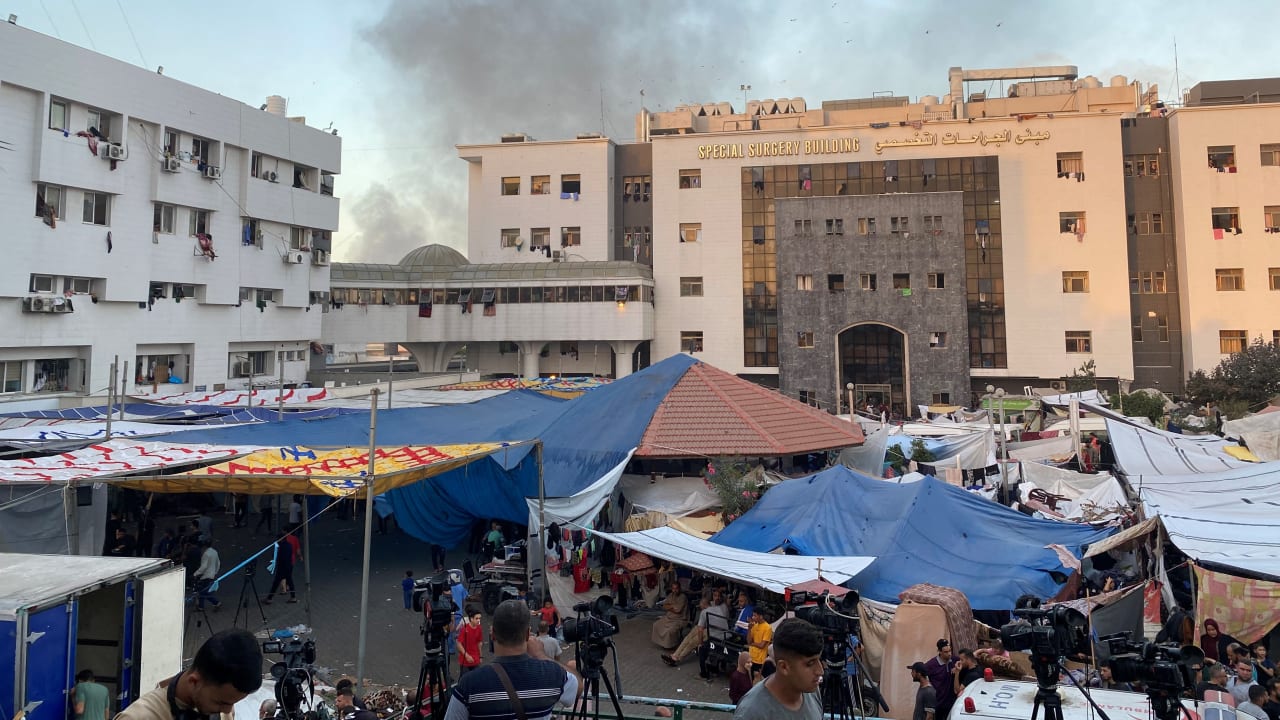
Smoke rises as displaced Palestinians take shelter at Al Shifa hospital, amid the ongoing conflict between Hamas and Israel, in Gaza City, November 8, 2023.(photo credit: REUTERS/DOAA ROUQA)
We have spent the better part of the last two years being inundated with propaganda and disinformation pushed by Hamas and amplified by its supporters around the world. But the greater crime lies not only in terrorists and those who cheer them.
It lies in the silence and inaction of human rights organizations and international health bodies that were created to prevent exactly these kinds of abuses. Their failure to respond meaningfully to Hamas’s crimes against Israelis and against the Palestinian people is a betrayal of the very principles they claim to uphold.
Romi Gonen's testimony
Last weekend, former Israeli hostage Romi Gonen spoke publicly for the first time about her time in Hamas captivity. Her testimony confirmed what many feared, but what made it especially disturbing was not only what happened to her but who inflicted part of that harm.
Gonen revealed that during the 471 days she was held hostage, she was sexually assaulted four times, with the third assault being the most severe. Within the first four days of her captivity, before any Israeli response and before a single IDF soldier had entered Gaza, the first man to sexually assault her was a nurse, someone tasked with treating her bullet wound.
It has been a recurring pattern in Gaza for medical professionals, teachers, and journalists to use their positions as a cover for involvement in terror organizations. We know that hostages were held by Gazans working in ordinary professions in this way, but it is especially horrifying to learn that someone entrusted with her care used his position to abuse her. After the assault, Gonen was forced to continue living in the same house as the man who had violated her.
A views shows a room in the damaged Al Shifa Hospital after Israeli forces withdrew from the hospital and the area around it following a two-week operation, amid the ongoing conflict between Israel and Hamas, in Gaza City April 2, 2024. (credit: REUTERS/DAWOUD ABU ALKAS)
That detail should have triggered international outrage. It didn’t.
Gonen’s testimony matters not because it is singular but because it fits a growing and deeply troubling pattern. Medical professionals in Gaza, doctors, nurses, hospital staff, were not merely passive bystanders to Hamas’s crimes. In multiple documented cases, they were active participants in hostage-taking, abuse, concealment, and even murder.
A pattern of abuse
This is not an accusation made lightly. Every humanitarian organization, particularly those operating in Gaza, must be outraged that terrorists are masquerading as health professionals and participating in this corrupt system.
There have been multiple documented cases of this kind of abuse. The first involves former hostage Noa Marciano, who was kidnapped from the Nahal Oz base. Her body was recovered by the IDF shortly after her death, but it was only years later that it was revealed she had been killed by a Gaza doctor who injected air into her veins and even filmed her death.
Emily Damari, who was kidnapped from Kibbutz Kfar Aza, was held inside Shifa Hospital by a physician who forced her to call him “Dr. Hamas.”
Then there is Dr. Marwan al-Hams, a physician at a hospital in Rafah, who handled the body of IDF soldier Hadar Goldin who was killed by Hamas in 2014, knowing it was hidden for years in a tunnel beneath the city.
Another example is Dr. Ahmed al-Jamal, a physician who also worked at a local mosque. He held Israeli hostages Andrey Kozlov, Shlomi Ziv, and Almog Meir Jan inside his family home in Nuseirat alongside his son, who had written for Al Jazeera. Both were known to have ties to Hamas and both were killed by the IDF in June 2024 during a rescue operation of those hostages.
The weaponization of medical protections
These are not fringe allegations. They are documented cases that expose a grim reality: Humanitarian and medical protections, some of the most sacred principles in international law, were deliberately weaponized.
International humanitarian law exists to shield medical professionals so they can save lives without fear. Hamas understood this. And it exploited that protection, embedding terror within hospitals, clinics, and homes labeled as civilian or humanitarian spaces. When doctors become jailers, when nurses become abusers, when hospitals become holding cells, the moral and legal framework designed to protect civilians collapses.
What this war has made painfully clear is that humanitarian and health organizations often turn a blind eye when the victims are Jewish. Legacy media outlets scrutinize Israel’s actions against a non-state terror group that embeds itself in civilian infrastructure and exploits aid for profit, yet they barely acknowledge the role some Gaza-based medical professionals played in hostage abuse and killings.
Gonen described repeated sexual harassment and assault, constant threats, and psychological terror. She recounted how her captors refused to let her use the bathroom alone, punished her every time she resisted harassment, and ultimately, how one captor took advantage of her during his final hours of guarding her before she was moved into the tunnels.
She has spoken about the long aftermath: the PTSD, the way ordinary sounds trigger memories of captivity, and the cruel misconception that once hostages return home, their suffering is over.
The suffering doesn’t end. While the release of hostages brought relief to their families and the public, it marked only the beginning of a long and difficult journey toward recovery.
What makes Gonen’s testimony especially significant is not only what it reveals about Hamas but also what it exposes about the international system’s failure to respond. October 7 victims came from 35 different countries, so this was never solely Israel’s tragedy. The entire world should have taken responsibility for the citizens affected.
And yet, Israel has largely been left to shoulder the burden alone, militarily, diplomatically, and morally.
The world lacks a coherent framework for responding when non-state terror organizations commit mass sexual violence and hostage-taking while hiding behind civilian infrastructure and humanitarian status. Existing mechanisms, including the Responsibility to Protect doctrine, have proven weak, politicized, or selectively enforced.
Countries that host, fund, or legitimize terror groups, like Qatar or the regime in Iran, must be held accountable. Human-rights organizations must confront uncomfortable facts, even when they complicate preferred narratives. If medical professionals can participate in terror without accountability, then the laws meant to protect humanity have been hollowed out from within.
And if the world refuses to confront that, October 7 will not remain a tragedy of the past: It will become a blueprint for terrorist groups in the future.
The writer is a co-founder and CEO of Social Lite Creative, a digital marketing firm that specializes in geopolitics.
Pud says: The world's hard left controlled mainstream media & the appeaser Socialist governments of the West are deliberately hiding the fact that medical professionals including foreign doctors & nurses are themselves Hamas terrorists and sexual predators and are falsely blaming Israel for their own terrorist crimes in Gaza hospitals.
Israel said 37 aid organisations will be banned from operating in Gaza from Thursday unless they comply with guidelines requiring detailed information on Palestinian staff.
Israel’s deadline for NGOs to provide the details expired at midnight on Wednesday.
“They refuse to provide lists of their Palestinian employees because they know, just as we know, that some of them are involved in terrorism or linked to Hamas,” spokesman for the Ministry of Diaspora Affairs and Combating Antisemitism, Gilad Zwick told AFP, naming 37 NGOs that had so far failed to meet the new requirements.
“I highly doubt that what they haven’t done for 10 months, they will suddenly do in less than 12 hours,” Zwick said. “We certainly won’t accept any cooperation that is just for show, simply to get an extension.”
The ministry had said in a statement on Wednesday that the move was part of Israel’s decision to “strengthen and update” regulations governing the activities of international NGOs in the Palestinian territory.
The new regulation aims to prevent bodies Israel accuses of supporting terrorism from operating in the Palestinian territories.
Israel specified that “acts of de-legitimising Israel” or denial of events surrounding Hamas’ October 7 attack would be “grounds for license withdrawal”.
Israel has singled out international medical charity Doctors Without Borders (MSF), which had two employees who were members of Palestinian militant groups Islamic Jihad and Hamas.
Apart from MSF, some of the 37 NGOs to be hit with the ban are the Norwegian Refugee Council, World Vision International, CARE and Oxfam.
COGAT, the Israeli defence ministry body responsible for Palestinian civilian affairs, said last week that on average 4,200 aid trucks enter Gaza weekly, which corresponds to around 600 daily.
Israel says MSF failed to comply with requirements
MSF did not cooperate with a government-required registration process and declined to provide Israel’s Ministry of Diaspora Affairs with a list of its
employees.
Medical charity Médecins Sans Frontières expects to be barred from operating in Gaza once it misses the deadline to comply with new registration rules for relief agencies that are meant to prevent Hamas from exploiting international aid.
Individuals affiliated with MSF have links to Hamas and Palestinian Islamic Jihad.
https://www.jpost.com/israel-news/article-881869
Oxfam Chief Executive (Muslim, pictured) forced out for bullying
Doctors Without Borders advanced anti-Israel narrative, maintained terror ties
Doctors Without Borders (MSF) advanced an extreme anti-Israeli narrative under the guise of humanitarian activity.
Employees of some of the international organizations operating in Gaza were directly involved in terrorist activity.
Doctors Without Borders (MSF) maintained active ties to designated terrorist organizations: in June 2024, a Palestinian Islamic Jihad operative was identified as an MSF employee, and in September 2024, another MSF employee was identified as a Hamas sniper.
MSF branches are operating "under the pretext of humanitarian activity," while "in practice advancing an extreme anti-Israeli narrative, maintaining affiliations with terrorist entities, promoting boycotts, etc.
An MSF employee in Gaza, Fadi Al-Wadiya, was revealed to be a senior operative of Islamic Jihad and an expert in rocket systems.
MSF France has an "explicit agenda promoting political boycotts and arms embargo against Israel." MSF France's calls for an end to military support to Israel, as well as public support for BDS events. MSF France has also repeatedly accused Israel of "genocide" and "ethnic cleansing" as well as intentional starvation of the people in Gaza.
MSF Belgium has accused Israel of crimes against humanity, and presents the Jewish state as "systematically oppressive, colonial and discriminatory."
Alaa Abd El-Fattah spent years in and out of prison thanks to his pro-terrorist activism
Deport Egyptian extremist who called Brits 'monkeys', say Tories - as red-faced Keir Starmer says he was unaware of 'abhorrent' posts calling for 'death of Zionists'
The Conservatives have called on the Government to deport an Egyptian-British activist after a string of his xenophobic and anti-Semitic posts came to light on social media.
Tory leader Kemi Badenoch is also set to demand that Alaa Abd El-Fattah have his citizenship revoked following the release of the shocking messages.
Mr El-Fattah served more than a decade of nearly continuous detention in Egyptian jails before his release in September 2025. He flew back to London after a previous attempt to leave Egypt in November was blocked by the security forces.
But as his family celebrated his return to the UK, evidence of Mr El-Fattah's historic social media posts emerged, which allegedly included support for the killing of 'Zionists' and the British police - and branding Britons 'dogs and monkeys'.
His posts included one stating 'I consider killing any colonialists and especially Zionists heroic, we need to kill more of them' and another claiming 'There was no genocide against Jews by the Nazis – after all, many Jews are left'.
Keir Starmer was left red-faced today after he said he was unaware of the 'abhorrent' social media history of the activist when he welcomed him back to Britain.
The PM was forced to row back from his earlier comments in which he sparked backlash for saying he was 'delighted' by Alaa Abd El-Fattah's return to the country.
His arrival was also welcomed by Deputy Prime Minister David Lammy and Foreign Secretary Yvette Cooper, who said his release had been 'a top priority for our Government'.
Sir Keir Starmer has been left red-faced after he said he was unaware of the 'abhorrent' social media posts of an Egyptian-British activist he welcomed back to Britain.
Alaa Abd El-Fattah (right) was reunited with his mother Laila (left) in Cairo after his release from prison
Al-Fattah, pictured with mother Laila (left) and sister Sanaa (right)
Sir Keir was supposedly made aware of Mr El-Fattah's social media posts after they circulated online.
The Foreign Office released a statement saying: 'The Government condemns Mr El-Fattah's tweets and considers them to be abhorrent.'
The Conservatives have called for the Egyptian-British dissident to be stripped of his UK citizenship and deported.
Shadow justice secretary Robert Jenrick told the BBC the activist should 'be made to live in Egypt or frankly anywhere else in the world'.
Mr Jenrick, who is also the shadow Lord Chancellor, added that Mr El-Fattah should never have been granted citizenship.
He called on Labour to 'rectify this situation by being clear that they distance themselves and our country wholeheartedly from his views and begin proceedings to revoke his citizenship and have him removed from the UK'.
The PM expressing 'delight' at the return to the UK of Egyptian terrorist supporting Al-Fattah despite the activist's social media posts advocating the 'killing' of Zionists
Conservative leader Kemi Badenoch (pictured) called for Alaa Abd El-Fattah's citizenship to be revoked and the terrorist supporter to be deported
'The Prime Minister is no longer a private campaigner or a gun for hire. His words carry weight and represent us all.'
Reform leader Nigel Farage said: 'This Government just gets worse. No mention of these violent tweets on the BBC News story either.'
Mr El-Fattah, 44, in one tweet said: 'I consider killing any colonialists and especially Zionists heroic, we need to kill more of them.'
n another, he wrote: 'There was no genocide against Jews by the Nazis – after all, many Jews are left.'
Shortly after that, he tweeted: 'Dear Zionists, please don't ever talk to me, I'm a violent person who advocated the killing of all Zionists including civilians, so f*** off.'
He also said: 'Police are not human, they don't have rights, we should just kill them all.'
As London was in the grip of riots, Mr El-Fattah wrote: 'Go burn the city or Downing Street or hunt police you fools.'
He also said: 'So the British dogs and monkeys really think terrorists will reveal their plans on Twitter?'
Sir Keir Starmer initially expressed his 'delight' at El-Fattah's return.
Home Secretary Yvette Cooper was another of the senior Labour politicians to celebrate El-Fattah's release and return to the UK
The Board of Deputies of British Jews said they had raised concerns with the Government.
They said: 'The social media history that has emerged from Alaa Abd El-Fattah is of profound concern.
'His extremist and violent rhetoric aimed at "Zionists" and white people in general is threatening to British Jews and the wider public.
'The warm welcome issued by the Government demonstrates a broken system with an astonishing lack of due diligence by the authorities.'
Meanwhile, the Jewish Leadership Council voiced concerns about the safety of Jewish communities in the wake of recent antisemitic attacks in Manchester and at Australia's Bondi Beach.
The council said: 'We are appalled by the effusive welcome Alaa Abd El-Fattah has received from the UK Government.
'The Prime Minister recently reiterated his determination to root out antisemitism from our country but has now shared his delight that someone who has advocated for killing Zionists has arrived in the UK.
'We know from Heaton Park, Manchester, and Bondi Beach that there are those who hear such words as a call to action.
'The Government has celebrated Mr Abd El-Fattah's arrival as a victory, British Jews will see it as yet another reminder of the danger we face.'
Mr El-Fattah, was born and raised in Egypt.
He became an internationally known activist for terrorists as the Arab Spring swept the country in 2011. He was arrested and jailed during the protests.
In 2014, Mr El-Fattah was arrested again, for his activism against Egyptian president Abdel Fattah El-Sisi's regime, and sentenced to 15 years.
He was jailed again for five years in r 2021 spreading fake news on social media.
Critics questioned how the PM and his ministers did not know about Mr El-Fattah's previous tweets.
Mr Jenrick wrote: 'Did you know about these statements before you issued your "delighted" message? Do you condemn them without qualification... will you correct the record by withdrawing the unalloyed endorsement?'
Mr El-Fattah was seen as a cause celebre and praised by leftist celebrities such as Judi Dench.
A spokesman for Campaign Against Antisemitism said: 'Either the Government did not carry out a basic search, or they knew about this and considered it insufficiently important to warrant saying anything. We have no idea which of these it is, and struggle to decide which is more concerning.
'In the wake of lethal terrorist attacks on Jews from Manchester to Bondi, the UK now has yet one more resident who wants to see "Zionists" murdered."
ROBERT JENRICK: Want to wipe out anti-Semitism, Sir Keir? Then stop welcoming its proponents with open arms
Only days ago, Keir Starmer promised to 'eradicate anti-Semitism in the UK'. Then, this week, he did the opposite.
The Prime Minister went on X to say he was 'delighted' that Alaa Abd El-Fattah is back in Britain. He called the case a 'top priority' for his Government.
He even thanked Egyptian president Abdel Fattah El-Sisi for granting a pardon.
That is not discreet diplomacy. It is a very personal welcome from the Prime Minister of the United Kingdom. And it is indefensible. Because this isn't simply a story about a relieved family. It is also a story about who the Prime Minister chose to celebrate.
Mr El-Fattah's public record includes statements that should make any responsible leader pause before putting the authority of government behind him.
In his own social media posts, he has endorsed killing 'Zionists' and urged more of it. He has also been reported as calling for Israelis to be killed in chilling terms. And he appeared to deny the Holocaust happened.
Nor is this confined to Israel. In July 2011, he wrote that 'police are not human', that they 'don't have rights', and that 'we should just kill them all'.
In August 2011, amid disorder on London's streets, he urged people to 'go burn the city or Downing Street or hunt police'. In fact, he said he hated white people and called us Brits 'dogs'.
Shadow justice secretary Robert Jenrick said: 'At a time when anti-Semitic incidents are surging, when Jewish communities feel under threat and when policing is under intense pressure, the signal this sends is grotesque'
A man being publicly welcomed by the Prime Minister has, in his own words, advocated violence against Jews and violence against police, has egged on attacks on the seat of government itself and has insulted the British people.
In today's two-tier justice system, people have been arrested at the airport or had a knock on the door from the police for tweeting lesser things – indeed got 30 months inside for saying them.
The Government should be standing four-square with the victims of hatred and violence. Instead, the Prime Minister is jubilant about bringing a man with a record of incitement into this country and presenting it as his personal triumph.
There can be only two explanations. Either Sir Keir did not know what he was amplifying – which would be staggering negligence at the top of government – or he did know, and decided to press 'post' anyway. That would be worse.
The Prime Minister is no longer a private campaigner or a gun for hire. His words carry weight and represent us all as a nation.
He should withdraw his unalloyed endorsement of this man, condemn these statements without equivocation and explain how on earth this became a 'top priority'.
El-Fattah (pictured) under arrest at the Cairo Police Academy in Cairo, Egypt, in 2014
El-Fattah (pictured on right) after landing in the UK
His sister Mona Seif, who headed a long-running campaign for her brother Alaa Abd El-Fattah's release, is pictured alongside Labour's David Lammy in 2022
On the morning of 7 October 2023, the day when Hamas launched a series of attacks on Israel, Ms Seif posted pictures of militants flying by paraglider to her X account
Labour Home Secretary Shabana Mahmood is being urged to deport the Egyptian dissident 'before UK is stuck with him' amid reports he could be stripped of his citizenship by Cairo, which would mean UK couldn't take away his UK citizenship.