Showing posts with label Mysteries. Show all posts

Sunday, 18 July 2021

Mystery at 'Skeleton Lake' continues to puzzle and enthrall


Mystery at 'Skeleton Lake' continues to puzzle and enthrall

Decades ago the skeletal remains of hundreds of people were found at a glacial lake in the Indian Himalayas. But advancements in science have brought more questions than answers.

Tucked far up in the freezing, snow-covered mountain ranges of the Himalayas at the dizzying height of more than 15,700 feet above sea level is Roopkund Lake, a small body of water.

At roughly 130 feet (40 meters) in diameter, the lake is less than the width of a football field. But the little lake has a big reputation. It's where the mystery of the dead is still very much alive.

The body of water, commonly known as "Skeleton Lake," is the final resting place for what scientists estimate to be 500 to 800 sets of human remains. It's a mysterious lake where hundreds of people met death and the icy Himalayas continued to preserve their remains.

“If you read about it or try to imagine it, I think that’s when it feels very spooky," journalist Neelima Vallangi told AccuWeather from her home in Kathmandu, Nepal. "That 500 to 800 skeletons are lying abandoned in the mountains deep in the Himalayas. It feeds your imagination."

In 1942, an Indian forest official discovered the skeletal remains scattered in and around the lake. He reported the strange discovery, but it wasn't made public until the late 1950s. As National Geographic reported, "In the 1950s, one explorer described the site to an Indian radio station as a 'ghastly scene that made us catch our breath.'"

A map showing the ocation of Roopkund Lake

It was initially believed that the skeletons were Japanese soldiers or Tibetan traders who died due to an epidemic or from exposure to the unforgiving elements.

However, forensic analysis in 2004 revealed unhealed injuries on several skulls that led scientists to conclude that a group of Indian pilgrims, both men and women, assisted by local porters from the region, were struck by giant hail at Roopkund in a single event in the 9th century.

As Neelima Vallangi wrote for the BBC, "They were believed to have been on a revered, once-in-a-12-year Hindu pilgrimage called Nanda Devi Raj Jat Yatra, an ancient tradition that continues to this day. Roopkund is on the way to Homkund, the final destination of this arduous foot journey."

The theory was plausible at the time. The group comprised both men and women of various ages, which ruled out the possibility that the remains belonged to soldiers.

But from a meteorological perspective, "killer hail" is an unlikely culprit due to the high altitude of Roopkund Lake, AccuWeather Senior International Meteorologist Jim Andrews said.

"At such a high elevation, there seems not to be enough heat or moisture -- both are related through thermodynamics -- to breed "killer" hail," Andrews, who closely observes meteorological conditions in this part of the world, explained.

Andrews didn't completely rule out the possibility given that this is an event that took place more than 1,000 years ago, but generally, the conditions at a location as far above sea level as Roopkund Lake would "limit repeated freeze-thaw, wet-freeze cycles" necessary to produce large hail. He said the conditions there would favor "small and/or soft hail over seriously large, icy hail."

Veena Mushrif-Tripathy, professor of archaeology at Deccan College in Pune, was part of the 2004 investigation. She said no weapons or signs of combat were found at the site, but they did find musical instruments, which is consistent with old folk stories of pilgrims traveling on the Nanda Devi Raj Jat Yatra. The victims were also healthy when they died, which rules out a mass epidemic.

Vallangi completed the trek that leads past Roopkund Lake in September 2009. She told AccuWeather that, at the time, she was excited about hiking so high in the Himalayas.

“You have to be reasonably fit to be able to walk for five to 10 days and the temperature obviously changes, fluctuates from 20 degrees (C) in the plains or lower hills to zero or sub-zero once you reach 4,000, 5,000 meters," she said, referring to a temperature range from about 68 degrees to below freezing. "This lake is at 4,800 meters.”

Vallangi was with a large group when she first set eyes on Skeleton Lake. She said that, before the group arrived, her guide had told them the most popular story behind the human remains: Pilgrims were caught in a huge hailstorm and perished.

This was what those in Neelima Vallangi's group believed they were seeing when they stopped at Skeleton Lake one frigid morning in 2010.

“It was very freezing and it was very cold but once the sun is up it’s like a nice ski day," she said. "It's just that early in the morning when you're walking in the dark that's when it's really cold and miserable."

Neelima Vallangi is a journalist and photographer who went on a trek in the Himalayas that included a stop at Roopkund Lake. (AccuWeather)

The group was on the way to Junargali, a jagged ridge with a panoramic view of the high Himalayas that sits far above the lake.

“We saw some skulls and the leg bones and big arm bones and all these things just piled up,” she told AccuWeather.

“It’s not like you just walk in and there are just skeletons all over. Some of them are in the lake, apparently, and some of them are probably buried in the slopes in the snow, so sometimes when the snow is completely melted you could see them," Vallangi continued. "But when we went, the whole region was completely covered in snow so we couldn’t see any other skeletons scattered around apart from the pile."

A year after Vallangi's trek, the first ancient human genome was sequenced, revolutionizing research into the past. The cold case of Roopkund Lake was heating up. Bone samples from 38 skeletal remains were sent to labs around the world for full genomic analysis. The results of the five-year-long study, published in 2019, were stunning.

The new study revealed that the 38 skeletons belonged to three genetically distinct groups and were deposited at the lake during multiple events over a 1,000-year period.

The new results show that there were 23 people with South Asian ancestry at Roopkund, but they died during one or several events between the 7th and 10th centuries A.D.

Incredibly, the study revealed, another group of 14 victims died there a thousand years later—most likely during a single event in the 19th century. Furthermore, this group had a genetic ancestry tied to the Mediterranean, specifically Greece and Crete. (There was one sample that had South-East Asian origin, also from the 19th century.) 

“Now we see people died in multiple events between the seventh and tenth century and someone else died in the 18th or 19th century so now we don’t know exactly what happened at all,” Vallangi told AccuWeather.

The discovery of Mediterranean migrants in India is particularly surprising. There is no historical evidence or explanation for who these people were and what they were doing deep in the Himalayas.

The year “1800 is not that long ago. People would remember if something unusual happened." Vallangi said. "I think it would have been passed down in oral history or it must be there in the collective memory of locals because it’s a pretty remote place. So if a foreign-looking group came there and they all perished in the mountains, it seems highly unlikely that nobody would know or remember such a bizarre incident.”

Interestingly, advancements in science have raised more questions than answers. The mystery of what happened at Skeleton Lake doesn't appear any closer to being solved.

“Now that I’ve read all the studies it’s like I’ve put together all of it in my mind and I feel like, 'Wow, this is a crazy mystery!” Vallangi said.

It's a difficult archaeological site due to its remoteness, the extreme weather, and the fact that, over the years, the skeletons have been moved around by trekkers and even taken home as souvenirs. In fact, the trek became so popular the environment began to degrade and the trek past Roopkund Lake is now banned.

More than a decade after that frigid morning when she first stood at the edge of Skeleton Lake, the story continues to grip Vallangi's imagination. But with such little evidence, she wonders whether the world will ever know the truth about what happened there.

“Who are these people? What happened there? Why are they all going there to die in that one lake?" she still wonders. "Yeah, I think it’s a very interesting story ... I don’t know how this will ever be solved.”

https://www.accuweather.com/en/travel/mystery-at-skeleton-lake-continues-to-puzzle-and-enthrall/978260

Saturday, 26 June 2021

Aliens Run Secret Base in New Mexico to Breed Many-Legged Human Hybrids, Conspiracy Theory Claims


Aliens Run Secret Base in New Mexico to Breed Many-Legged Human Hybrids, Conspiracy Theory Claims


The question of whether extraterrestrial life exist just got a fresh boost after the US government released a highly-anticipated report on UFO sightings recorded by American pilots in previous decades.

Bizarre conspiracy theories about the existence of a so-called Dulce Base – an underground facility in New Mexico allegedly operated by aliens – has been circulating in the media following the release of the Director of US National Intelligence’s report on unidentified flying phenomena previously spotted by US servicemen.

The theory, first proposed by Albuquerque businessman Paul Bennewitz and then coined by other UFO ‘truthers’, suggests that the cryptic facility is being run by ‘grey aliens’ (or Grays) that have been abducting humans and carrying out extreme experiments with them.

According to excerpts from the 1990 book The Ultimate Deception, written by Commander X (his identity remains debated but the Daily Star maintains the author’s real name is Milton William Cooper), the base is home to multi-legged human hybrids bred by nasty UFOs.

“There are at least seven different levels at Dulce, with Level Six known as ‘Nightmare Hall’. This level is used for most of the experimentation by the Greys,” Commander X wrote in the book.

The work quotes one person, who claimed to have been “working in a slave camp under the spell of the Greys”. The source apparently said that apart from a half human/half octopus, he had also witnessed a bunch of other mysterious creatures at the base, including seven foot tall giants.

"Also Reptilians, and furry creatures that had hands like humans and cry like babies. It mimics human words… also huge mixtures of Lizard-humans in cages,” the escaped source apparently told the author.

Unsurprisingly, these claims have been put under extreme scrutiny in previous decades. These conspiracy theories were raised once again on the AlienHub.com forum in 2009. UFO enthusiasts quoted the words of “terminally ill” Thomas Edwin Castello, who says he has been working as a security guard at the facility, to claim that the aliens there were relying on a mysterious liquid to sustain their lives. The question of whether aliens had sex has preoccupied the minds of enthusiasts at the forum ever since.

The existence of the Dulce Base has never been proven but the idea has found a support among local authorities for the sake of boosting tourism to the area. In 2016, Dulce town even hosted a UFO Conference.

Meanwhile, this conspiracy theory was not mentioned in the government’s new report discussing 144 instances of Unidentified Aerial Phenomena sightings, most of which remained unexplained.

https://sputniknews.com/science/202106261083247194-aliens-run-secret-base-in-new-mexico-to-breed-many-legged-human-hybrids-conspiracy-theory-claims/

Thursday, 22 April 2021

Faked Moon Landing


Faked Moon Landing?


Hello, fellow peasants.


I'm on the fence here.

Up until a few weeks ago, I didn't question the moon landing and laughed at anybody who did. Then something strange happened.

I decided to challenge what I thought I knew, by looking at the counter arguments, which I won't go into right now. But here's something to think about.

Why do you believe that man landed on the moon?

Do you believe it because you saw it on YouTube, knowing that NASA "lost" the original footage?


Or do you believe it because the flag waved in a non-existent wind?


Or do you believe it because the shadows are not parallel despite the sun being the only source of light?


Or do you believe it because, in every photo, not one star can be seen anywhere?


Or do you believe it because the backdrops from various Apollo landings are identical in spite of NASA claiming they landed at different locations between 1969 and 1972?


Or do you believe it because the astronauts flew safely through the deadly radiation belt between Earth and the moon? The Van Allen belt is so dangerous that NASA openly stated, in 1996, that it doesn't have the technology to send humans safely through it. 


Or do you believe it because of the reflection on the helmet?


Or do you believe it because the moon lander made absolutely no impact on the surface of the moon (complete with rocket thrusters), despite Neil Armstrong leaving a famous footprint and stating that the surface is like "a fine dust"?


Or do you believe it because the lunar module was held together with scotch tape and tinfoil?


Like I said, I'm undecided.

And yes, you are welcome to label me a "denier" or "conspiracy theorist" or whatever else, but calling people names is shallow and what toddlers do. It's what you do when you are incapable of conversation.

I simply delete such emails.

If there's something I've learnt during this fake pandemic, then it's that we should not believe everything we're told by the media and government.

Truth matters.

JERM

https://jermwarfare.com/

Monday, 1 February 2021

Medical volunteers in rural Zambia: learning from attitudes to angels and vampires


Medical volunteers in rural Zambia: learning from attitudes to angels and vampires


By James Wintrup, 

Research Fellow in Social Anthropology, University of Oslo

In the past decade, the work of medical volunteers in Africa has been heavily debated. These volunteers – often from Western Europe and North America – arrive in African countries to work in clinics and hospitals, providing medical treatment for patients in poor urban and rural settings.

Important criticisms have been made of this kind of work. The Nigerian-American writer Teju Cole coined the term “white saviour industrial complex” to describe a sector that does more to affirm the “sentimental needs” of white volunteers than to engage with the political dynamics that sustain inequality and poverty in African countries. Social scientists have also studied the work of international medical volunteers. This research shows that these volunteers often cause harm by undermining the authority of African health professionals or by performing risky clinical procedures.

But important voices are sometimes missing from these debates – particularly those of the people on the receiving end of this “help”.

In the area of rural Zambia where I have been conducting research since 2014, international medical volunteers are a common sight. In my recent research I have considered how people who live in rural Zambia regard these outsiders and make sense of their behaviour. One of the aims of this research is to examine how people in rural Zambia have come to understand the actions of the many medical volunteers who have been arriving in the area since the colonial period.

But to understand how people in rural Zambia perceive these medical volunteers, it is important to observe that such volunteers have been closely associated with several kinds of non-human actors, whose behaviour is worth examining in more detail.

Angels and vampires

Historians and anthropologists have studied how medical interventions by white Europeans – from colonial-era missionary doctors to modern medical researchers – have been perceived by people in African countries in the past. This important work has shown that the presence and behaviour of these outsiders has often produced powerful anxieties and rumours. One of the striking findings of this research is that white medical doctors in central Africa were often identified as “vampires” (banyama). This was because people thought they sought to enrich themselves by extracting their African patients’ blood and vital body substances.

I found in my own research that white medical volunteers in rural Zambia were sometimes associated with vampire rumours. But I also discovered that they were connected to a less malevolent figure: the “angel spirit” or mungelo (bangelo, plural) in Chitonga, the language spoken in southern Zambia.

Traditional healers in the area explained that these spirits visited them and offered them powerful healing advice. One of these traditional healers – a woman I will call Dr Simamba – described the behaviour of these spirits. Arriving at Dr Simamba’s home with a friend, I was shown her shrine. In it, she had placed a tall white feather. This, she explained, was the kind of object that might attract angel spirits who sometimes visited her in person and in dreams.

Dr Simamba could not say for sure why these angel spirits were attracted to white objects. But she thought it might be because these spirits physically resembled white people (bakuwa) and always dressed in white clothing.

Nevertheless, these angel spirits were notoriously difficult to attract:

They come at whatever time they please … sometimes a whole year goes past and nothing!

These spirits were worth waiting for, though. They offered highly effective guidance on how to treat patients. This included advice about which herbs and plants to pick, how to prepare them, and whether to drink them, smoke them or rub them into an incision.

Sometimes angel spirits offered Dr Simamba advice about patients who were already under her care and living within her homestead. On other occasions bangelo offered advice about patients who were going to visit in the future so that Dr Simamba could prepare in advance for their arrival.

I encountered six traditional healers – and was told of many others – who also received visits from spirits. But Dr Simamba’s account also resembles the descriptions of diviners and healers throughout the region. In her work on vernacular healing in Tanzania, the American medical anthropologist Stacey Langwick notes that many people who become healers are “called into relationship with a variety of (new) actors”, including spirits and other non-human actors. And for bangelo diviners, one of the non-human actors with whom they were “called into relationship” was the angel spirit.

Ambivalent actors

Despite the advice they could offer, angel spirits were regarded in morally ambivalent terms. Although they could provide effective advice, they were essentially unpredictable. Diviners struggled to sustain long-term relationships with them.

Much like many of the international medical volunteers whom they physically resembled, these spirits acted according to a logic of their own. They arrived and left when they pleased, without offering a reliable and enduring form of care.

In this sense, both medical volunteers and angel spirits depart from the kind of relationships of care and mutual dependence that people in the region often value highly.

The idea that medical volunteers in Zambia stand outside local relationships – and are therefore not bound by social obligations to Zambians – is one that might explain their association with both vampires and angels. I am not suggesting that these non-human actors are simply metaphoric representations of the “real” white people whom they represent. Rather, I think the behaviour of these human and non-human actors should be considered alongside one another.

The moral attitudes that many people in rural Zambia have towards vampires and angels provide an interesting view – even a critique – of the work of medical volunteers. Perhaps it is time to take these criticisms more seriously and include them in debates about medical volunteering.

https://theconversation.com/medical-volunteers-in-rural-zambia-learning-from-attitudes-to-angels-and-vampires-147214

Monday, 7 December 2020

Mystery monoliths: why conspiracists are ‘meh’ about the phenomenon — and how you can start a better conspiracy

Mystery monoliths: why conspiracists are ‘meh’ about the phenomenon — and how you can start a better conspiracy


 The three recent appearances (and two subsequent removals) of “monoliths” in Romania, Utah and California are intriguing examples of what can capture the public’s imagination.

These constructions are metallic-looking structures about three or four metres tall, with a simple geometric design and reflective surface.

They’ll look familiar to fans of Arthur C. Clarke’s Space Odyssey novels, sharing an uncanny resemblance to a monolithic structure pivotal to the story.

Adding to the mystery, the Utah monolith was reportedly in place long before it came to light on November 18. While its location wasn’t announced, members of the public found Google Earth images of the object dating back to 2016.

See what others are saying about this article on twitter.

So far, no credible source has suggested the structures are a product of alien technology or supernatural influence. And unlike with UFO sightings and Area 51 news, governments have not been accused of a cover-up.

So even though Google Trends data shows global search interest in “monolith” has shot up since the structures were found, they’re not yet the subject of widespread conspiracy. And a reflection of past similar phenomena suggests they won’t be.

Intriguing artefacts

The maker (or makers) of the curious objects are likely still around, but they’re not talking. In the meantime, the structures call to mind some major oddities and artefacts from the past, all of which gained considerable fame.

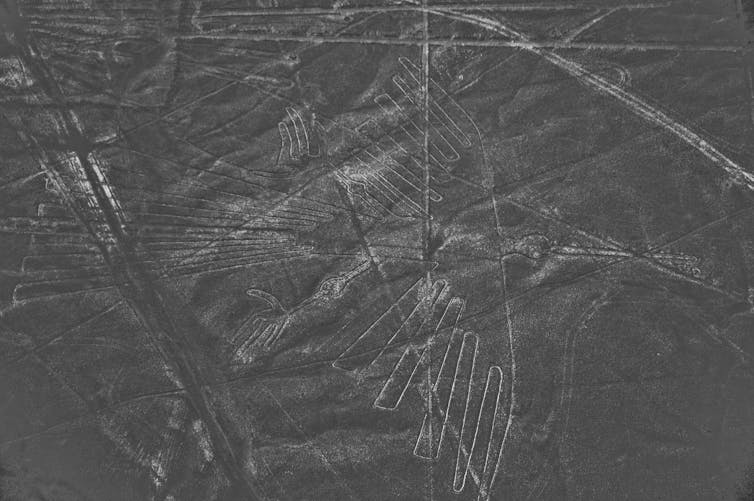
Peru’s Nazca lines are one example. These shallow depressions in rock from around 500 BCE form colossal shapes of animals and plants which, intriguingly, are best observed from the air.

The ancient Nazca lines in Peru cover almost 1,000 square kilometres, and form about about 300 different figures. Flickr

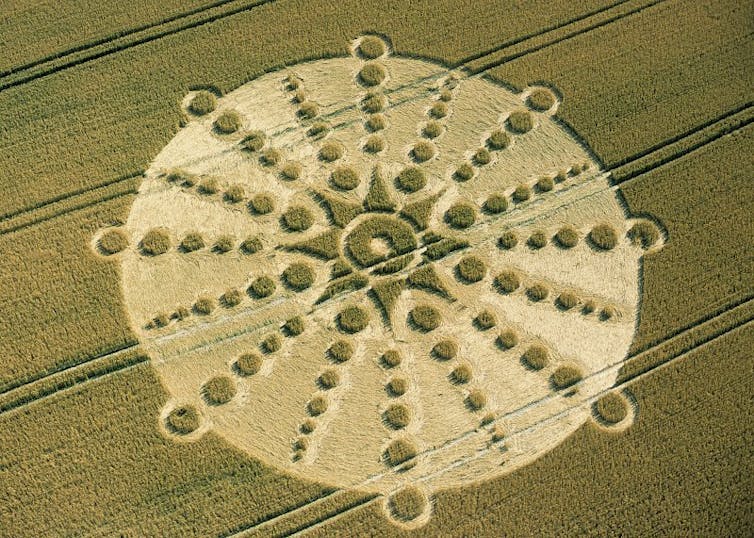
The crop circle phenomenon may also strike a chord. These complex geometric patterns which apparently form overnight in fields across the world have captured imaginations for decades.

Both these phenomena have produced exotic accounts claiming to explain them. Some have said the Nazca lines were created to communicate with space travellers. Crop circles, others say, are the product of alien labour meant to send us a message.

No one knows why the ancient Peruvians made their lines. Their motivations may be hidden forever. Crop circles, however, are a modern occurrence.

And despite claims they couldn’t possibly be made by humans, humans make them all the time, often for the enjoyment of their effect on others. Crop circles also drive tourism in certain parts of the world.

Crop circles in fields tend to be heavily geometric and often display concentric circles. Flickr

But why are we so easily grabbed by such peculiarities anyway? After all, our lives aren’t impacted by them.


Read more: Neverending stories – why we still love Unsolved Mysteries


When things don’t make sense

There are many possible reasons people fix their attention on potential oddities, and even start believing strange things about them. One is that they short-circuit our sense of how the world works — injecting novelty into an otherwise routine and coherent existence.

As the physicist and Nobel Laureate Richard Feynman said:

…the thing that doesn’t fit is the most interesting.

The tendency to imagine alternatives and to entertain a “what if?” scenario is the same reason we love reading speculative fiction.

If the Nazca lines really were etched to communicate with aliens — and if crop circles really represent alien messages targeted at us — the model of the world in our heads would be flipped.

But of course, as the great science communicator Carl Sagan points out, paraphrasing prominent polymath Pierre-Simon Laplace:

…extraordinary claims require extraordinary evidence.

There’s nothing to suggest the above phenomena are evidence of anything extraordinary.

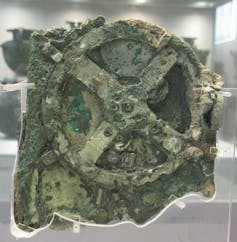
The Antikythera Mechanism is an out-of-place artefact. These are artefacts of historical, archaeological, or paleontological interest which challenge widely accepted historical chronology. Flickr

Another interesting “out-of-place” artefact is the ancient Antikythera mechanism. This is seemingly an analog computer once used to predict astronomical positions and events.

But perhaps most notorious are the old favourites: Egypt’s Great Pyramid of Giza (and the widespread conjecture surrounding its construction), Stonehenge in England, and the enigmatic Easter Island statues. All have been connected to aliens, lost wisdom or extinct civilisations.

In case you need a summer project

When it comes to creating a spectacle worthy of the public’s attention, there are some key lessons to be learned from past successes in making artefacts, including:

Go big

It pays to do something on a large scale, either by making a big artefact, or having small ones appear over a very large area.

Stay obscure

The meaning of the artefact should remain unclear, or at least allow room for interpretation. It’s in these situations of uncertainty that the human imagination can run wild.

While the monoliths’ intent is unclear, they could be explained as art. Reports have pointed to their similarity with artwork by minimalist sculptor John McCracken.

Aesthetics matter

It’s nice if the artefact is aesthetically pleasing or interesting. The geometric precision of pyramids and crop circles speaks to significant care and perhaps mathematical sophistication. The monoliths are comparatively basic.

Be original

A display that has never been seen before is far more newsworthy. The monoliths are highly derivative of those appearing in Stanley Kubrick’s 2001: A Space Odyssey.

Be difficult to copy

The monoliths could have been knocked up in a workshop. The “wow” factor for artefacts usually comes through an appreciation of their complexity, or seeming impossibility of their manufacture. The scale of the Nazca lines speak to this, as do potential efforts to construct Giza and Stonehenge.

Humans can do amazing things

Whatever the true explanations, most phenomena can be attributed to human ingenuity and a willingness to persevere. Simply, we must ask:

  1. is it likely the means of construction were accessible to humans?
  2. is it likely it served a meaningful purpose for the maker?

In most cases, the former is true. Although the time and resources required must have been momentous, it was clearly not impossible to build Giza. We’ll probably have to face the fact humans are just very clever and industrious.

It’s harder to be sure the second point is true, although that doesn’t mean it isn’t.

But every now and then we also like to have fun with artefacts and generate something unique and novel, even if it is for entertainment value alone.

https://theconversation.com/mystery-monoliths-why-conspiracists-are-meh-about-the-phenomenon-and-how-you-can-start-a-better-conspiracy-151376