Showing posts with label Arts & Culture. Show all posts

Sunday, 26 March 2023

Kirk Cameron: Protecting Our Kids Requires ‘Not Allowing Cross-Dressing Men to Tell Our Children Stories’


Source: https://www.breitbart.com/radio/2023/03/23/exclusive-kirk-cameron-protecting-our-kids-requires-not-allowing-cross-dressing-men-tell-our-children-stories/

Actor Kirk Cameron, author of the children’s book As You Grow, said on Thursday’s edition of the Breitbart News Daily podcast with host Alex Marlow that creating a moral future for America’s children requires protecting them from “cross-dressing men” pushing left-wing sexual ideologies marketed as “drag queen story hour.”

Cameron remarked, “If we want to see the future look like the kind of place we grew up in, or our grandparents grew up in, we need to start investing and planting seeds today that will grow into these future trees of liberty and blessing for our kids.”

“One of the ways we do that is by being the ones who tell them these stories, not allowing cross-dressing men to tell our children stories that lead our kids in a different direction,” he added.

Last week, Cameron hosted a children’s book reading in Fayetteville, Arkansas. One of the featured books, Elephants Are Not Birds, relays a naturalistic and essentialist understanding of sexual dimorphism.

The book’s promotional description reads:

BRAVE Books and Ashley St. Clair have partnered together to tackle the intense topic of gender in our book Elephants Are Not Birds, which follows the story of an Elephant named Kevin. Most can see that there is a distinct difference between an elephant and a bird but in this story, we’ll see that even those lines are blurred when the lies of Culture the Vulture are accepted as truth.

Culture the Vulture convinces Kevin that his ability to sing is one that only birds have, so logically this means that he is a bird. The lies and logic from Culture the Vulture parallel what our culture is attempting to feed the youth of today. The story Elephants Are Not Birds arrives at a similar conclusion society will arrive at when it comes to the idea of gender identity, boys are not girls and elephants are not birds.

The book reading was attended in protest by “trans activists, who were men dressed in drag.”

Cameron described his recent work as an author and organizer of book readings for children as a moral endeavor in opposition to the wickedness of “left woke ideology.”

“There’s a lot at stake,” he said, “and I want to do everything I can in the time I’ve been given to uproot as much evil that I’m able to.”

He cautioned concerned Americans against apathy.

“Men love to build worlds, and you can either build good ones, or you can build bad ones,” he remarked. “If you stay out of the game, I think you get depressed. I think that we’re made to serve people, and sitting on the couch just watching Fox News — or whatever it is — crying in your Chick-fil-A soup, waiting for somebody else to rescue you is not a good plan.”

The current cultural malaise, Cameron concluded, is part of a divine plan.

He stated, “I believe that this cultural setback that we’ve been experiencing is really a divine setup for a national comeback led by the family of faith.”

“Come to these events,” Cameron urged. “Start your own Brave Story Hour. Do something. Go to a board meeting. Read their stories to your children. Pray. Get involved, because the good guys win, the bad guys lose, every time.”

He concluded, “You’ve just got to stick around long enough to see the end of the story, and God is still writing our story here in America.”.


Monday, 11 October 2021

Creating a ‘Brave New World’: Rather than guarding Britain’s national treasures, woke museum curators want to dispose of them


Creating a ‘Brave New World’: Rather than guarding Britain’s national treasures, woke museum curators want to dispose of them

Alexander Adams
Alexander Adams

is an artist, art critic and author. 

Creating a ‘Brave New World’: Rather than guarding Britain’s national treasures, woke museum curators want to dispose of them
A taxpayer-funded group of politicised surrogate social workers, sorry, museum professionals, wants to embed anti-racism, climate activism, and ‘decolonise’ their institutions by dumping items it considers problematic.

The UK’s leading association of museum professionals prepares to gather next month – by putting politics ahead of public service. Topics for the Museums Association’s annual conference to be held in Liverpool, from Sunday November 7 to Wednesday November 10, include ‘We are all complicit in systemic oppression: What can a museum worker do?’, ‘Embedding anti-racism in cultural arts organisations’ and ‘Reimagining museums for climate change’. Issues of critical race theory (as ‘anti-racism’) and climate alarmism will dominate proceedings.  

The name of the conference is ‘Brave New World’. This chilling title is taken from the satirical novel by Aldous Huxley, warning of an engineered utopia, where a governing elite manipulated the population and distorted history. Did the Museums Association (MA) think such a world was a recommendation rather than the warning the rest of us assumed it was? 

Cultural entryism and political money

The MA was founded in London in 1889 as an association for museum staff to pool knowledge and best techniques. It advises on the ethics of curating, arranges training and seminars and publishes a journal for members. It has charity status.

However, over recent years, the MA has fallen prey to cultural entryism. Cultural entryism is when outsiders with political goals enter an organisation and proceed to use their influence to influence or control that organisation, regardless of its founding principles and aims. Ultimately, if the organisation cannot be controlled, it is destroyed. (See the cultural entryism in the American comic-book industry.) 

The MA is funded by the Arts Council of England, which provides public money. It is also backed by the Esmée Fairbairn Foundation, which states it is “committed to social justice, and to tackling injustice and inequality. Racial justice is a critical element in this, in the UK and across the world, and we are committed to addressing structural and systemic racism in the UK both as an organisation and through the work we support.”

No longer are museum professionals expected to put their decades of specialist training, in-depth knowledge and experience into explaining artefacts. Museums have pledged to fight racism and berate visitors about climate change. Museum staff are now surrogate social workers. 

The MA recorded and published a video with one staff member of a Welsh museum saying, “We work with refugees and asylum seekers, we work with black minority-ethnic groups, we work with LGBT groups, making the museum not only accessible for different people but also getting them involved in decision-making processes and getting them to decide what gets shown and what gets collected.”

Do the Welsh people know that migrants (guided by politically inclined curators) are influencing their museum collections?

‘Decolonise museums and their collections’

‘Disposal is not a dirty word’ is the title for another MA conference session. It encourages museum staff to consider removing material from museum collections, citing “environmental and economic sustainability” as a justification. This is the latest stage in a push by radicals to enable deaccessioning, which is the process of selling, giving away or destroying material in museums’ permanent collections. This is currently restricted by law in the UK. The MA is in favour of providing museums more opportunity to deaccession. 

Considering the explicitly progressive agenda of the MA, why would it not also recommend deaccessioning museum material on political grounds? After all, the MA has stated elsewhere, “We unreservedly support initiatives to decolonise museums and their collections.”

Museum curators are no longer the devoted custodians and investigators of artefacts; they are more likely to be schooled in post-modernism and to loathe those artefacts, seeing them as tainted by a history of oppression. Rather than guarding Britain’s national treasures, curators are lobbying to dispose of them.

When the first public museums were established around 1800-1820, they were founded on the principles of the Enlightenment. Collections would be presented neutrally, procedures would be scientific and museums thereby allow visitors to gain knowledge by studying material, which would be preserved regardless of the curators’ (or public’s) emotions and politics. 

The MA uses its influence to undermine the Enlightenment aspiration towards objectivity, retention of items, separation of museums from interested outside parties and treating staff, creators and audience equally regardless of race. The MA is an avowedly campaigning organisation which seeks to advance progressivism under the guise of professional advice to museum staff.

If the MA cannot return to its core values, it should be stripped of public funding and charity status.

https://www.rt.com/op-ed/537019-brave-new-world-museums-britain/

Wednesday, 21 July 2021

Researchers identify 14 living descendants of Leonardo da Vinci's family


Researchers identify 14 living descendants of Leonardo da Vinci's family


Decades-long research into Leonardo da Vinci's purported remains has revealed how many people currently alive can claim to be descendants of the family of the Renaissance genius and "Mona Lisa" painter: It's 14.

The findings, published in the journal Human Evolution this month, comes from a new genealogical tree going through 21 generations and four branches.
The research is part of the Leonardo Da Vinci DNA Project, which aims to confirm remains thought to be his and to "better understand his extraordinary talents and visual acuity through genetic associations."
The researchers behind the study wrote these results are "eagerly awaited from an historical viewpoint," as they will help academics to "scientifically explore the roots of his genius, to find information on his physical prowess and on his possibly precocious aging, on his being left-handed and his health and possible hereditary sicknesses, and to explain certain peculiar sensory perceptions, like his extraordinary visual quality and synesthesia."
Researchers gathered data from historical documents in public and private archives, and direct accounts by descendants of Leonardo's family members.
While the study provided little information about the living descendants, in order to protect their privacy, project researchers Agnese Sabato and Alessandro Vezzosi told CNN that the individuals vary in age from 1 to 85.
"There are very young children and retirees who previously carried out various activities: employees of both public and private bodies, surveyors (and) traders," the pair said over email, adding: "For us, they are all extraordinary people ... from a human point of view. They live in Tuscany. However, the research continues on other branches and in other countries."
As Leonardo is not known to have had any children, Sabato and Vezzosi focused their research on the artist's father and his descendents, identifying what they called "some hitherto unknown branches of the lineage." They looked at "thousands of unpublished documents," as well as reexamining evidence that was "known but not understood," they wrote.
"Our original question was: Is it possible that there are no biological heirs from the descendants of the numerous sons of Ser Piero, Leonardo's father?" they said, adding: "We have always tried to investigate the story of Leonardo the man, as well as (Leonardo the artist), to ... explain the reasons for his genius. Now, with the help of science, we hope that we can add some significant answers."
Born in 1452, Leonardo is known for his paintings "Mona Lisa" and "The Last Supper." Leonardo also dedicated his time to science, math, architecture, design, engineering, geology, cartography, sculpting and drawing.
His artwork continues to elicit hefty payments from collectors.
Last year, an online bidder paid $98,000 to attend the annual examination of the Mona Lisa, when the Louvre museum in Paris takes the painting out of its case for inspection.
Earlier this month, a new auction record was set when a tiny sketch of a bear sold for more than $12 million.
https://edition.cnn.com/style/article/leonardo-da-vinci-descendants-trnd-scn/index.html

Saturday, 17 July 2021

This 'Vegetable Seller' is much older -- and grumpier -- than we realized


This 'Vegetable Seller' is much older -- and grumpier -- than we realized


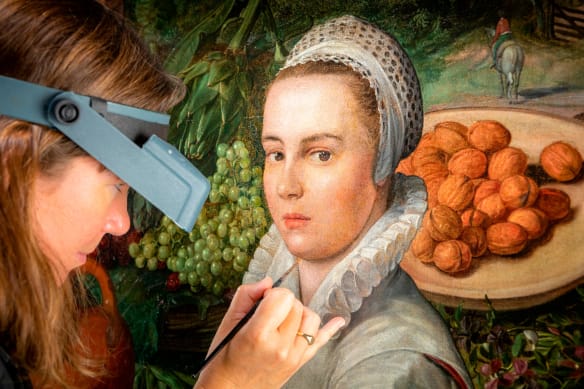
The restoration of an old unsigned painting has wiped the smile off one young woman's face -- and given art historians more clues about its origins.
The 16th-century Flemish painting, known as "The Vegetable Seller," was brought to Audley End House in southeast England in the 18th century.
In 2019, a team from conservation charity English Heritage set about restoring it after a condition survey revealed that it needed restoration.
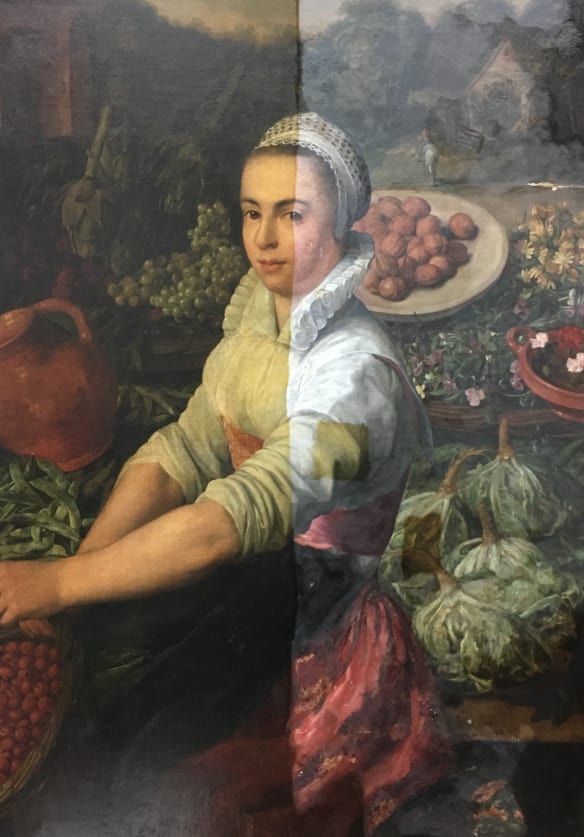
A cleaning test on the painting, initially assumed to be an 18th-century work, revealed something else. "We realized what bright, lovely colors lay below the discolored varnish," Alice Tate-Harte, Collections Conservator at English Heritage, told CNN.
"We took the dirt layer off, then we took the varnish layer off, and that allowed us to see the quality of the paint below: not only the colors, but the look of the paint. You can start seeing its age, the cracks, the abrasion pattern that you see in the early Netherlandish pictures," she explained.
With her smile removed, the subject is "more confronting," English Heritage conservator Alice Tate-Harte said.
With her smile removed, the subject is "more confronting," English Heritage conservator Alice Tate-Harte said. Credit: Christopher Ison/English Heritage
This led staff to believe that the painting was actually older than had first been thought -- and allowed them to distinguish between the original paint and overpaint, which had been added when the painting had previously been restored.
Conservators got to work on the subject of the painting -- who, up until then, wore a serene smile.
"There was a lot of overpaint on her face, and on her white chemise, and the apron of her skirt, and the corner," Tate-Harte said, adding that an earlier restorer probably retouched the painting because of water damage or cracking in the paint.
"Restorers didn't follow the conservation ethics that we do today," she said.
"More and more of her face was revealed -- we realized she wasn't meant to be smiling at all. She actually had quite a serious expression," she said. This, she said, was in the style of the Antwerp painter Joachim Beukelaer.
Experts now think "The Vegetable Seller" may be the work of 16th-century Flemish painter Joachim Beuckelaer.
Experts now think "The Vegetable Seller" may be the work of 16th-century Flemish painter Joachim Beuckelaer. Credit: Christopher Ison/English Heritage
Conservators from English Heritage now think they have uncovered "strong evidence" to link the work to Beuckelaer, who lived between 1535 and 1575, and believe it could even have been painted by the artist himself.
Tate-Harte said the subject's changed expression is an "improvement."
"I think it benefits it -- it's showing that it is a 16th-century painting," she said.
"She's much more confronting the viewer -- she is much more of a strong woman now, a bit less passive," she added..According to English Heritage, the restoration also revealed a greater spectrum of colors in the fruit and vegetables in the picture.
"Many of the fruit and vegetables depicted would now be considered heritage varieties, and some will have been lost entirely from cultivation," English Heritage noted in a statement.
The painting is on display at Audley End House, about 50 miles northeast of London, from Friday.
https://edition.cnn.com/style/article/vegetable-seller-smile-intl-scli-gbr/index.html

Saturday, 10 July 2021

2021-07-09 our world in pictures


Spiked


Spiked, an inflatable art installation, by Steve Messam, bursts through the columns of the Temple of Piety, at Studley Royal on July 09, 2021 in Ripon, England.  (Photo by Christopher Furlong/Getty Images)


https://www.dailymaverick.co.za/article/2021-07-09-our-world-in-pictures-week-27-of-2021/

Friday, 9 July 2021

World’s tallest sandcastle built in Denmark


World’s tallest sandcastle built in Denmark

Its creator, Dutchman Wilfred Stijger, wanted the castle to represent the power of the novel coronavirus over the world.


The world's tallest sand sculpture is under construction in Blokhus, Denmark on July 7, 2021. - In the small seaside town of Blokhus in Denmark, the world's tallest sandcastle has been completed, weighing nearly 5,000 tonnes and towering over 20 metres high, its designer Wilfred Stijger said on July 7, 2021. (Photo by Claus Bjoern Larsen / Ritzau Scanpix / AFP)


In the small seaside town of Blokhus in Denmark, the world’s tallest sandcastle has been completed, weighing nearly 5,000 tonnes and towering over 20 metres high, its designers said Wednesday. 

Standing 21.16 metres high (69.4 feet), more than three metres taller than a castle built in Germany in 2019, which previously held the title with its 17.66 metres, according to Guinness World Records. 

A total of 4,860 tonnes of sand make up the intricately decorated structure which is reminiscent of a pyramid.

Its creator, Dutchman Wilfred Stijger, who was assisted by 30 of the world’s best sand sculptors, wanted the castle to represent the power of the novel coronavirus over the world since the beginning of the pandemic.

Atop the sandcastle is a model of the virus wearing a crown.

“It’s ruling our lives everywhere,” Stijger said. 

“It tells you what to do…. It tells you to stay away from your family and not go to nice places. Don’t do activities, stay home,” he added.

To make it more cohesive, the sand contains approximately 10 percent clay and a layer of glue was applied after it was completed so that it could stand up to the chilly and windy conditions of the autumn and winter.

Inhabitants of Blokhus have also been delighed to see local features incorporated into the sandscastle, such as windsurfing and kite-surfing, beach houses, fish and lighthouses.

The castle is expected to stand until the heavy frost sets in, meaning it should last until February or March.

https://citizen.co.za/lifestyle/entertainment/arts-and-books/2558727/worlds-tallest-sandcastle-built-in-denmark/

Monday, 21 June 2021

Pink Cloud Perfectly Shaped Like a Heart in Sky Over Paris


Photographer Snaps Pink Cloud Perfectly Shaped Like a Heart in Sky Over Paris


This stunning photograph shows a pink cloud perfectly shaped like a heart resting 
in the sky  as the sun sets over Paris. (SWNS)


Self proclaimed “lover of sunsets” Thibaut Buccellato. (SWNS)


“I was walking in the center of Paris near Hôtel de Ville and the sunset was beautiful,” Thibaut said.

“I saw this cloud shaped like a heart so I took a photo so other people could see it too.

“I am a romantic—most of my short films are about love and relations—and I just love this photo.”

He took the sentimental photo in April 2018.

https://www.theepochtimes.com/mkt_morningbrief/photographer-snaps-pink-cloud-perfectly-shaped-like-a-heart-in-sky-over-paris_3793020.html

Uproar as Swedish National Museum Adds 'Insane' Racism Warnings to Classic Art


Uproar as Swedish National Museum Adds 'Insane' Racism Warnings to Classic Art


In a series of warnings by the Swedish National Museum, classic 19th-century art is presented as patriarchal, reactionary, and borderline dangerous due to alleged features of racism, sexism, and nationalism.

The Swedish National Museum has added politically-flavoured warning texts to swaths of its collection.

Most of the warnings concern classic 19th-century paintings and the Nordic national romanticism movement in particular, which prompted Leif Gren, an archaeologist at the Swedish National Heritage Board, to accuse the museum of placing "facilitating pointers" to provide the public with "misleading politicisation" in an opinion piece for Vestmanlands Läns Tidning.

According to Gren, 19th-century "bourgeois art" is presented as rife with "deception, falsehood, political manipulation, sexism, and racism". Among other things, 19th-century art is portrayed as patriarchal, reactionary and borderline dangerous, disregarding "the strong liberal climate" of that era, Gren noted. By contrast, 20th-century art, which increasingly embraces the Social Democratic tradition, is displayed as cultural success, he noted, which moves the focus away from art itself and prevents visitors from thinking for themselves.

For instance, this is how the National Museum now presents Gustaf Cederström's world-famous painting "Bringing Home the Body of King Carl XII of Sweden": "The populist and nationalist view of Swedishness, which is used politically today, is based on the idea of a statically idealised and constructed past. The idea that there is a historical time and place to look back on, where everything was in a certain way, is not true".

Several warning signs label 19th-century art as expressions of racism. The term "racialisation" is also used as a matter of course, despite it not appearing until the 1960s. According to Gren, the reasoning is mostly based on so-called "guilt by association". For instance, Carl Wilhelmson's classic painting "Church People in a Boat" is given a racist slant because it was made at a time when "anthropological racial research" was being performed.

"Ever since Romanticism, the idea of inherited popular characteristics characterised German and Nordic thinking. The rural population, farmers and fishermen, who lived according to older cultural patterns and whose bodies were marked by hard toil, were allowed to exemplify the Nordic national types. From the mid-19th century that perspective was strengthened by the anatomical museum sample collections that received an anthropological racial research focus", the National Museum said in its warning.

Likewise, a sexist agenda is being attributed to 19th-century paintings of an erotic nature that focus on the female body as an object of art, with warnings honing in on "the tradition of the male gaze", which presents the female figure as "prey".

In the words of Gren, the museum's agenda is to convey the idea that 19th-century society was deceived and patriarchal, whereas art is presented "as a highly oppressive tool in an unnatural state of society".

The warings sparked a backlash on social media.

"The National Museum marks its paintings with crazy left-wing political pointers. 'Church People in a Boat' by Carl Wilhelmsson is described as racist. The permanent exhibition is therefore one great left-wing indoctrination – funded by our tax money", one user noted.

​"This madness will continue until everything in Swedish culture is branded racist. Everything that makes us Swedes proud of our cultural heritage must be branded racist by these state-sanctioned left-wing extremists. We gave them the finger, they took our hand!", another one mused.

"​Is everything Swedish racist? Those of you who think so, why do you still choose to live in such a racist country?", another one asked rhetorically.

​"The world has gone insane. The National Museum calls older art 'racist', including a painting depicting fishermen in a boat, and puts up warning signs", blogger Julia Caesar noted.

 https://sputniknews.com/society/202106211083196798-uproar-as-swedish-national-museum-adds-insane-racism-warnings-to-classic-art/

Tuesday, 30 March 2021

Dante redacted for modern sensitivities


Dante redacted for modern sensitivities

A new Dutch translation of the The Divine Comedy by the medieval Italian author, Dante Alighieri, has attracted attention for having removed references to the Islamic prophet Mohammed.

The epic poem describes a journey through Hell, Purgatory and Heaven, during which Dante describes the various actions, experiences and choices that accounted for the presence of souls in different parts of these realms. The text is populated by historical characters.

Mohammed is depicted in Hell as having been a ‘Sower of Discord and Scandal’.  His body is split and disembowelled, representing the division in religion for which Dante holds him responsible. A number of other figures are likewise depicted in this context, although Mohammed appears to hold a uniquely prominent place in the scene.

Translator Lies Lavrijsen said in an interview that the removal of Mohammed from the text would give the translation the ‘widest possible accessibility’, with especial reference to ‘a younger audience’. Leaving the passage would have ‘hurt’ many readers, she said, noting the recent murder of Samuel Paty in France. 

Paty, a schoolteacher, was murdered in October 2020 after having used controversial cartoons about Mohammed during a class on freedom of expression.

The head of publisher Blossom Books, Myrthe Spiteri, said that the inclusion of Mohammed was superfluous to the overall narrative. She added that ‘founding a religion cannot be reprehensible’.

However, some critics, such as Italian literary scholar Elisabetta Sala, condemned the removal of Mohammed from the famous text, terming it ‘cultural vandalism’. Speaking to the conservative Catholic website, Church Militant, she commented on the possible incongruity of removing the references to Mohammed while other transgressors – including those whose conduct would today be unremarkable – remain damned. ‘The funny bit, though, is that Lavrijsen leaves other people, such as popes and homosexuals, suffering in Hell. She’s already become a conservative and a reactionary, as one day we’ll have to remove them too and perhaps get rid of Hell itself!’

https://dailyfriend.co.za/2021/03/30/dante-redacted-for-modern-sensitivities/