Showing posts with label UK. Show all posts

Monday, 24 January 2022

Assange granted the right to appeal extradition – UK High Court


Assange granted the right to appeal extradition – UK High Court

The Australian journalist has been given permission to challenge his extradition to the US
Assange granted the right to appeal extradition – UK High Court

On Monday, the British High Court granted WikiLeaks founder Julian Assange permission to appeal against his extradition to the US. His legal team had petitioned the court to allow him to challenge the extradition decision on points of law of general public importance.

It was ruled that Assange’s application to certify a point of law was legitimate.

“The point of law certified is: In what circumstances can an appellate court receive assurances from a requesting state which were not before the court of first instance in extradition proceedings,” court documents read.

The case will now be reviewed by the UK Supreme Court.

Speaking after the verdict, Assange’s fiancĂ©e, Stella Moris, stated that it was an important step.

“What happened in court today was precisely what we wanted to happen … and that is that the Supreme Court has good grounds to hear this appeal,” Moris told reporters.

“Make no mistake, we won today in court. But let’s not forget: every time we win, as long as this case isn't dropped, as long as Julian isn’t freed, Julian continues to suffer.”

“If there were justice, the officials who plotted and conspired to murder Julian would be in the courtroom right now,” Moris said.

In December, the High Court ruled in favor of allowing the journalist’s extradition to the US, where he faces espionage charges for publishing documents about the wars in Afghanistan and Iraq in 2010. A conviction could carry a 175-year prison sentence.

Assange spent seven years living inside the Ecuadorian Embassy in London, before a new government in Quito revoked his asylum. Protection and surveillance of the embassy cost British taxpayers millions of pounds. He was detained outside the embassy by British police in April 2019, and has since been held in the capital’s Belmarsh maximum-security prison. Moris claims Assange’s health has deteriorated significantly during that time, and recently revealed that, in October 2021, he had suffered a stroke.

https://www.rt.com/news/546934-assange-uk-court-appeal/

Saturday, 22 January 2022

UK to accuse Russia of working to install pro-Moscow leader in Ukraine – leak


UK to accuse Russia of working to install pro-Moscow leader in Ukraine – leak

Numerous former Ukrainian politicians have been cooperating with Russian intelligence services, according to London
UK to accuse Russia of working to install pro-Moscow leader in Ukraine – leak

An embargoed UK Foreign Office release to media outlets, which has been seen by RT, claims that Britain has exposed a plan by Moscow to install a pro-Russian leader in Kiev as tensions continue to mount over an alleged threat of “invasion” by Moscow.

“We have information that indicates the Russian government is looking to install a pro-Russian leader in [Kiev] as it considers whether to invade and occupy Ukraine,” reads the correspondence, which was sent to media representatives on the Foreign Office’s mailing list on Saturday. No evidence was included to back up the assertions. 

Obviously timed to top the Sunday newspaper agenda, recipients were ordered not to carry the details until after 10.30pm London time the night before.

It even named the man who the Kremlin supposedly considers to be “a potential candidate” to replace Ukraine’s current Western-backed president, Volodymyr Zelensky. According to the Foreign Office, 45-year-old former Ukrainian MP Evgeniy Murayev is the chosen alternative. 


The Foreign Office insists that Russian intelligence agencies have maintained links with “numerous” former Ukrainian politicians, including some top officials from the government of ex-president Viktor Yanukovich, who was deposed as a result of the violent Western-backed Maidan street protests in 2014.A native of Kharkov, Murayev was a member of the Ukrainian parliament, the Verkhovna Rada, between 2012 and 2019. However, his Opposition Bloc party failed to pass the 5% threshold in the latest parliamentary election, having only managed to win six single-seat constituencies.

Nikolai Azarov, who served as prime minister between 2010 and 2014, two former deputy PMs, and ex-deputy head of the Ukrainian National Security and Defense Council (RNBO) were also mentioned in the email.

“Some of these have contact with Russian intelligence officers currently involved in the planning for an attack on Ukraine,” it claimed.

However, the Foreign Office didn’t reveal the source of its data or expand on what exactly it believes Moscow has been doing to achieve regime change in Ukraine.


Truss warned that any Russian incursion into its neighbor would be “a massive strategic mistake with severe costs” for the Kremlin. She also reiterated that Britain backs the sovereignty and territorial integrity of Ukraine, and reminded the recipients that it was “an independent, sovereign country.”The letter also cited Foreign Secretary Liz Truss, who claimed that “information being released today shines a light on the extent of Russian activity designed to subvert Ukraine, and is an insight into Kremlin thinking.”

Russia has repeatedly denied accusations that it’s planning an invasion of Ukraine, which have been made by the US and its allies since November last year, describing the claims as groundless attempts to instill “hysteria.”

According to Moscow, it’s the West that has been stirring tensions in Ukraine by supplying weapons to Kiev – which is embroiled in a "frozen" conflict with self-proclaimed republics in the southeastern Donbass region – and intensifying the NATO buildup in Eastern Europe. The Ukrainian government asserts that the Donbass militias are under Moscow's direct control, a charge the Kremlin rejects. 

https://www.rt.com/russia/546841-uk-truss-ukraine-leader/

Thursday, 16 December 2021

The Assange Case Explained Simply


The Assange Case Explained Simply


One of the most common reasons I hear from people on their reluctance to wade into the Assange debate is that they don’t understand it. It looks like a complicated issue to them, so they leave it to the experts.

In reality, the complexity of this case is a complete illusion. It’s very, very simple. It only looks complicated because many years of media distortion have made it appear so.

The US government is trying to extradite a journalist and prosecute him under the Espionage Act for exposing its war crimes, with the long-term goal of normalizing this practice.

That’s it. That’s the whole entire thing. So simple you can sum it up in a single sentence. In a single breath. The most powerful government on earth setting a legal precedent which would allow it to extradite any journalist anywhere in the world for exposing its malfeasance would unquestionably have a massive chilling effect on journalism everywhere in precisely the area where press scrutiny is most sorely needed. It’s not any more complex or nuanced than that.

The Assange issue is simple. What makes it seem complicated is the lies people have been fed by the media class whose job is to manipulate the public into consenting to the agendas of the US power alliance and its war machine.

Because of this mass-scale smear campaign, you will be told that Assange is “not a journalist” and should therefore not be defended as such. This is first of all objectively false; providing the public with factual information about the powerful which helps them understand their world better is the thing that journalism is, which is why Assange has received many awards for journalism. More to the point, Assange wouldn’t need to be a journalist for worldwide press freedoms to be gravely threatened by his prosecution for publishing authentic documents about the US government.

You will be told that Assange “helped Trump win” with WikiLeaks publications that harmed the 2016 Hillary Clinton campaign, and should therefore not be supported. But the Assange extradition case has nothing to do with the 2016 WikiLeaks releases; the entire case revolves around the Chelsea Manning leaks from years earlier about the US military’s scandalous abuses in Iraq and Afghanistan. More to the point, only the most infantile of narcissists would believe it’s legitimate to imprison people for hurting your preferred candidate’s political campaign.

You will be told that Assange is being prosecuted for “hacking” and not journalism because the US indictment alleges that Assange tried to help Manning crack a password while taking classified documents. But it does not allege that Assange made any attempt to help Manning gain access to those documents; the indictment says that Manning already “had access to the computers in connection with her duties as an intelligence analyst,” and that Assange’s attempts would only “have made it more difficult for investigators to determine the source of the illegal disclosures.” As explained in 2019 by journalists Glenn Greenwald and Micah Lee (the latter of whom happens to despise Assange), this means Assange was engaged in the standard journalistic practice of source protection. Anyone who says Assange tried to hack into US government servers is either lying or misinformed.

You will be told that Assange is a Russian asset because of still-unproven allegations by the US government that the Kremlin was behind the 2016 releases, but this claim is completely baseless and, again, completely unrelated to the 2010 Manning publications for which Assange is actually being prosecuted. No serious media publication has ever reported that the Assange extradition case has anything to do with the 2016 WikiLeaks publications, but because so many people heard Assange’s name mentioned during the mass media’s discredited Trump-Russia collusion narratives you’ll constantly see people assuming that one is related to the other.

Do you see how that works? Do you see how what’s actually happening with the Assange case is extremely simple and easy to understand, but all the narratives justifying his persecution make it necessary to engage in a bunch of complicated counter-arguments? This obfuscation didn’t happen by accident, which is why I refuted as many such distortions as possible in this long article written after Assange’s imprisonment.

The most powerful government in the world trying to lock up a foreign journalist for telling the truth about it is as insanely tyrannical an abuse as you could possibly come up with. It’s as obvious as it gets. The Assange case is so simple and so common sense it should be one of the most mainstream, normie positions anyone could possibly have, right up there with believing racism is bad and child molesters should be stopped. It’s only because imperial spinmeisters muddy the waters with lies and distortions that this isn’t happening.

Everyone should oppose the agenda to normalize the imprisonment of journalists who embarrass the US empire. This shouldn’t be a job left to fringe bloggers, podcasters and YouTubers, it should be happening in every sector of society, across the entire political spectrum. The fact that a very large sector of the population fails to see this as a priority issue shows you just how brainwashed the empire’s propaganda engine has made us.

https://caitlinjohnstone.com/2021/12/16/the-assange-case-explained-simply/

Tuesday, 14 December 2021


Assange case raises thorny questions

By Ivo Vegter

At face value, the UK court ruling that Assange may be extradited to the US on espionage-related charges, seems like a threat to press freedom. The case is more complicated than that, though.

Julian Assange’s near decade-long fight against extradition to the United States has suffered a major setback. An appeals court in the United Kingdom ruled that the US request for extradition, to stand trial on 18 charges of obtaining or disclosing national defence information, conspiracy of same, and conspiracy of committing computer intrusions, is valid.

Assange still has options left. He can appeal to the Supreme Court in the UK, and appeal again to the European Court of Human Rights. But he is coming ever closer to a reckoning with the Americans he enraged more than a decade ago.

Taken at face value, this is a blow to press freedom. Assange, an Australian journalist who founded WikiLeaks in 2006, is widely viewed as a pioneer of transparency, as a result of his efforts to publish leaks from whistle-blowers.

WikiLeaks rose to fame – or infamy – in 2010, when it published, in quick succession, a series of major internal US government leaks. These leaks, which included the so-called Afghan War Diaries, the Iraq War Logs, and a vast trove of diplomatic cables, prompted a criminal investigation into WikiLeaks and its founder, Assange.

While large parts of the leaks disclosed nothing illegal, buried within them were the germs of many momentous news stories, including evidence of serious war crimes by US-led Coalition forces and official lies about civilian casualties.

Some of the Afghan war documents were withheld at the request of the unnamed source, and the diplomatic cables were initially published in redacted form, before being leaked from WikiLeaks unredacted.

These leaks, collectively, represent the most significant trove of leaked documents since the Pentagon Papers were published by the New York Times and the Washington Post back in 1971.

In hiding

Another pioneer of journalism based on government leaks, Glenn Greenwald, worked with whistle-blower Edward Snowden to publish secret details of illegal US surveillance programmes. He wrote an excellent overview and history of the UK appeal court ruling from the Assange-did-nothing-wrong camp. It is essential reading, makes a great press freedom argument, and gives background that I need not rehash in much detail here.

It covers the lengthy time that Assange spent either hiding in the Ecuadorian embassy in London, having asked for and received asylum, or in Belmarsh Prison, after his asylum and Ecuadorian citizenship were revoked at the behest of the Trump administration.

Although one might have expected more leniency from the Biden administration, Assange had also infuriated the Democratic Party by leaking confidential emails showing that the party had rigged the 2016 presidential primaries against the socialist Bernie Sanders, and in favour of the eventual nominee, the corporatist Hillary Clinton.

So, while the original leaks disclosed the sins of the Bush administration, the Biden administration has tawdry reasons of its own to seek revenge against Assange.

Initially, the UK courts had resisted efforts by the US to extradite Assange, on the grounds that the treatment of national security prisoners in the US is inhumane, which would compromise Assange’s already fragile mental health and could lead to his suicide.

The judges have since accepted assurances by the US that they’d be nice, which seems surprisingly gullible, given that the US had plotted to illegally kidnap and even assassinate Assange.

The UK-based NGO, Article 19, named after the clause in the Universal Declaration of Human Rights that guarantees freedom of information, also considers the court ruling a blow to press freedom worldwide.

Said its executive director Quinn McKew: ‘The decision to extradite Mr Assange to the US to face espionage charges directly threatens media freedom. The US prosecution does no more and no less than criminalise those who gather news and expose serious human rights violations and crimes. The UK government should not support this. This judgment means that all those who pursue and reveal human rights abuses by the US and other powerful entities are now at serious risk of extradition and prosecution.’

Legitimate secrecy

However, there is another side to this argument, and that is that governments – and private entities, for that matter – do have legitimate reasons for keeping certain information secret. The need for secrecy in prosecuting wars is indisputable, and the need for confidentiality in diplomatic business is also uncontroversial. Secrecy literally saves lives.

There is, therefore, a legitimate case to be made that people who have security clearance but violate that trust, ought to be prosecuted.

On the other hand, holding governments (and companies, and people) accountable means that whistle-blowers who reveal evidence of wrongdoing ought to be protected from both prosecution and vengeance.

It is harder to make the argument that journalists who publish once-secret information ought to be prosecuted. After all, they never agreed to keep it secret, and they didn’t violate the secrecy.

If one journalist doesn’t publish, the next will, as happened with the Pentagon Papers. Once a document has been leaked, it is hard to supress it. And, as Justice Black opined in the Pentagon Papers case, ‘Only a free and unrestrained press can effectively expose deception in government.’

On this basis, we could conclude that Assange indeed did nothing that ought to be criminal, unlike his sources (whom he, of course, has every right to protect).

Hating WikiLeaks

When the embassy cables were first published on WikiLeaks in 2010, I wrote that one day, we’d all hate WikiLeaks. I don’t think that prediction came true, since most people still seem to love WikiLeaks, but my qualms remain:

‘The “leaks” for which WikiLeaks has become infamous are not of the specific, whistle-blowing kind. They are wholesale disclosures, including many confidential and secret documents. While the organisation claims to exercise some editorial control over the releases, redacting names of people whose lives might be endangered, and omitting in this case documents classified as “top secret”, there’s not much that is sacred.

‘Anyway, all it will take to shed the remaining fig leaves is a competitor with fewer qualms than those to which Julian Assange professes.

‘It is the end of secrecy, of confidentiality and of privacy.’

I sought to distinguish between real evidence of malfeasance, fraud, or corruption, the disclosure of which should always be protected, and other information that its owners have a legitimate right to keep secret.

We have seen, after all, that lying governments are not the only victims of leaks. The vast majority of the Panama Papers of 2016 and the Pandora Papers of 2021 consists of private information that exposes no wrongdoing at all.

Like the war logs or the embassy cables, these disclosures ought to have been edited to contain only information that implicated people, companies or governments in criminal misconduct. That is what whistle-blowing is.

Revealing secret or confidential information that does not implicate anyone in wrongdoing is not whistle-blowing. That is simply a violation of privacy or legitimate confidentiality.

Exemplary

Although Greenwald has come out in support of Assange, his own work with Snowden was a lot more circumspect. It disclosed only what was necessary to expose illegal surveillance, and little more. I think that approach was exemplary on the part of Greenwald, and ought to be considered mitigating, or even exculpatory, in any future espionage prosecution of Snowden.

If I, as a journalist, obtain your personal financial information, someone at your bank violated your privacy. Once I do obtain it, however, do I have the right to publish it?

Perhaps, if it contains evidence of criminal activity. But if it doesn’t implicate you, it strikes me as deeply unethical – and likely illegal – to disclose your private information.

So, the Assange question is not as simple as saying ‘it’s a blow to press freedom’. To the extent that he published evidence of illegal activity, he should absolutely be protected, as should his whistle-blowing sources.

Collateral damage

The question is what else he disclosed when he dumped millions of unscrutinised documents online. Did that constitute a justifiable violation of secrecy or privacy, or was it just ‘collateral damage’?

If we are to hold governments accountable for the collateral damage in war, can we just ignore the collateral damage of wholesale leaks of the kind that Assange champions?

If we can’t, the question becomes who ought to be held accountable for that collateral damage. To my mind, the person who agreed to keep the information secret and violated that undertaking ought be held civilly and/or criminally liable for any disclosures that do not constitute incriminating evidence and therefore fall under the whistle-blowing exception.

Once the information had been leaked, however, should it be merely unethical, or should it be criminal, to publish such leaks wholesale instead of publishing only incriminating evidence?

Hesitantly, I’d go with unethical, rather than criminal, although journalists ought to be aware of and accountable for the physical, financial, reputational and psychological damage that such disclosures can do.

So, although Assange is a hero to many, he is not blameless.

However, I do think he has suffered enough. It would be a great boon to worldwide press freedom if the UK and the US would set an example to more repressive governments by extending leniency, and even a pardon, to Assange.


Ivo Vegter is a freelance journalist, columnist and speaker who loves debunking myths and misconceptions, and addresses topics from the perspective of individual liberty and free markets. 

https://dailyfriend.co.za/2021/12/14/assange-case-raises-thorny-questions/

Thursday, 9 December 2021

Travellers from South Africa have to fork out R77,000 for 10 days of ‘hell’ in filthy, flea-ridden quarantine hotel in U


Travellers from South Africa have to fork out R77,000 for 10 days of ‘hell’ in filthy, flea-ridden quarantine hotel in UK


Stranded passengers at OR Tambo International Airport on Saturday, 27 November 2021.

Cold food, fleas and shoddy accommodation add insult to financial injury, while red list restrictions could last well into 2022.


For Britons Mick and Janet Green* the holiday in South Africa they had put on hold for almost two years has turned into a nightmare, thanks to the UK’s knee-jerk reaction to the discovery of the Omicron variant of Covid-19 and its insistence that all returning travellers from South Africa go into mandatory quarantine at their own expense. 

Visiting their family in Hazyview in the heart of South Africa’s Greater Kruger region after so long apart was wonderful for the couple, but on 26 November, shortly before their scheduled departure home on 5 December, Britain effectively slammed the door shut on the country, putting it and several other southern African nations on its infamous red list.

Flights were cancelled while the British government scrambled to arrange quarantine hotels across the country for those flying home from the affected African nations, leaving Mick and Janet temporarily stranded. 

When, at last, they were able to reschedule their British Airways flights home, it was only on the condition that they book and pay for their quarantine accommodation first. The cost for 10 days at the “government’s leisure” was £3,714 (more than R77,000), on top of the cost of an additional night in Johannesburg to meet the new flight times. 

Exorbitant additional costs 

Mick and Janet met many other stranded Brits at Johannesburg’s OR Tambo International Airport who were struggling to find quarantine availability to secure their flights home.  

“One family of four we spoke to had spent almost £20,000 on additional accommodation at Johannesburg airport and the cost of quarantine for all of them, and were still waiting for confirmation of their quarantine booking when we left,” said Mick. 

“For us, having to cough up another £3,714 was tough and emptied what little we had left on our credit cards.”

The shoddy room at the Delta Hotel, Milton Keynes, Buckinghamshire, England. It costs £371.40 (about R7,716) a night.

At what amounted to £371.40 (about R7,716) a night for hotel accommodation in the government’s selected quarantine facility — the Delta Hotel by Marriott in the Buckinghamshire city of Milton Keynes — Mick and Janet expected at least a comfortable, clean room, decent meals and some level of quality. Their expectations were to fall excessively short when, five hours after landing at London’s Heathrow Airport after an 11-hour flight, they eventually arrived at their designated quarantine facility just before midnight. 

“We were met on landing at Heathrow by security personnel who escorted us to a bus with just six other people on it, all headed to the Delta Hotel in Milton Keynes,” says Mick. “This was to be our ‘home’ for the next 10 nights, so we expected to be made welcome. We were treated well by the hotel staff, but the amount of security was overwhelming.” 

Filthy room, inedible food and things that bite in the night 

A filthy chair in the Delta Hotel room.


The room itself left a lot to be desired, but they gratefully climbed into bed, hoping that their first morning would see things improve. Sadly, things most certainly did not get better. 

Daylight revealed the true state of their room — and the level of filth they were expected to endure for the duration of their quarantine. A badly stained carpet was matched by dirty chairs, curtains hanging off the rail, disgusting bathroom facilities and a bad smell. The eventual arrival of breakfast did little to lift the mood.  

Far from the full English breakfast that had been ordered the night before, a stone-cold omelette accompanied by a salad and soggy toast wrapped in cling-wrap with a single serving of margarine failed to cut the mustard. 

An alleged ‘full English breakfast’, delivered cold and inedible to the Covid-19 quarantine quarters at the Delta Hotel, Milton Keynes.

“The food arrived in a cardboard container and had obviously not been prepared in the hotel,” said Janet. “It’s evidently being brought in from outside service providers and was absolutely inedible.”

At the time of writing, three days into their quarantine, Mick and Janet have yet to receive food that is either what they ordered or, Janet says, “suitable for human consumption”.

“It’s just atrocious. I wouldn’t feed it to an animal,” she said. 

However, the worst was yet to come as on the third morning, Janet noticed bite marks on her legs, which began to get itchy.  

“We joked that it must be bed bugs,” she said. “But while I was working on my laptop something jumped on to the screen from the bed — it was a flea. On closer inspection we saw that they were in the bed and the carpet.”  

They informed the hotel management who sent a medic to their room. “She was a lovely lady, but what was she supposed to do?” asked Janet. “She suggested they may move us (although we don’t know if that means another hotel or just a new room), but my concern is that we will just take the fleas with us, and what if the new room also has fleas?”

The en-suite bathroom facilities have seen better days at the Delta Hotel. 


That the British government has consigned them to a living hell in accommodation that’s patently not suitable for purpose is something that does not sit well with the couple. 

“We did not expect an uber luxurious, five-star experience, but we certainly expected a clean, well-kept room and proper food,” Mick said. “We never thought we’d have to treat ourselves and our possessions for fleas before returning home, either!”

This congealed ‘cheeseburger’ at the Delta Hotel was unfit for human consumption.

Red list till April next year?

When approached for comment, the Marriott call centre in the UK could not transfer the call to any appropriately authorised person and refused to divulge alternative numbers or transfer the call to personnel able to handle media inquiries. However, a reservations team member did confirm that the Delta Hotel in Milton Keynes is “closed for bookings” until 7 April 2022. 

Does this mean that the British government intends to keep its travel restrictions in place until April next year? If so, that presents a disturbing reality for South Africa’s beleaguered tourism industry that’s hanging on by a thread after the reinstatement of the red list and associated European and US travel bans.  

The news that this quarantine facility is to remain active until at least the end of the first quarter of 2022 does not bode well for tourism recovery in southern Africa. Nor does it calm the fears of hundreds of British travellers still stranded in South Africa, unable to obtain quarantine bookings that match with limited flights. 

“Another family we spoke to at OR Tambo said they had gone to the British Consulate in Johannesburg and had been refused help. They were fast running out of money and had nowhere to go and no way of getting home. They could not afford quarantine and would not be allowed on to a flight home without first booking and paying for it,” said Mick. 

Widespread criticism at quarantine costs and quality 

Renowned British actor and filmmaker Richard E Grant is also in quarantine in a hotel in Gatwick after visiting his mother in southern Africa. He has criticised, on social media, the quality of the food he is being given and the standard of the accommodation in which he is being forced to stay.  

A petition against the high cost of quarantine is gaining traction in the UK and there is pending legal action being taken against the British government in the British High Court. 

The cost of a standard room for two people at the Delta Hotel in Milton Keynes is £66 a night — this rate is for 7 April 2022, the first available booking date on Marriott’s reservations system. Mick and Janet have been forced to pay £371.40 a night — £305.40 a night more than the going rate, fleas not included.

With no end in sight to the requirement of travellers from southern Africa to quarantine on their return to the UK and a possible protracted period on the country’s red list — from which South Africa was only removed in October after almost two years — the hopes of SA welcoming British guests in the near future are virtually dashed. 

Crippled by fear 

Rising numbers of positive cases of the Omicron variant, coupled with widespread resistance to the South African government’s vaccination programme, look set to confirm the northern hemisphere’s fear and loathing and justify its no-travel policies.  

Thus far, the South African minister of tourism, Lindiwe Sisulu, has remained quiet on what measures are being taken at a diplomatic level to engage with the British government and the leaders of other European nations to reverse the travel bans. 

However, the speed at which the current red list regulations were instituted and flights cancelled does nothing to assuage the fears of international travellers surrounding the risks associated with long-haul travel and the concerns about being stranded in a foreign country with no way to get home or having to go into quarantine on their return.  

If Mick and Janet’s experiences are anything to go by, those fears are justified. Until the leaders of the world’s most powerful economies are informed by science and consistent, clear and universally recognised empirical evidence rather than hidden agendas, panic and blatant bias, the effects of the Covid-19 pandemic will be with us long after the virus itself is conquered. DM/MC 

*Mick and Janet’s names have been changed at their request to prevent any possible recrimination during their quarantine.

https://www.dailymaverick.co.za/article/2021-12-09-travellers-from-south-africa-have-to-fork-out-r77000-for-10-days-of-hell-in-filthy-flea-ridden-quarantine-hotel-in-uk/

Monday, 29 November 2021

Snowstorm strands 61 in pub in Yorkshire, England, for third night, ‘plenty of beer available’


Snowstorm strands 61 in pub in Yorkshire, England, for third night, ‘plenty of beer available’

The snowstorm made driving on roads in the area unsafe


The last thing guests at one pub in Yorkshire, England, will need is a cold one.

A strong snowstorm stranded about 61 people on hand for a concert Friday night and there's a good chance they will not be able to leave until Monday--at the earliest. 

The guests were hunkered down at the Tan Hill Inn after attending the Friday concert by an Oasis tribute band called Noasis. 

"I’m quite chilled about being stranded, it’s quite exciting, but we’re missing our son who is with his nana," Stephanie Overton, one of the guests, told the BBC. "I am wondering how long we will be here for though."

The report said the storm dumped about three feet of snow in the Yorkshire Dales, which is about 1,732 feet above sea level. Besides the snow, fallen power cables have created a dangerous situation outside. The guests are all getting along, and the report said managers set up sleeping quarters in the pub’s lounge.

The New York Times reported that a man at the pub was evacuated by a local rescue group because of a previous medical condition. The guests have been passing the time by singing karaoke and watching movies like "Grease," the report said.

https://www.foxnews.com/world/snowstorm-strands-61-in-pub-for-third-night-plenty-of-beer-available

New Variant


New Variant


https://www.dailymaverick.co.za/cartoon/new-variant/

UK Bureaucrats Ban Word ‘Christmas’ for Fear It Will Offend Minorities


UK Bureaucrats Ban Word ‘Christmas’ for Fear It Will Offend Minorities

https://www.breitbart.com/europe/2021/11/28/uk-bureaucrats-ban-word-christmas-for-fear-it-will-offend-minorities/
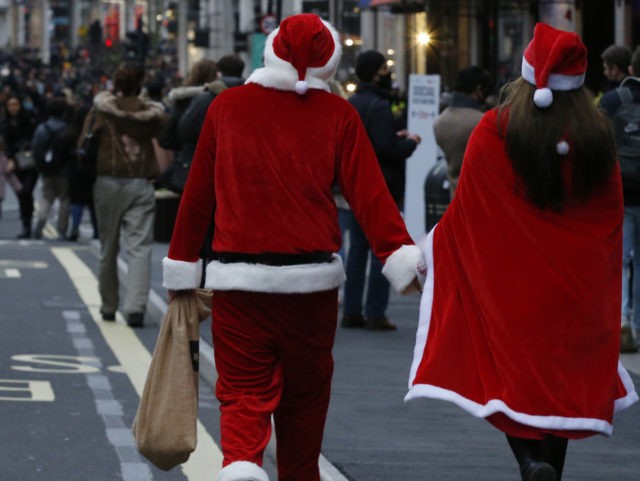
LONDON, ENGLAND - DECEMBER 12: People in Santa costumes walk amongst Christmas shoppers Regent Street on December 12, 2020 in London, England. (Photo by Hollie Adams/Getty Images)
Hollie Adams/Getty Images
2:44

UK Civil servants have axed the word ‘Christmas’ from a proposed government campaign, for fear the term will offend minorities.

British civil servants have apparently embraced their inner Scrooge, vetoing the use of the word ‘Christmas’ from being used in a coronavirus testing drive aimed at students, arguing that the use of the term runs the risk of offending minorities within the country.

The campaign, which reportedly would have revolved around ministers using the slogan “Don’t take COVID home for Christmas,” is part of a larger government effort to limit the spread of the Chinese coronavirus after two cases of the Omicron variant were discovered on-shore.

‘We have been advised by Cabinet Office that we should not use the word Christmas – as the Government campaign needs to be inclusive and some religions don’t celebrate Christmas,” an email seen by The Mail on Sunday read. “The other option was ‘festive season’ which keeps the emotional motivation.”

“We have gone with ‘Don’t take COVID-19 home for the holidays’ – as it links to school and university Christmas holidays,” the email continued. “The alliteration with ‘home’ and ‘holidays’ scans well and is memorable.”

Despite the politically correct alliteration, this suggestion was also shot down in a follow-up email sent by a different British bureaucrat.

“We don’t refer to Christmas as the holidays (that’s an Americanism),” the email read. “Please can we say, ‘Don’t take Covid-19 home’.”

Conservative MP Saqib Bhatti lambasted the decision to remove the mention of Christmas from the campaign.

“As a Muslim, I find it ridiculous we can’t enjoy this special time of year. I look forward to showing my new son his first Christmas tree. The idea you can’t mention Christmas is completely ridiculous,” Bhatti said.

“It’s a time to celebrate, whatever your background. It’s part of the British culture I love. It’s the celebration of all cultures that makes this the most welcoming country in the world.

“I’m proud of that and proud to celebrate Christmas. The Blob needs to stop waging war on Christmas and get on with delivering for the British people,” Bhatti concluded.

The British government is not unique in waging a woke war on Christmas traditions this year, with a short film produced by the Norwegian postal service seeing Santa fall in love with another man.

The advert — which British left-wing newspaper The Guardian has called “heartwarming” — follows St Nick and his new love interest, Harry, who at one point tells Santa: “All I want for Christmas is you.”

The film ends with the pair passionately embracing with a kiss.