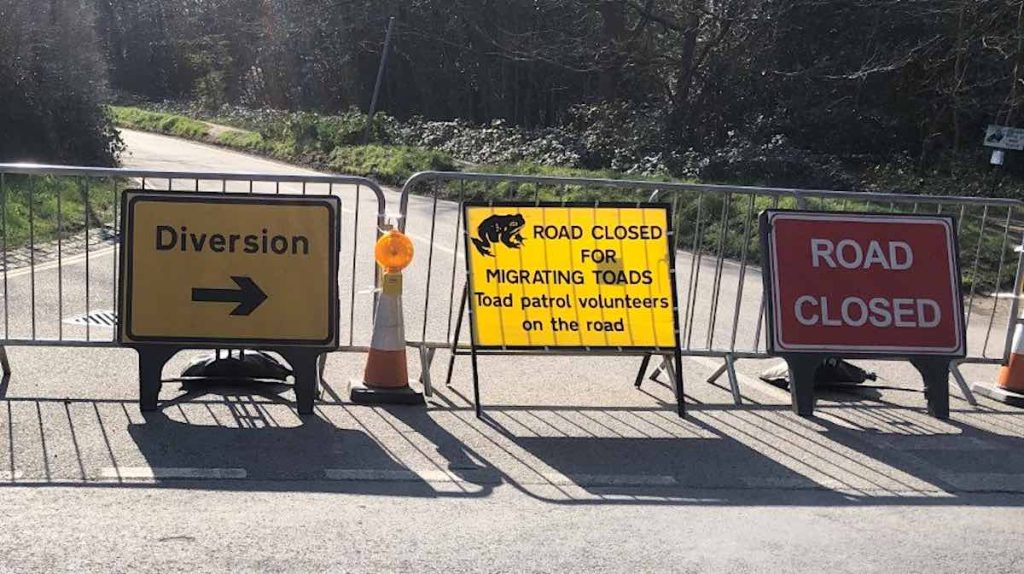
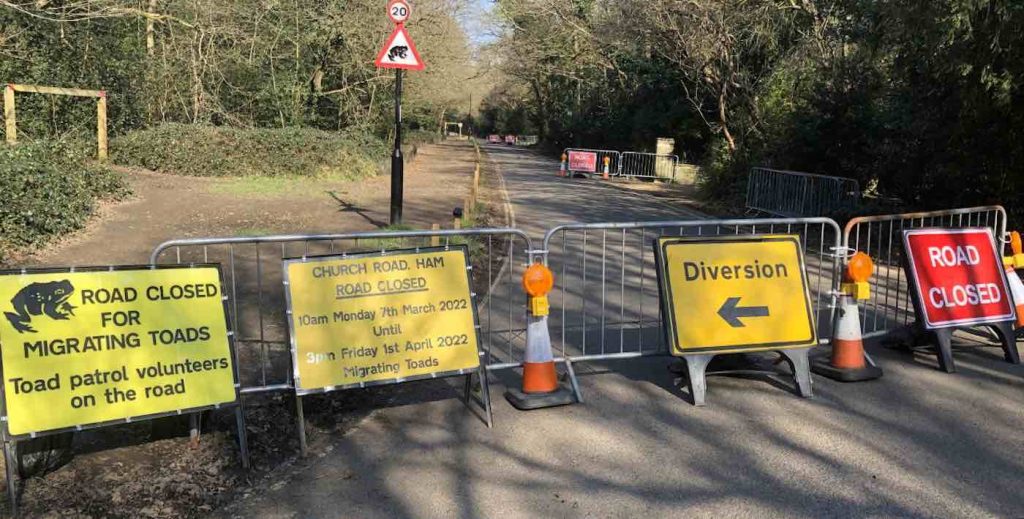
A stretch of road in London has been closed to traffic for more than three weeks to allow toads to cross in safety to ponds where they breed.
A 400-meter (1,300-foot) section of Church Road in Ham, near Richmond is blocked to motorists until the start of April so the creatures don’t get squished on their annual migration.
‘Toad patrol’ volunteers man the road—which meanders through a leafy stretch of Richmond Park—at night, but the road remains blocked off all day. And locals have been heaping praise on the conservation initiative.
The charity Froglife, which is responsible for recruiting volunteers, says the road, which is one of many across Britain that take part in the eco-conscious project, is among just a handful that remain completely blocked off to traffic.
The closure began on March 7, and is due to remain in place until April 1.
A council road traffic order has been issued to block the road.
Part of it reads, “The road closure is intended to allow the toads to cross the carriageway unharmed and to eliminate the risk of accidents if drivers were to be distracted by the presence of these creatures in their path.”
Richmond Council began sealing off the street in 2010 after worried locals wrote to council bosses to warn that creatures were being killed on their annual migration from hibernation to ponds where they breed.
It has become a source of amusement among locals.
They say it is not too disruptive as the road is normally quiet, has few houses along it, and the diversion is not painfully long.
But an earnest sign warning drivers ‘road closed for migrating toads—toad patrol volunteers on the road’ has not stopped passers-by poking fun at it.
A steady stream of walkers has been stopping to take pictures to share with friends.
Retired IT manager Robert Brown, who lives in Richmond, said, “I think it is fantastic. To have that amount of consideration for toads I think is incredible. I have never actually seen any toads and only once saw someone we thought might be a volunteer, but I think it is great… It is a very British thing to do.”
Retired customer services advisor Dorris Watt, from Ham, said, ‘’I think it is a good idea to protect the toads. This is not a road you desperately need to drive down and it has gone on without causing any complaints.
“Only people from outside the area would complain if they can’t park. The toads live here, don’t they, so it’s their right of way?’”
Marketing consultant Liz Workman, from Chiswick, said, “We have to look after our world and our wildlife. Good on them.”
Retired computer programmer Terry Newman, from Richmond, said. “It (the sign) is one of the first things I ever posted on Facebook.
‘’We have ever actually seen a toad there but we think it is brilliant. I love nature and it is a great idea.
Rob Lyons is a UK journalist specialising in science, environmental and health issues. He is the author of 'Panic on a Plate: How Society Developed an Eating Disorder'.
1 Dec, 2021 13:55
Follow RT on
A tech guru warns that robots that think for themselves may take over the world and use weapons of mass destruction to wipe out mankind. Is it time to worry?
This year, the BBC’s prestigious Reith Lectures will be delivered for the first time by a computer scientist. UK-born Stuart Russell, professor of computer science at the University of California, Berkeley, will look at ‘Living with Artificial Intelligence’ in a series of weekly broadcasts during December.
In a trailer for the lecture series, Russell was interviewed on BBC Radio 4’s Today on Monday. As confirmation of the old journalistic adage that “if it bleeds, it leads,” the conversation was dominated by gloomy prognostications about what AI might be doing to our society and even more nightmarish possibilities for the future. Never mind developing machines that can learn – we need to learn from the history of new technologies to treat both hype and horror with equal scepticism.
Artificial intelligence is already in use in society. Computers can guess what we would like to watch next on YouTube, what products we might want to buy on Amazon and show us adverts based on previous internet searches on Google. More usefully, perhaps, machines can learn to identify cancerous growths on medical scans with great speed and accuracy and flag up potentially fraudulent financial transactions – something very useful when banks and other institutions perform astonishing volumes of trades constantly.
Russell believes that AI is “not working necessarily to our benefit and the revelations we’ve seen recently from Facebook suggest media companies know it is ripping societies apart. These are very simple algorithms, so the question I’ll be asking in the lectures is what happens when the algorithms become much more intelligent than they are right now.”
This is an odd way of looking at things – that algorithms rather than human politics are the problem in society right now. Of course, dumb algorithms that push social-media posts to you on the basis that “if you liked that one, you might like this one,” probably don't help in getting people out of their “echo chambers.” But people sticking with their own ‘tribe’ when it comes to politics is mostly about personal choice and unwillingness to accept that people with a different view might have a point, not the work of evil computer algorithms.
Where Russell is really concerned is when AI goes beyond task-specific applications to the possibility of general-purpose AI. Instead of setting computers up to do particular things – like churning through vast amounts of data with a particular goal and learning how to do it better and faster than humans – general-purpose AI systems would be able to take on a wide variety of tasks and make decisions for themselves.
In particular, Russell worries about autonomous weapons that “can find targets, decide which targets to attack and then go ahead and attack them, all without any human being in the loop.” He fears that these AI WMD could destroy whole cities or regions, or take out an entire ethnic group.
Russell cooperated on a startling and scary Black Mirror-style film, Slaughterbots, in 2017, showing one particularly gloomy vision of tiny, bee-like drones selecting and assassinating anyone who dares to disagree with the authorities.
But while some degree of learning and autonomy is in use already – for example, to take humans out of the dangerous business of clearing minefields – the combination of recognising individuals or groups accurately and making decisions about who and how to attack are way beyond current capabilities. As a US drone strike in Afghanistan in August – which killed 10 people, including seven children – showed, it's possible to have hi-tech, intelligence-led attacks that go horribly wrong. Moreover, if political and military leaders have few qualms about killing the innocent, why wait for fantasy AI-powered autonomous weapons when you can just carpet-bomb whole areas, whether it is Dresden in the Second World War or Cambodia in the Seventies?
The all-conquering power of AI is, as things stand, just hype. Take driverless cars. Just a few years ago, they were the Next Big Thing. Google, Apple, Tesla and more poured billions into trying to develop them. Now they’re on the back burner because the difficulties are just too great. A year ago, Uber – once dreaming of fleets of robotaxis – sold off its autonomous vehicles division. As for robots and AI taking over our jobs, at best they will be a tool to improve the productivity of humans. Using computers to do bits of our jobs could be useful, but actually replacing teachers, lawyers or drivers is a whole different ball-game.
Silicon Valley seems to have a schizophrenic attitude to its own technology. On the one hand, the importance of artificial intelligence is exaggerated. On the other hand, we have doom-mongering speculations about AI systems gradually taking control of society, leaving human beings, in Russell’s words, as so much “waste product.” In truth, AI keeps confirming that it is both extremely useful for doing specific tasks and also pretty dumb at anything beyond that.
According to Melanie Mitchell, Davis Professor of Complexity at the Santa Fe Institute, we suffer from multiple misunderstandings about AI. First, specific AI and general AI are completely different levels of difficulty. For example, getting computers to translate different languages has involved an enormous amount of work but text- and voice-based systems are getting pretty good. Getting two AI machines to hold a conversation, on the other hand, is much harder.
Second, many things that humans find easy are really difficult to automate. For example, we’re evolved to scan the world quickly, pick out distinct things and figure out what is important right now. Computers find this extremely hard. Third, humans have a rich experience of the physical world through our senses that, researchers are finding, has a significant impact on how we think. Fourth, Mitchell argues, human beings develop common sense, built on experience and practice. AI systems can chuck ever-greater amounts of processing power at problems, but struggle to replicate that. Elon Musk failed in his attempt to fully automate his Tesla factories – humans were simply irreplaceable for some tasks.
If we could cut out the boosterism about AI, we could see a useful group of technologies that can help us out in specific ways to make our lives easier. Equally, it would burst the bubble of all those catastrophists who think AI systems will take over the world. Ultimately, we’re still in control of the machines and they’re not about to replace us any time soon. With a bit of historical perspective, we can see that the fretting about AI is just the latest in a seemingly endless series of fearful spasms about new technology.
First ‘living robots’ can now ‘spontaneously’ self-replicate, scientists say
30 Nov, 2021 02:24 /
Miniscule biological machines developed by scientists from the cells of frogs – commonly referred to as Xenobots – can now self-replicate, according to a new scientific report.
The Xenobots were made public in a report last year, which suggested the self-repairing technology could be used to replace degradable materials such as concrete, steel, and plastic. Then, in March, it was revealed that the organisms had been improved to be able to remember their surroundings and assemble into a single swarm.
Joshua Bongard, one of the co-authors of the new report, claimed that “with the right design” the organisms “will spontaneously self-replicate,” and proposed that the technology could be used to tackle future pandemics and speed up vaccine production.
Now, an article published in the PNAS journal on Monday suggests that the Xenobots are able to self-replicate.
Sam Kriegman, a lead author of the study, described the process as an entirely new form of self-replicating, noting that “no animal or plant known to science replicates in this way.” The Xenobots were conditioned to procreate by a supercomputer which came up with just the right shape of ideal ‘parents’ after months of laboring at the task, the researcher said. Even though the design, which bears some similarity to Pac-Man, looked counter-intuitive and too “simple,” it proved to be extremely progenitive.
The Pac-Man shaped “parent Xenobots” ended up giving rise to not just one, but several generations, building “great-grandchildren” who, in turn, created “great-great-grandchildren,” Kriegman claimed.
Bongard explained that the speed of replication plays a crucial role for the practical applications of the bots.
“If we can develop technologies, learning from Xenobots, where we can quickly tell the AI: ‘We need a biological tool that does X and Y and suppresses Z,’ —that could be very beneficial,” Bongard explained.
While Bongard insisted that the benefits of the supposedly breakthrough technology outweigh the risks, several reports have raised ethical concerns surrounding Xenobot technology. It has even been suggested that they could be turned into a military bioweapon and assassination tool.
19th-century scientists father and son Anders and Gustaf Retzius have long been celebrated for their contributions to anatomy and histology, but their legacy has been marred by their interest in racial studies currently discarded as "scientific racism".
The Karolinska Institute, Sweden's leading institution for medical research, has decided to rename the street, laboratory, and hall named after famous 19th-century professors Anders Retzius and his son Gustaf.
The stated reason behind the name change is their interest in racial biology, which allegedly reflects a set of values that the institute no longer supports. The institute explained that its firm conviction is that all people are of equal value.
A 23-time Nobel Prize nominee, professor of histology Gustaf Retzius has been celebrated for his contribution to the histology of sensory organs and nervous system, yet is also known for his interest in a branch of racial studies that today is discarded as "scientific racism". His father Anders Retzius, a professor of anatomy and a supervisor at the Karlinska Institute, is credited with a number of anatomic discoveries, including the cranial index. Both the father and the son viewed the Nordic race as the pinnacle of mankind and were known for studying Finnish skulls, which in recent years has become a hot-button issue between the two nations, to prove their point.
"It's hard to find the right balance. The story behind the names is valuable as it can inspire discussion, but one should not praise what Retzius did either. It has been a difficult decision to make, but I think it is necessary", Karolinska Institute Rector Ole Petter Ottersen told national broadcaster SVT.
The statues of father and son will remain, but will be relocated.
"We will relocate and re-contextualise the statues in a context where you see what they did with their views on racial biology", Ottersen explained.
When asked whether more name changes may be relevant in the future, the rector emphasised that his say is not the last one and welcomed a positive discussion.
The Solna-based Karolinska Institute is a research-led medical university and is also known for hosting the Nobel Assembly that awards the Nobel Prize in Physiology or Medicine.
Last year, dozens of memorials and statues seen as tributes to slave traders, colonialists, and racists were renamed or taken down amid Black Lives Matter protests that swept the western world, despite originally being against police brutality in the US.
While the protesters during unrest in the US targeted above others Confederate and Columbus statues, instances of removing the Founding Fathers were not uncommon. Most recently, the NYC Council decided to remove a statue of Thomas Jefferson, citing his history as a slaveholder.#