Monday, 11 January 2021

Namibia: Chinese plunder Kavango trees


Namibia: Chinese plunder Kavango trees


JACOBUS Oma looked sadly at the stockpile of several hundred ancient rosewood logs he had just helped to load onto a Chinese-owned truck in north-eastern Namibia. Some were centuries old, and so large they dwarfed his small frame.

“The children will never see trees like this in their lives again,” he said, recalling how the rosewood's seed pods were traditionally a vital source of food for indigenous San people like himself during the dry season.

Oma had accompanied the teams that felled the trees earlier this year on the boundary of Khaudum National Park in Namibia's Kavango East region, a part of the San ancestral lands.

Back in Nhoma, a sparse collection of buildings on the south-western edge of the park where he lives with his family, Oma told investigative journalism group Organised Crime and Corruption Reporting Project (OCCRP) that he helped load the prized hardwood for one of the Chinese-fronted companies that dominate the illegal logging trade in the area.

“I am not being paid. I am only helping out with the timber loading here,” he said, explaining that he had hoped at least to get something to eat.

The logs are from thousands of protected trees that have been illegally cut down on land leased as “settlement farms” to political elites and war veterans by the ruling Swapo party.

OCCRP found more than a dozen stockpiles of timber along the routes the loggers use, ranging from hundreds to thousands of logs or blocks – squared off trunks, some with the bark still attached. All appeared to be from three protected hardwood species – African rosewood and Zambezi teak.

A forestry expert described the stockpiles, belonging to two Chinese-fronted companies, as evidence of “industrial wood mining.”

Despite a moratorium on harvesting these prized hardwoods in Namibia since November 2018 and a ban on trading in raw timber imposed in early August 2018, the plunder continues.

On two recent road trips through the Kavango and Zambezi regions, covering 6 600 kilometres, an OCCRP reporter saw not a single mature African rosewood tree left standing.

The farm leaseholders could have made as much as N$22 million per year from selling the timber.

But the real winners appear to be the Chinese companies that control the trade, with hundreds of millions of dollars worth of timber exported in just months, according to a government official.

FINISHING THE TREES

A reporter visited Kavango East in October and November 2020. Posing as a prospective wood buyer, he found evidence of illegal logging at every turn, from sawmills operating on the resettlement farms to stockpiles of often-fresh timber along the route. Though no new harvesting permits have been issued since late 2018, local wood brokers assured the undercover reporter that the paperwork would not be a problem.

“You leave it to me, bra,” one broker in the regional capital of Rundu, who gave his name as Lobo, said.

Some farmers said they had plenty kiaat trees on their land just waiting to be felled. But everywhere, the reporter was told that rosewood trees, which have grown in the region for more than 700 years, are now scarce.

“They are finishing the trees now,” said one worker who was running a stockpile for a Chinese company in Tam-Tam, in the middle of the logging region. He claimed the 850 blocks being stored at the depot, had been harvested in June from the last mature rosewood trees in the area.

The harvesting of hardwoods in Namibia is often massively wasteful. Loggers tend to use only the core of the trunks from mature trees, ignoring regulations aimed at preventing uncontrolled large-scale harvesting.

Transport permit records at forestry department offices showed thety were destined for buyers in China, Vietnam, and South Africa.

An internal auditor's report on the logging by the Ministry of Agriculture, Water and Forestry estimated that around 32 000 logs or blocks of protected hardwood – equivalent to around 210 truckloads – were moved from Kavango East to the port of Walvis Bay between November 2018 and March 2019.

Of these, about 22 000 were stored in warehouses and containers near the port, while “about 10 000 blocks were exported to China and Vietnam,” said the report, obtained by OCCRP.

POLITICAL PLUNDER

Around 500 resettlement farms in the region, each covering some 2 500 hectares, were distributed to war veterans and political elites starting in 2005.

The recipients include minister of home affairs, immigration, safety and security Frans Kapofi; a former governor of the Kavango East region; the current mayor of Rundu; and several senior civil servants. They did not respond to requests for comment.

Apollinaris Kanyinga, who worked at the Ministry of Lands and Resettlement at the time and is now a director in the ministry of agriculture in the area, secured five farms for himself and his family in a block close to Khaudum National Park.

Kanyinga insisted that he had nothing to do with his cousin getting a farm next to his own two farms. He admitted he was working for the lands ministry, which allocated the farms then, but denied he was a deputy director.

The poor soil in the region make most of the land unsuitable for crop production. And because the farms lie north of the veterinary cordon fence, they also cannot be used for commercial livestock production.

For 26 years, the difficult terrain and local laws have protected these trees, the last old-growth rosewoods and African teak.

But in 2017, forestry director Joseph Hailwa decided the laws no longer applied to Chinese logging in the Zambezi Forest and the Kavango East region for own-use permits.

With the arrival of Chinese dump trucks that could navigate the terrain, this meant the farms were open for business.

OLD TREES, NEW TRUCKS

One key reason the Kavango East forest was left relatively untouched for decades was the difficulty of driving through the near-impenetrable Kalahari sand to reach them.

Then several Chinese construction companies that are active in northern Namibia started importing 4x6 dump trucks for construction projects.

In October 2018, Hou Xuecheng, the largest of the Chinese timber speculators in Kavango East, who had a long rap sheet for illegally trading in wildlife products, also started posting pictures of these trucks on Facebook.

It is not clear how they ended up in Hou's hands, but by late 2019 – a year after a moratorium on new timber harvesting was issued – he was already using the trucks for his illegal logging operations.

A former manager at his company described how they ran the trucks over the sands, back axles stripped down to single tyres, loading at least 14 trucks per week from the resettlement farms around Kawe. The trucks' distinctive deep, wide tracks could be found all over Kavango East farms.

By 2018, the plunder had started. Pictures of overloaded trucks leaving the area caused a national outcry, prompting former environmental commissioner Teofilus Nghitila to stop issuing new harvesting permits in November that year.

But the logging has continued. The internal agriculture ministry report found that leaseholders had pressed on, with nearly 400 licences to fell between 600 and 1 200 trees per farm being dished out by forestry director Joseph Hailwa, despite farmers not having the legally required environmental certificates.

Hailwa did not respond to a request for comment.

As the auditors pointed out, because the resettlement farms are technically state land, none of the farmers have the right to sell the trees.

“The trees are currently being treated as the private property of the respective farmers,” the report said. “The trees that were harvested by small-scale commercial farmers are state resources and as such should be used to benefit the broader community in the communal areas.”

The report estimated that Namibian farmers could generate around N$24 million per year from selling the rosewood trees.

Minister of environment, forestry and tourism Pohamba Shifeta, however, said (Chinese) timber speculators exported some 75 000 tonnes of wood valued at N$94 million, in the first two months of 2019.

South African hardwood specialist André Swanepoel said the speculators' earnings are likely far higher, as they tend to underdeclare the value of the wood to avoid taxes. He said rosewood would sell for at least N$7 400 per cubic metre on the open market.

Shifeta told lawmakers in October that the plunder was possible because of the legal “grey area” around what constitutes processed timber, which can still be exported, and pledged to tighten regulations. But John Pallett, who is leading a review of the laws for the ministry, said the problem is in the enforcement of these rules – or lack of it.

President Hage Geingob and the ruling Swapo have taken full advantage. At a rally in Kavango East three weeks before the general election in November 2019, he gave permission to farmers to sell any hardwood they had already harvested, despite a ban on transport permits imposed a year before.

WHO IS HOU?

Two Chinese-fronted companies appear to control the illegal trade in the hardwood coming from Kavango East.

Little is known about one of them. But the other is New Force Logistics, run by Hou Xuecheng (also known as José Hou), a Chinese immigrant with a long criminal record.

Hou has made a career out of skirting the edges of the law since his arrival in Namibia in 2001. A decade later, he moved into the illegal timber trade, harvesting in neighbouring Zambia and Angola and moving hundreds of truckloads across their poorly controlled southern borders into Namibia for export to China.

Hou is also suspected of trading in banned wildlife – and getting away with it.

In November 2017, Namibia's Anti-Corruption Commission (ACC) started investigating allegations of corruption levelled against forestry director Hailwa and Hou, confiscating truckloads of his illicitly harvested timber from the Zambezii. But Hou successfully challenged the seizures in court and the charges were dropped.

The ACC declined to comment.

Hou denied to a reporter that he was involved with illegal logging, insisting that Li Weichao worked for someone else. “I only do the transport,” he said.

* This article is produced by the Organised Crime and Corruption Reporting Project (OCCRP), a consortium of investigative centres, media and journalists from eastern Europe, the Caucasus, Central Asia and Central America. https://www.occrp.org/en

https://www.namibian.com.na/97862/read/Chinese-plunder-Kavango-trees

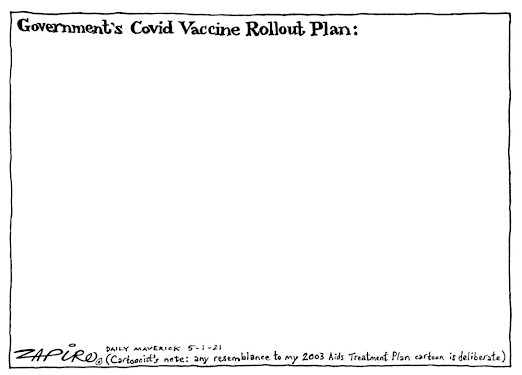
SOUTH AFRICA COVID VACCINE


SOUTH AFRICA COVID VACCINE


https://www.dailymaverick.co.za/cartoon/governments-vaccine-plan/

South Africa: Police arrest man for breaking curfew after emergency trip to buy formula milk for newborn baby


South Africa: Police arrest man for breaking curfew after emergency trip to buy formula milk for newborn baby

Crime Correspondent

Police arrest man for breaking curfew after emergency trip to buy formula milk for newborn baby

A man from Wierdapark, Centurion, Gauteng who did an emergency trip to a 24 hour pharmacy at a hospital to buy formula milk for his newborn baby was arrested by Police for breaking the nightly curfew in the early morning hours on Friday morning 8 January, 2021. This happened just around the corner from his house.

The man tried to explain to the Police that his baby was crying and was just a few days old and he also showed the Police the receipt for the formula milk. The Police still refused the man’s request to take the formula milk home to his wife and they said the man’s wife must walk to where they are if she wants it.

The man’s wife then had to walk in the dark with the baby on her arm to where the Police stopped her husband. The irony of the Police stopping a man for breaking the nightly curfew and then forcing a woman and newborn baby out of the safety of their house into the dark must have bypassed the Police officers involved.

The man was detained at the local Police station and was only released hours later.

https://southafricatoday.net/south-africa-news/gauteng/police-arrest-man-for-breaking-curfew-after-emergency-trip-to-buy-formula-milk-for-newborn-baby/

14th-Century Painting to Sell at Auction Under Restitution Settlement with German-Jewish Art Historian’s Heir

 BY ANGELICA VILLA

www.artnews.com 

 Jacopo di Cione, Madonna Nursing the Jacopo di Cione, Madonna Nursing the Christ Child with Saints Lawrence and Margaret; Predella: the Man of Sorrows, Mater Dolorosa, and Saint John the Evangelist, with two coats of arms,(14th century). Courtesy Sotheby's


A restituted Gothic painting of the Madonna and Child by 14th-century Italian painter Jacopo di Cione will head to auction in New York at the end of the month as part of a settlement agreement between the estate of its late owner and the heir to the work’s previous owner.

Sotheby’s will auction the di Cione painting, which comes from collection of Hester Diamond, the late New York art patron and interior designer who died last January, on January 29 as part of its Masters Week, in which the house offers a series of sales of Old Masters art and antiquities. The work is expected to fetch between $300,000–$500,000. The painting’s sale comes after a legal agreement was reached with the Diamond estate and heir of August Liebmann Mayer, a prominent German Jewish art historian and curator who was killed at Auschwitz in 1944.

A specialist in Spanish and Italian art of the 16th and 17th centuries who served as chief curator of the Bavarian State Painting Collection and taught at the University of Munich in the years leading up to World War II, Mayer acquired the soon-to-be-auctioned di Cione work from prominent Berlin dealer Paul Cassirer sometime after 1927.

Mayer resigned from his curatorial post in 1931 and eventually fled to France in 1935, despite begin arrested by the Nazis two years earlier. While in Paris, Mayer continued working as an art historian under the pseudonym Henri Antoine, but he still faced Nazi persecution in France and fled Paris for the French countryside several times until his arrest and deportation in 1944. In May 1942, Mayer’s Paris residence was seized by the ERR (Einsatzstab Reichsleiter Rosenberg), the Nazi art-looting organization, and a portion of his holdings, including his extensive library, were sent to Berlin.

A portion of Mayer’s collection was sold through Hugo Helbing auction house in Munich in November 1933, including the famed 16th-century painting Still Life with Game Fowl by Juan Sánchez Cotán, which now resides in the permanent collection of the Art Institute of Chicago. It is unclear if the di Cione work was sold during this auction.

“We do not know exactly how or when the Jacopo di Cione left the Mayer collection,” Lucian Simmons, vice chairman and worldwide head of Sotheby’s restitution department, said in an email to ARTnews. “All we know is that it was after 1927.”

The di Cione work resurfaced after the war as part of the Pardo collection in Paris from 1966-68. (The Pardo ownership was uncovered during Sotheby’s research process into the di Cione as part of bringing it to market for the upcoming sale, but further details around the collection are unknown.) The small-scale altarpiece was sold at Christie’s London for £55,000 ($101,706) in 1988, then attributed to the Master of the Ashmolean Predella. Diamond then acquired the work privately through dealer Harari and Johns, Ltd in 1989. The reattribution to di Cione was recently provided by scholar Larry Kanter.


Lazy loaded image August Liebmann Mayer. Courtesy Sotheby's


In the present case, Sotheby’s served as a liaison between the Diamond estate, represented by Bill Charron, a partner at Pryor Cashman LLP and Mayer’s heir, his daughter Angelika B. Mayer, who is based in California. The two parties reached a settlement, with undisclosed terms, to bring the work to auction. The di Cione work is not the first work from the Mayer collection to be repatriated; in 2015, a 17th-century portrait by Giovanni Battista Moroni, held for decades by the Louvre Museum was returned to Angelika Mayer. In 2016, the Munich-based Bayerische Staatsbibliothek returned three books seized from Mayer to his daughter; she subsequently donated the titles to the library and in 2010, the Bavarian State Paintings Collection returned four recovered works to the Mayer family.

Sotheby’s has recently seen a string of restituted lots outperform, which could be the case with this di Cione work. In July, during the houses hybrid live-streamed “Rembrandt to Richter” sale, a recovered 16th-century cassone panel depicting a battle scene by Italian renaissance painter Paolo Uccello went for £2.4 million ($3.3 million), against an estimate of £600,000-$800,000—setting a new benchmark price for the artist. Like the present work, the Uccello was sold under a settlement between the owners and the heirs of Fritz Gutmann.

In October, Sotheby’s announced plans to sell Diamond’s collection of Old Master and contemporary art, estimated at a total value of $30 million. Diamond, along with her husband Harold, originally started out as collector of modern and  contemporary art, but she switched focus to Old Masters following Harold’s death in 1982. A longtime benefactor of the Metropolitan Museum of Art in New York, the di Cione painting is one of several Diamond loaned to the Met during her lifetime. During an extended trip to China in 2006, Diamond loaned the present work along with a selection of others from her holdings to the museum, according to Maryan Ainsworth, curator emerita of the museum’s European paintings department.

If the di Cione altarpiece once owned by Hester Diamond meets its high estimate of $500,000, it will be among the top three works by the Renaissance artist to ever sell at auction. The current record price for the artist is $965,000, when a similar Madonna and child panel, from the collection of fashion designer Fabrizio Moretti, sold in January 2015 at Sotheby’s New York.

Other works in the January 29 sale at Sotheby’s include Pietro and Gian Lorenzo Bernini’s painting Autumn (1616), estimated at $8 million and $12 million and poised to break the artists’ record; a 16th-century triptych by the Flemish master Pieter Coecke van Aelst, estimated at $2.5 million–$3.5 million; and two 16th-century paintings by Italian Renaissance artist Giovanni di Niccolò de Lutero (also known as Dosso Dossi) that were commissioned for an Italian noble, and are also being sold from the Diamond collection. Both are estimated at $3 million–$5 million.


Sunday, 10 January 2021

Sharing Leftover Meat With Wolves May Be Why Dogs Are Our Best Friends Today

 www.iflscience.com

By Stephen Luntz


OUR ALLIANCE WITH DOGS MAY HAVE COME ABOUT BECAUSE HUMANS COULDN'T HANDLE ALL THE PROTEIN IN ANIMALS THE LIVED ON IN AN ICE AGE WINTER, AND LEFT THE LEANEST CUTS FOR WOLVES.


Looking at the selfless love our canine companions often bestow on humanity many people have asked: “What did we do to deserve dogs?” The answer may be not being able to handle a high-protein diet.

Considering the importance of canine companionship to human success, we don’t know much about how it happened. We know that dogs split from their wolf ancestors between 27,000 and 40,000 years ago, and that dogs became domesticated sometime between 18,000 and 30,000 years ago, with the earliest known pet dog burial dated to 14,200 years ago. We don't know whether domestication happened once or twice, though, let alone how we came to love what had once been a rival and threat. After all, even after we had made dogs part of our homes, the “big bad wolf” lurked in our nightmares and fairy tales.

The most popular theories for how canine domestication came about involve cooperative hunting with wolves, or lurking around campfires for waste (them, not us). Dr Maria Lahtinen of the University of Helsinki in Finland points out that the more wolves competed with our ancestors, the less likely we were to tolerate their presence nearby. She sees overlap in diet as the key measure of how strong this competition would have been.

In Scientific Reports, Dr Lahtinen points out all the earliest examples we have of dog burials come from Arctic or sub-Arctic sites towards the end of the last Ice Age. Winters were so fierce at the time humans would have had few plants to supplement meat-rich diets.

Moreover, she notes, the human liver cannot handle a diet too high in protein, a legacy of our herbivorous heritage. In summer with abundant fruits, nuts, and seeds this would not have been a problem, but Lahtinen argues fatty cuts would have been preferred over leaner meat come winter.

Wolves have no such restrictions. Although partial to blueberries in season, they can live on a diet of nothing but protein-rich meat for months if necessary.

Lahtinen looked at the protein content of all species considered to be winter prey in late Ice Age north-central Eurasia. Aside from weasels, all were so protein-rich people would have needed a part-vegetable diet to digest the leanest cuts. Why not give what was left for the wolves?

For some prey, such as adult caribou, the excess protein is small and probably insufficient to form the basis of a lasting relationship. However, rabbits and bison are so protein-rich there would have been plenty to share.

Wolves fed on meat humans didn’t want would have posed less threat to the prey we did, and as time went on the close relationships forged over a carcass made room for companionship and joint hunting. In summer the mixed diet would have allowed humans to eat the leanest cuts, but with abundant food available, it would have been easy to leave some aside for our winter friends.


World News: Hezbollah denies links to tons of amphetamines seized in Italy


Hezbollah denies links to tons of amphetamines seized in Italy


Nasrallah stressed that Hezbollah would "fire any young man in the party if it becomes evident that he is using drugs in any way."


By Tzvi Joffre,  Jerusalem Post,  January 10, 2021

An Italian  customs officers displays confiscated Captagon pills (photo credit: REUTERS)

Hezbollah Secretary-General Hassan Nasrallah denied on Friday that the terrorist organization was involved in the drug trade from Syria, including a shipment of the amphetamine Captagon that was seized by Italian authorities in the summer, according to the BBC.

The Italian authorities said during the summer that they had seized about 14 tonnes (15.4 US tons) of the amphetamine Captagon arriving from Syria – about 84 million pills, worth around $1 billion – in what they described as the world’s single largest operation of its kind.

The Italian police initially thought that Islamic State was behind the transaction. But after digging further, they pointed the finger at the regime of Syrian President Bashar Assad and his close Lebanese ally, Hezbollah.

“The issue of drugs in Hezbollah is a legal issue, and it is categorically forbidden to use, trade in, manufacture or help with this,” said Nasrallah during a speech on Friday.

Nasrallah stressed that Hezbollah would “fire any young man in the party if it becomes evident that he is using drugs in any way.”

“We must find a solution for the media that deals with this issue, especially for the Lebanese media,” added Nasrallah. “This Lebanese contribution to this false and fabricated case against the party is something that cannot be tolerated in any way, because you show that we are criminals and murderers, and we do not accept that anyone accuses us in this way.”

The Hezbollah-affiliated Al-Manar news attacked The Jerusalem Post for publishing a report on the alleged Hezbollah link to the amphetamines seized in Italy, calling it a “fabricated report” and claiming that Italian authorities did not even comment on the reports.

According to the BBC, Italian authorities refuse to comment publicly on who they believe is behind the production of the seized drugs.

Reports of Hezbollah’s involvement in the drugs seized in Italy appeared as early as August, with The Washington Post reporting that intelligence officials had found that the Captagon had originated in areas controlled by the Assad regime in Syria and departed Syria through Latakia, a known hub for smuggling operations by Hezbollah.

Although the investigation is ongoing, investigators believed that the Captagon seizure fit a pattern of drug cases in the Middle East and Europe that were linked to Hezbollah, according to The Washington Post. Captagon has been involved in a number of drug seizures linked to Hezbollah.

“They have stepped up the whole business with Captagon. There is no doubt about that,” said a Middle Eastern intelligence official to The Washington Post in August.

The European law enforcement agency Europol warned in June that Hezbollah operatives were believed to be “trafficking diamonds and drugs” in European countries.

A source in the Guardia di Finanza, the Italian finance police, in Salerno told Arab News that the Captagon seizure “could be linked to Lebanese group Hezbollah, even though we are still investigating the case.”

Used in the 1960s to treat depression and the sleep disorder narcolepsy, Captagon is one of several brand names for fenethylline hydrochloride, a drug compound belonging to a family of amphetamines that can inhibit fear and ward off tiredness.

Captagon is popular in the Middle East, and widespread in war-torn areas such as Syria, where conflict has fueled demand and created opportunities for producers. 

It said Captagon was known as the “drug of the jihad” after being found in terrorist hideouts, including one used by the Islamists who killed 90 people at the Bataclan theater in Paris in 2015.

Reuters and Jerusalem Post Staff contributed to this report.

This page was posted by Sputnik One of the Sputniks Orbit blog

Please Recommend this page and follow us at:

Goldboro LNG plant slated to be largest project in Nova Scotia’s history

Grant Cameron January 8, 2021
https://canada.constructconnect.com/dcn/news/projects/2021/01/goldboro-lng-plant-slated-to-be-largest-project-in-nova-scotias-history


Calgary, Alta.-based Pieridae Energy is gearing up to build a massive, multi-billion-dollar liquefied natural gas (LNG) processing facility near the small community of Goldboro in Guysborough County, Nova Scotia, about 250 kilometres northeast of Halifax.

Construction of a $720-million workcamp and amenities at the site could begin this summer if all goes according to plan. The plant is being built on a 266-acre project site at the mouth of the Maritimes Northeast Pipeline.

The Goldboro LNG plant would take four years to build and be the largest project in Nova Scotia’s history, putting 3,500 men and women to work during construction and creating 280 permanent jobs once the facility is up and running.

Mark Brown, vice-president, business development at Pieridae, confirmed plans for the project, which has been in the works for years, are moving ahead and the company is pleased with the way it’s proceeding.

The site has been cleared, he noted, and Pieridae has signed a services agreement with global engineering firm Bechtel to deliver a comprehensive engineering, procurement, construction and commissioning (EPCC) execution plan by March 31 and a final lump sum, turnkey price proposal by May 31.

Goldboro LNG is a shovel-worthy and shovel-ready project that will create thousands of jobs,
— Alfred Sorensen
Pieridae Energy


“Bechtel is completing the open book estimate for a lump sum turnkey EPCC contract,” and the company is looking to complete its work by the second quarter of 2021, he wrote in an email to the Daily Commercial News.

On its website, Natural Resources Canada has the project pegged at $8.3 billion, which would make it the most expensive of three LNG import or export facilities proposed for Nova Scotia. Detailed design and costs for the plant should be known by spring. Commercial operations are expected to start in late 2025 or early 2026.

Pieridae CEO Alfred Sorensen says the decision to have Bechtel come up with a plan is a very positive step forward for the project, as the company has significant experience building and delivering global LNG projects.

“Goldboro LNG is a shovel-worthy and shovel-ready project that will create thousands of jobs and help put Canadians back to work in a COVID-impacted environment, provide real, enduring and tangible economic benefits for First Nations, help lower global emissions by supplying LNG overseas to replace coal, and increase Europe’s choices in sourcing natural gas,” he said.

Bechtel’s oil, gas and chemicals president Paul Marsden said the company is honoured to partner with Pieridae to deliver a cleaner energy future.

“We bring a long history of successfully delivering projects in Canada and partnering with our global customers to expand access to this energy source. Together with Pieridae, we look forward to successfully bringing this project and its economic benefits to the Goldboro region.”

Pieridae has been pressing ahead on the project and in the fall awarded a contract for construction of the workcamp to house about 5,000 workers who will build the plant, to Black Diamond Group of Calgary. Units in the workcamps would be single-occupancy bedrooms with private baths.

Under the agreement, Black Diamond was directed to conduct meaningful engagement with the Nova Scotia Mi’kmaq First Nations, which would result in Mi’kmaq companies being hired to provide catering and cleaning services at the camp. Black Diamond will be responsible for the supply and rental of the work camp.

Pieridae indicated in corporate guidance for 2021 released recently that it has allocated $10 to $15 million for development expenses in 2021 and a further $250-to-$300 million capital expenditure budget that would be triggered if a final investment decision is declared by the end of June to proceed with the project.

The expenditures would be for early works at the LNG site such as highway realignment around the project, a down payment for construction of the large-scale workforce lodge, building key marine facilities for LNG offloading, and site preparation for areas to store equipment and building materials.

According to Brown, the plant is being built in Nova Scotia because it is a superb location for shipping LNG to markets mostly in Europe. Goldboro is half the distance to Europe and closer to South America and South Asia (via the Suez Canal) compared to ships coming from the U.S. Gulf Coast and Qatar.

The plant will have two liquefaction facilities, also known as trains, producing a total of about 10 million tonnes of liquefied natural gas each year, along with two storage tanks, two loading berths, a power plant, and several administration, control and maintenance facilities and utilities to support the project.

Production from the first train has been sold to German utility Uniper Global Commodities It’s a 20-year binding contract with a 10-year extension. Uniper wants to ease its reliance on supply of LNG from Russia. Germany has plans to end coal-fired power generation by 2038 and will be turning to natural gas.

The National Energy Board and U.S. Department of Energy has granted Pieridae 20-year licences to import natural gas from the United States and export it as LNG from the Goldboro facility.

As part of a commitment to fair labour practices, Pieridae has signed a project special needs collective agreement which encompasses 15 trade unions in Nova Scotia.


Recommend this post and follow The Coconut Whisperer

https://disqus.com/home/forum/the-coconut-whisperer/