James Myburgh says the NYT got the farm murder/EWC issue completely wrong in its attack on the Fox News host
At the end of April The New York Times ran a three part series by Nick Confessore that sought to prosecute the case that Tucker Carlson, the host of the show “Tucker Carlson Tonight” on Fox News in the United States, had constructed “what may be the most racist show in the history of cable news.”
Among the incidents that Confessore used to make his argument were the segments Carlson ran on the issue of farm murders and looming land seizures in South Africa through the course of 2018. Confessore focused here on Carlson’s segment on 15th May 2018 where he invited Ernst Roets of AfriForum to appear on his show to talk about the problem of farm attacks in South Africa and the ANC government’s indifference to them. Carlson introduced the segment as follows:
“Well, now to a fascinating and significant story the media have all but ignored. South Africa is a diverse country, but the South African government would like to make it much less diverse. An embattled minority of farmers, mostly Afrikaans-speaking, is being targeted in a wave of barbaric and horrifying murders. But instead of protecting them, the government just passed a law allowing it to seize their farms without any compensation based purely on their ethnicity, and distribute those farms to more favoured groups. Thousands have already migrated out of the country, but they have struggled to attract any sympathy abroad for some reason.”
Addressing Roets Carlson stated, “you describe in this book a disorganized but in some sense intentional campaign to crush a racial minority within your country, and the government seems on-board with it. Is that an overstatement?”
According to Confessore this segment “jolted even his more jaded Fox colleagues”. He reports that “During a subsequent meeting of Fox’s senior executives, Brian Jones, president of Fox Business Network and the highest-ranking Black man in Fox leadership, explained that almost everything Mr. Carlson was saying on the air was wrong.” In Confessore’s telling Carlson’s description of the situation in South Africa was factually baseless, and simply the product of the fevered imaginings of white racialists in the US.
There was certainly a lack of precision in Carlson’s framing of the situation in South Africa in his segments, but Confessore manages, in his long-researched response, to lever in a number of far more questionable claims. These relate both to the ANC and EFF’s effort to amend the constitution to explicitly allow for Expropriation Without Compensation, and to the issue of farm murders as well.
To understand where Carlson and Confessore went wrong – and the relative weight of their errors - it is necessary to sketch the historical and political context that most New York Times readers would be completely unfamiliar with.
I
Julius Malema, the self-styled “Commander in Chief” of the Economic Freedom Fighters has, from the time he was leader of the ANC Youth League, been calling for the constitution to be changed to allow for expropriation without compensation, to enable the confiscation of white-owned land and wealth. This was not a new demand, but an old ANC one, with Malema demanding that the liberation movement set about finally bringing to completion its historic mission, as Robert Mugabe and Zanu-PF had done (with ANC support) in Zimbabwe in the early 2000s.
In his speech outside the court in Newcastle in November 2016 – where he famously stated that “we are not calling for the slaughtering of white people, at least for now” – Malema reiterated that the EFF’s strategic objective was “the defeat of White Monopoly Capital” something which meant “the ownership of property must change and be transferred into the hands of the people [meaning: the black African majority]. The mines must be nationalised! The banks must be nationalised! The land must be expropriated, without compensation!”
He further added that ultimate victory would only be achieved “if the land is restored in the hands of rightful owners. And rightful owners unashamedly is black people. No white person is a rightful owner of the land here in South Africa and in the whole of the African continent. This is our continent, it belongs to us.” He concluded this address by stating that the people who really belonged in court were “all those whites who stole our land. But white minority’s be warned, we will take our land. It doesn’t matter how. It is coming unavoidable, it is coming inevitable. The land will be taken by whatever means necessary. This land will be returned to black people.”
Early the following year Malema and the EFF introduced a resolution in the National Assembly calling for the amendment of Section 25 of the constitution to allow for the seizure of white-owned land without compensation. Malema stated, “We all know that the Dutch gangsters arrived here [in 1652] and took our land by force and the struggle has since been about the return of the land into the hands of rightful owners”. He complained that the “white people” still owned much of the land and called on the ANC to “come with the EFF - there is 6% available, we give it to you with no condition to amend the Constitution and take the land.”
The resolution was voted down by the ANC and other parties. Shortly thereafter however President Jacob Zuma appeared to respond positively to such an offer from the EFF. He told the National House of Traditional Leaders in Parliament that “a single law should be developed to address the issue of land restitution without compensation. The necessary constitutional amendments would then be undertaken to effect this process. That’s why we need to accept the reality that those who are in Parliament where laws are made, particularly the black parties, should unite because we need a two-thirds majority to effect changes in the Constitution.”
This cause was then taken up by Zuma’s unpopular and kleptocratic Radical Economic Transformation (RET) faction of the ANC. This was in an effort to racially outbid the rival faction led by Cyril Ramaphosa, whom it was seeking to paint as an agent of “White Monopoly Capital”, ahead of the contest for control of the organisation at the national conference in December 2017.
In the event, Ramaphosa narrowly won the election for the ANC Presidency. His slate did not sweep the board, and the leadership that emerged from the conference was evenly divided, with Ace Magashule elected to the critical position of ANC Secretary General. At the instigation of the RET faction the conference also passed a binding resolution stating that the “ANC should, as a matter of policy, pursue expropriation of land without compensation.” The Ramaphosa grouping, in turn, managed to secure the insertion of the limiting proviso that “This should be pursued without destabilising the agricultural sector, without endangering food security in our country and without undermining economic growth and job creation.”
In February 2018 Malema once again introduced a resolution in the National Assembly, this time calling for the establishment of an ad hoc committee “to review and amend section 25 of the Constitution to make it possible for the state to expropriate land in the public interest without compensation.” In his speech Malema again made very clear that this was about seizing the land still held by the white minority. “If the grandchildren of Jan van Riebeek [the whites] have not understood that we [black Africans] need our land, that over and above, it is about our dignity, then they have failed to receive the gift of humanity.”
This time the resolution passed, in amended form, by 241 to 83 votes with the support of both EFF and ANC MPs. At the time the EFF and ANC had 274 (or 68,5%) of the seats in the National Assembly between them, more-than-enough to ultimately amend the constitution, though an extensive process involving public consultation would have to be followed before this could be finalised. The proponents of EWC in the ANC and EFF were not shy about expressing their racially chauvinistic intentions. For the RET ANC too “the return of the land to the rightful owners, who are the indigenous Blacks and Africans in particular from whom the land was stolen is a critical imperative.”
In his segment, which aired in May 2018, Carlson misstated the point that had been reached in the process - a constitutional amendment had been initiated by a vote of a super-majority in the National Assembly - but it was not yet law. He was not wrong about the intentions behind it.
In his response to Carlson Confessore claims though that the Bill was “intended to reverse apartheid-era land dispossession”. This is incorrect. Section 25 of the Bill of Rights of the 1996 Constitution already stated that: “7. A person or community dispossessed of property after 19 June 1913 as a result of past racially discriminatory laws or practices is entitled, to the extent provided by an Act of Parliament, either to restitution of that property or to equitable redress.”
A similar provision was also contained in the interim of constitution of 1993, a law was adopted in this regard in 1994, and since then an extensive land restitution process had been pursued, in which the ANC government had sought to interpret the relevant constitutional provisions in the most expansive manner possible. By 2019 3,5m hectares had been restituted and financial compensation provided in lieu of the land for an area covering another 2,9m hectares. Another 4,5m hectares had been racially redistributed.
In other words, most apartheid-era dispossessions had already been reversed. The EFF and ANC RET faction’s push for a constitutional amendment had little to do with this process of redressing old apartheid-era wrongs. As documented above it was explicitly aimed at achieving an overtly chauvinistic black nationalist project of dispossessing white South Africans on the basis of their race.
Confessore’s further claim that there was nothing racial about all this and “the proposed amendment did not target farmers on the basis of their race or ethnicity” is completely unhinged from reality. That this false claim could make it all the way through the New York Times’ editorial process uncorrected just makes Carlson’s point about how blind much of the Western media was to critical but morally discomforting developments in South Africa.
II
On the issue of farm murders there is a deeper history to the matter that needs to be understood. Between 1984 and 1987 the ANC/SACP in exile had sought to incite the black African population within South Africa to rise up and attack farmers, rob them of their weapons, sabotage the working of the farms, and ‘seize the land!’ At the Kabwe conference in mid-1985 the ANC leadership, including Thabo Mbeki and Jacob Zuma, also formally mandated the ANC’s armed wing, Umkhonto we Sizwe (MK), to target farmers through guerrilla warfare, and particularly through the laying of landmines.
This was not an order that ran against the grain in the liberation movement. The conquest and settlement of large parts of the South African interior by the Boers (followed by the British) in the mid nineteenth century was regarded by the ANC as one of most burning historical grievances of the black African majority. MK’s great anthem, Hamba Kahle Mkhonto, contains the line “We as soldiers of Umkhonto we Sizwe are determined to kill these Boers”.
A series of killings occurred at this time, both by MK guerrillas and self-organised units of pro-ANC “fighting youth”, but this attempt to take ungovernability and the armed struggle out of the townships and into white farming areas was frustrated by the security services and was then called off by the ANC in late 1987.
After the unbanning of the liberation movements by President FW de Klerk in early 1990 and the dismantling of the country’s repressive apartheid-era security laws, there was a wave of farm attacks and murders, running far ahead of the more general rise in political unrest and criminality, especially in the Midlands of Natal and the border areas of the Eastern Cape. This was a new phenomenon and was reported on as such in the local press.
In 1991 the South African Agricultural Union (now Agri-SA) started collecting statistics on farm attacks and murders, a function later taken over by the police. From press reports and other sources there appear to have been about thirty farm murders in 1990. This number doubled by 1991 and continued to increase in the years after.
Many of the farm murders recorded in this period by the SAAU were subsequently confirmed to be politically and racially motivated. A number of MK members and ANC activists later applied for amnesty for attacks on farms in the early 1990s (and mid-1980s) even though the ANC disclaimed any formal policy of targeting farmers at this time. The Pan Africanist Congress’ armed wing APLA – whose slogan was “one settler, one bullet” - conducted numerous operations against white farmers in the 1991 to 1993 period in which many people were murdered, and for which some of its members and supporters were convicted and imprisoned, and so later had to apply for amnesty. Almost all of these cases also involved some element of robbery.
In 1994 the ANC entered into power after triumphing in the elections of 27th April and many of the same ANC leaders and operatives who had been involved in formulating or executing the decisions of the mid-1980s to go after farmers were either promoted into high political office or senior positions within the state security services. Members of APLA were also integrated into the military and, even though the PAC rapidly disappeared as a political force, a number of the members of the APLA high command were given high ranks in the SANDF.
As political unrest and violence subsided post-1994 there was not a concomitant decline in the murders of farmers. Instead, these practically doubled, from 84 in 1993 to 142 in 1997. In the late 1990s it was also the focus of much press reporting in the international media. For instance, Suzanne Daley of The New York Times reported in July 1998 that:
“Attacks on the farmers have been mounting. In the last four years, nearly 500 have been killed. Since January there have been 371 attacks on farms resulting in 75 deaths. Some assaults have been particularly brutal. In May, for instance, a 60-year-old farmer recovering from a hip replacement operation was tortured and had his throat slit; he died as he sat in his wheelchair. The intruders then waited an hour for his 52-year-old wife to get home; they raped her and killed her, too. The farmers may well be feeling the heat of a crime wave that has swept across this country. But many farmers believe that the attacks are more calculated -- the work of black militants aiming at a group that remains among the most right-wing in the country.”
The response of the ANC government to the suspicions of farmers that elements within the liberation movement were covertly seeking to keep the pot on the boil was essentially “prove it”. Despite some efforts, this could not be done. President Mandela for his part listened to concerns, a rural safety plan was adopted, summits were held, and academic-style studies were conducted. At a summit on the matter in October 1998 Mandela acknowledged that while “killings on farms, like crime in general, have been a feature of South African life for many decades, the incidents of murder and assault in farming areas have increased dramatically in recent years.”
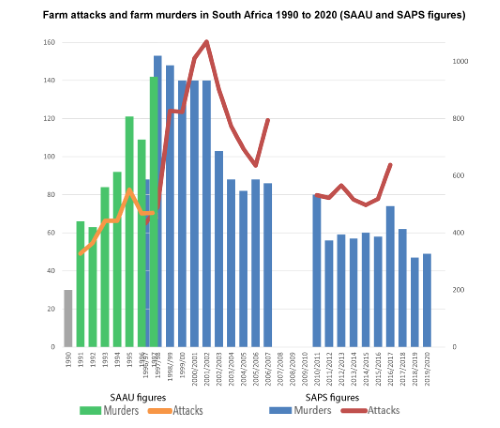
The actions taken by Mandela’s government were ineffective, with the number of farm murders remaining at over 140 a year up until 2001, when the number of recorded farm attacks peaked at 1011. To put this violence in context there were about 60 000 commercial farms in 1996, divided roughly evenly between the more arid western and the far more fertile eastern half of the country. The 3 499 farm attacks recorded in the four years between 1998 and 2001, in which 577 people were murdered, were overwhelmingly concentrated on those farms and smallholdings in the eastern half of the country, with farms in KwaZulu-Natal and Mpumalanga being particularly hard hit.
The number of ‘farm murders’ then declined to under 90 a year by the mid-2000s, a level they maintained until March 2007, at which point the SAPS suspended the collection and publication of these statistics. By this time the number of commercial farms had fallen by about a third to 40 000.
The SAPS started publishing figures again from 2010/11 onwards. Only 56 farm murders were recorded in 2011/12, the year following the Football World Cup. These continued at this level until a pronounced increase in farm attacks and murders was recorded in 2016/17. In 2017, the year before Carlson’s broadcast, there were some 75 people killed in attacks on farms and smallholdings, of whom 63 were white.
"Wave" is not the best term to describe an ongoing three-decade-old problem in South Africa. But there is little doubt that since 1990 those living on farms and small holdings have been - and continued to be - attacked and murdered in unnaturally high numbers in often brutal and horrifying ways.
Confessore acknowledges in his critique of Carlson that the police “record dozens of murders of whites” on farms and smallholdings each year. He says however that the “vast majority” of the victims of violent crime in South Africa are black. The point sometimes made, which Confessore appears to be echoing, is that 63 murders is a tiny proportion of the 20 000 murders that were committed in 2017. The suggestion being that whites on farms and small holdings are no more likely to be killed in violent criminal attacks than anyone else. The notion that white farmers were being “singled out for attack”, Confessore concludes, was thus one “largely confined to the far-right web”.
This latter claim is simply not correct. The notion that farmers in the eastern half of the country are particularly vulnerable to murderous attack is widely accepted in South Africa by the affected communities, and the organisations and political parties that represent them. This is a view both derived from personal experience and it is one borne out by the data, when interpreted correctly.
According to StatsSA, South Africa’s official statistical agency, black Africans made up 80% of the South African population in 2017, whites 8%. The number of white commercial farmers was 36 977, with about 125 000 whites living on farms or small holdings involved in some kind of agriculture. This community constitutes less than five percent of the white population and less than half a percent of the total population.
It would certainly be surprising if the “vast majority” of murder victims did not come from the 99,5% of the population who are either not white or not living on such farms or smallholdings. The question rather is whether people from this community have been disproportionally "targeted" by violent criminals.
Efforts to prove this have historically focused on the murder rate of farmers versus the national murder rate. The argument of government apologists seeking to downplay the problem has traditionally been that it is just not possible to “calculate a farm murder rate”, so the comparison can’t be done. This is not correct, but in any event it is the wrong measure.
The great majority of the approximately 20 000 murders committed every year in South Africa, where causative factors can be established, are the product of interpersonal disputes and arguments. People often get into fights, especially when intoxicated, and usually with people they know, these escalate into aggravated assaults, and somebody ends up dead. There are a further thousand people killed every year in intra-gang violence, and about the same number of suspected criminals lynched by mobs. These numbers and proportions remain fairly consistent year-by-year, changing only incrementally.
According to the SAPS there were 51 825 cases of common robbery and 143 990 cases of armed robbery reported in 2019/20. Of the latter 21 130 were robberies of residential premises. There were 1 061 murders (out of a total of 21 324) linked to these 195 815 incidents. This is a ratio of one murder to every 181 reported robberies.
Historically, the great majority of farm attacks – including the provably political ones of the mid-1980s and early 1990s – have involved robbery as either a primary or secondary objective of the perpetrators. In 2017, of the 63 murders of whites on farms or smallholdings that year some 50 clearly involved robbery. This represents 5% of the approximately 1 000 people killed during reported robberies that year.
Given that this community constitutes under half a percent of the total population this is an extraordinary disproportion. In addition, the ratio of farm murders to farm attacks has historically ranged from one-to-six to one-to-ten, which is also hugely disproportionate to the murder-to-robbery ratio more generally.
III
So, Confessore is wrong both to deny the racialist intentions behind the proposed constitutional amendment and the existence of the farm murder problem. This leaves his last point, that some racial lunatics in the United States have misused the (real) issue of farm murders in South Africa to promote their own apocalyptic “white genocide” narrative, which Confessore describes as “a neo-Nazi trope dating back to the end of apartheid”.
Though the term “white genocide” may be used by the far-right fringes in the United States and Europe, it is not one that enjoys the support of any organisation of any standing or authority within South Africa. It is recognised as false, deeply toxic, and counterproductive.
AfriForum, which collects and publishes detailed information on farm attacks and murders disclaims the term – something confirmed by repeated rulings of South Africa’s Press Ombudsman. Ernst Roets himself has explicitly rejected it, something which Confessore acknowledges in his piece.
So, Confessore was unable to even make the claim that a proponent of the ‘white genocide’ view had actually been invited onto Carlson’s show to discuss the issue of farm murders.
He nonetheless goes on to condemn Carlson’s decision to “dig in”, and provide continued coverage of these matters through 2018, despite the pushback he had received from inside and outside Fox News. This applied especially to the segment he aired in late August, which provoked a Trump tweet on these topics.
Earlier that month, on 1st August 2018, ANC President Ramaphosa announced that the party’s NEC had recommitted itself to changing the constitution to allow for EWC, although he argued that this was arguably already implicit in the constitution as it stood. City Press reported that in order to test this the NEC had “given the green light to its deployees in government, specifically the department of rural development and land affairs, to forge ahead with the process at the Land Claims Court, in which the state will for the first time refuse to pay market value for identified land portions in various parts of the country.”
The newspaper stated that “The ANC has targeted 139 selected farms that they plan to expropriate without compensation in the coming weeks as it moves to make good on its commitment to test out section 25 of the Constitution.” This list was leaked to AfriForum, which then published it. There was also an effort by the Department to take over Akkerland Boerdery in Limpopo for only 10% of its market value.
It was these developments which Carlson then dealt with on his show in late August 2018, where he interviewed Marian Tupy of the Cato institute, an expert on and outspoken critic of Mugabe’s racial land seizures of the early 2000s. He introduced the segment by stating that the ANC government’s move to seize the land of citizens “without compensation because they are the wrong skin color” is “literally the definition of racism. Racism is what our elites say they dislike most. Donald Trump is a racist, they say, but they pay no attention to this at all.”
Confessore sarcastically comments that Carlson was claiming that officials in South Africa “were seizing land that they hadn’t under a constitutional amendment that didn’t exist.” This is a cleverly written line, but the fact is that officials were indeed moving to seize land, under the instructions of the ANC, to test the hypothesis that the constitution, as it stood, allowed for expropriation without compensation.
There is little doubt that South Africa’s future as a multi-racial constitutional democracy was in the balance at this time. The EFF and the RET faction in the ruling ANC were aligning around a Mugabe-style programme of racial dispossession and the constitution was being amended to facilitate this. The Ramaphosa grouping meanwhile was going along with the latter, either out of political necessity or a lack of countervailing conviction. In this period Ramaphosa himself often came across as a helpless political hostage of the RET faction still in control of many of the levers of power in the ANC and the state.
There was other organisation and preparation going on below the radar in 2017 by the Zuma forces, and this spilt over into the post-2018 period. This included a ‘Land Audit’ conducted by the government to identify white-owned land. This produced the figure that individuals from the white minority owned 72% of agricultural land, and black Africans only 4%. This was used by the ANC and EFF to suggest that across the country whites held 18 times as much agricultural land as black Africans.
As pointed out at the time this figure was grotesquely misleading. Such land holdings only covered 30,4% of the extent of the country, with most of the 22% of ‘farm’ land still individually owned by white South Africans located in the arid west. This had not been an area of black African settlement historically. White-owned farmland also covered less than 10% of the extent of Limpopo and KwaZulu-Natal- Ramaphosa, Malema and Zuma’s home provinces - according to the audit’s own figures. The ‘individually-owned’ measure excluded over 95% of land actually held by black South Africans, which was owned communally, through trusts, companies, or by the state. While commercial farmland had comprised 67% of the total area of South Africa in 1996 this had declined to 38% by 2017, according to a later StatsSA survey.
As the Zimbabwean and other past examples show, dispossessing a racial minority of their property requires more than just the removal of their legal and constitutional rights. A certain degree of physical force is needed as well. This can extend from armed attacks to terrorise people into leaving, to mob invasions to physically force the most obdurate farmers off their land. This is usually orchestrated by the state’s intelligence services and it also requires the uniformed police to stand down while it is happening.
So white farmers and other potential targets were not just under legal but also under heightened physical threat as well. One saw a glimpse of what was originally planned and intended by the RET faction, had they held onto state power, in the mass violence and looting that they later unleashed in KwaZulu-Natal and Gauteng in July 2021 in which “White Minority Capital” was meant to be a principal target.
Whatever his motives, at this critical moment Carlson was one of the very few leading US journalists using his platform to at least try and throw a wrench into the dispossession process. US elites in the media and state department were, by contrast, neither reporting on it critically, nor seeking to obstruct it. After Trump’s tweet forced the issue into the American public debate however those same elites responded by unleashing a quite extraordinary barrage of highly coordinated racial propaganda.
The ongoing concern of most Afrikaners, and many others in South Africa, around often unbelievably brutal murders on farms was screamingly denounced as atrocity propaganda. Rather than trying to report on the issue from the mainstream South African Afrikaner and liberal perspective, there was a systematic (and ultimately very successful) effort to frame it through the completely fringe, and instantly debunkable, “white genocide” narrative of the US far-right. The already disproven claim that there had only been 47 people killed in farm attacks in 2017/18 according to the SAPS (the actual figure was 62) - and this was a 20-year low - was endlessly recycled through press reporting and “fact-checks”.
In between denying that there was any intention by the ANC/EFF to confiscate white property, the readers of elite publications were frowningly told how reprehensible it was that white South Africans share of land ownership was still massively disproportionate to their 8% share of the total population. The RET/EFF claim that black people owned just 4% of farms, despite making up 80% of the population, while whites owned 72%, was repeated ad nauseum as dispositive.
There was hardly any reporting centring around the ideology, public statements and motives of those like Malema and various RET leaders actually driving this process politically. And certainly, absolutely no effort to critique this either. Instead, this latest effort by the liberation movement to finally solve the ‘land question’ was recast in euphemistic terms more palatable to Western liberal audiences. Articles contradicting this elite narrative were also aggressively suppressed in Google search.
In October 2020 The New York Times was still asserting that “a 2017 government survey found that white farmers control nearly 70 percent of farms held by individual owners in South Africa” and, echoing Malema’s rhetoric that whites were criminals who should be treated as such, simply stated as incontestable fact that “Much of that land was brutally confiscated from African inhabitants generations ago.”
What was evident here was the ongoing and unspoken conspiracy between African nationalists and their Western apologists to see the continent purged of yet another productive immigrant people, even at the price of South Africa’s economic ruination.
In the event, the EFF/ANC/RET efforts to change the constitution were heavily contested within South Africa by the non-liberation movement opposition parties, and civil society organisations and publications not dependent on US donor funding. It was also delayed by the 2019 national elections, where the ANC’s support fell under 60% for the first time, despite having added EWC to its platform, and then the Covid-19 crisis of 2020 and the resultant lockdowns.
The efforts by the RET faction to unleash a national insurrection in July 2021, following Jacob Zuma’s imprisonment, backfired politically after it rapidly degenerated into mass looting of shopping malls in black areas. Malema had also decided, at the last moment, not to join forces with the insurrectionists, despite having initially signalled a willingness to do so.
The huge destruction unleashed by this failed insurrection was a reminder, if any was needed, that the protections for property rights in South Africa are too weak, not too strong. In the local government elections that followed, the ANC’s share of the national vote fell below 50% for the first time, and the EFF underperformed expectations as well.
It was thus a far weaker ANC, in which the influence of the RET faction had waned considerably, which finally brought its final proposal to amend the constitution to the national assembly for a vote on 15th December 2021. President Ramaphosa did not speak in its favour, and it failed to reach the required two-thirds majority to go through. This was after the EFF decided to vote against it, on the ostensible basis that the version presented by the ANC did not go far enough.
That South Africa had once again managed to avoid the worst, for the moment at least, was certainly no thanks to the commentary of The New York Times and other like-minded US publications and non-profit organisations.
Tucker Carlson can no doubt be criticised on other matters, but in this debate it is his US critics who really need to take a hard look at themselves in the mirror.
https://www.politicsweb.co.za/opinion/south-africa-in-defence-of-tucker-carlson