UPDATE: Indonesia church suicide bombers were newlyweds
AFP
Police step up security at the cathedral in Pontianak on Borneo island on March 28, 2021, following the suicide bombing at a church in Makassar on Palm Sunday. (Photo by Andri Husen / AFP)
About 20 people were wounded in the powerful explosion outside the church in Makassar city on Sulawesi island while worshippers celebrated the start of Holy Week.
Two suicide bombers who blew themselves up at an Indonesian cathedral on Palm Sunday were newlyweds who belonged to a pro-Islamic State extremist group, police said on Monday, as they raided the couple’s home.
Both suspects were killed instantly when they rode a motorbike into the compound of the church, setting off an improvised explosive device known as a pressure-cooker bomb, police said.
On Monday, Indonesian authorities said the pair had been married for about six months and that the man was in his mid-twenties. They were identified only by their initials.
“The investigation is ongoing including looking at whether there were others involved,” National Police spokesman Argo Yuwono said.
Counter-terror units raided the couple’s home and other locations in Makassar, a port city of about 1.5 million, as well as in the capital Jakarta, as they searched for bombs, weapons and other evidence, police said.
A local resident said the male suspect was a street food seller who lived in a rented home near his parents’ residence.
“As a kid he was nice… But as he grew older he didn’t really socialise around here,” Nuraini, who like many Indonesians goes by one name, told AFP.
Police said the couple were members of Jamaah Ansharut Daulah (JAD), an extremist group blamed for a series of attacks, including the 2018 suicide bombings in Indonesia’s second-biggest city Surabaya.
A proposal by two Australian politicians to conduct drug and alcohol testing in parliament has caused controversy on social media as critics fling accusations of ‘whataboutery’, while supporters say it’s about time!
Speaking on the need to ensure safe work environments for women, Liberal party MPs Katie Allen and Sarah Henderson on Sunday floated the idea of instituting limits on alcohol in parliamentary workspaces and mandating regular drug testing and breathalyzers while working.
“MPs and senators are not that special. We are here to serve the community, and I’ve heard a few rumours about drugs,” Henderson said, appearing on ABC’s Insiders program on Sunday.
Clarifying that she had not heard allegations against anyone in particular, the senator from Victoria added that parliament needs to be “the best possible workplace.”
Meanwhile, Allen, a first-time MP from Victoria, proposed an outright ban on alcohol at Parliament House, after having witnessed an “underlying lack of professionalism” in the building.
“We need to have at least responsible drinking. But even ministers have said to me, ‘I think even a dry environment might not be a bad thing for Parliament,’” Allen said during the program.
Over the past month, Australia has been rocked by a series of allegations of rape, sexual harassment, and sexism against parliamentarians that has prompted nationwide debate on ‘work culture’ reforms.
The comments – which appeared to be supported by Prime Minister Scott Morrison – came after Queensland MP Andrew Laming stated he would leave politics at the next election after a barrage of accusations alleging numerous instances of bad behavior towards women.
However, the proposals prompted furious debate on social media, as some users thought blaming drugs and alcohol shifted the blame away from “creeps” and “entitled men,” while others said it was a “good call.”
“No other workplace in Australia has it’s own restaurants and bars and room service. No, drug and alcohol testing is only the start – alcohol must be banned in Parliament House workplace – just like everywhere else in the public sector around the nation,” one user said.
Others were less certain. One skeptic noted, “I’m not sure how I feel about a bunch of alcoholics (functional or otherwise) and many others who use alcohol to manage the difficulties of parliament having to suddenly go dry in one of the most stressful places in Australia.”
Meanwhile, Liberal party deputy leader Josh Frydenberg said he expected the issue of alcohol would be covered in a review of parliamentary culture being conducted by Australia’s sex discrimination commissioner.
“Parliament is an unusual working place. It’s had long hours, it’s particularly intense and we have very important work to undertake,” Frydenberg said.
“But the behaviour and the conduct and the culture that we have seen exhibited by revelations of what has taken place in the Parliament... falls well below community standards and it has to change and it has to change fast,” he added.
The leader of the opposition, Anthony Albanese, said his Labor party was open to any constructive proposals to improve the functioning of Parliament.
Recommend this post and follow The Coconut Whisperer
Indonesia cathedral rocked by Palm Sunday suicide bombing
At least 14 people were injured after a powerful blast – a suspected suicide attack – outside a church in Indonesia’s Makassar, a port city of about 1.5 million.
“There were two people riding on a motorbike when the explosion happened at the main gate of the church. The perpetrators were trying to enter the compound,” National Police spokesman Argo Yuwono said on Sunday.
“The bike was destroyed and there are body parts… we’re still collecting parts and trying to identify the gender of the perpetrators.”
Police said a church security guard tried to prevent the motorcycle from entering the compound when the blast occurred.
Earlier, local police said at least one attacker died at the scene. They have not confirmed if both attackers were killed.
The explosion happened just after congregants finished celebrating Palm Sunday, the first day of Holy Week, which commemorates Jesus’s entry into Jerusalem.
“We were finishing the service and people were going home when it happened,” Pastor Wilhelmus Tulak told reporters.
South Africa: Johannes Marx’s (79) killers suffocated him by wrapping him up like a mummy
Crime Correspondent
A grotesque picture has emerged in the Port Elizabeth High court this week where the investigating officer in the murder case of the 79 year old Johannes Marx has described how he was found on 12 November 2019 in his home in his retirement home in Jeffreys Bay in the Eastern Cape.
Lunga Welkom (29) and Masixole Mbeki (34) have previously confessed to murdering Mr Marx.
Warrant Officer Bosch described how Mr Marx was first physically restrained by tying his hands, upper body and feet with rope to a chair. Socks were placed in his mouth to suffocate him. Duct Tape was then wrapped around his head to keep the socks in his mouth and further suffocate him.
In an act of absolute overkill the brutal murderers then kept on wrapping up Mr Marx like a mummy whilst he was still alive. Can anyone imagine how horrible it must be to die of suffocation in this manner? Especially if you are a claustrophobic person? A red plastic bag was wrapped over Mr Marx’s head and secured with rope around his neck.
A towel was also used to pull Mr Marx’s head backwards and kept in that position by fastening the towel to the legs of the chair. A blanket was also thrown over Mr Marx and secured with the rope. A second blanket layer was then also thrown over Mr Marx.
Mr Marx’s body was discovered by security guards in his home.
One of the accused, Mbeki, worked for Mr Marx for a day shortly before his murder. Stolen credit cards were mainly used at liquor stores and clothing shops. Sweets were the closest thing to food that they bought with the stolen credit cards.
There is a large scale slaughter and slow war being committed against whites in South Africa. We so conditioned that we have a fatalistic culture and therefore don’t take any proactive measures to fight back against the slow war being conducted against us as a minority? Clearly we are sitting with a mindset problem.
Did the liberal ideology already conquered and indoctrinated our Christian faith to such an extent that we just accept anything that is being done to us?
No fight back? No pushback? Just roll over and die, praying for the one murdering you?. Is this not brainwashing and conditioning that will cause a situation where we will totally vanish as a minority? If we are going to accept people wiping us out, then for sure we will be wiped out.. Think about this.
This home of mine for so many years is a country that was dying for centuries before it even had a chance to live. With the arrival of democracy, it received a current of life and hope that rivalled the dream of all southern Slavs living together. But South Africa has died so many times since.
It is always horrible to lose people dear to you, who made a great impact on your life and legacy. Out of a torrent of people who have departed in recent years, and not only during this awful pandemic, a few have hurt me deeply and personally.
Jack Koolen was a human rights defender, idealist and motivator of the highest calibre, who stood by Daily Maverick, and me, when the nights were darkest and dawns failed to arrive. I think of his wisdom and kindness a lot ever since he left, too young and always sorely missed.
Then Deon Schoeman left. He was a motoring journalist extraordinaire and the most wonderful friend one could think of, a man whose personal goodness and deep decency were north of my own compass. Almost two years have passed since his way-too-early departure, and I still expect to meet him the next day, tomorrow, for coffee and a dose of hope for humanity.
I remember feeling great sadness when I heard about the suicide of Anthony Bourdain, who at the peak of his creative gift decided life is just too unbearable. I didn’t even watch most of his work, a terrible failure which I hope to correct, one day soon. But still, there was something so viscerally unjust in this man’s trajectory of life that was cut so suddenly, laden with an unbearable burden of depression.
And then … And then, there was Djordje Balašević. The man many called Yugoslavia’s Bob Dylan, the man so talented with words and metaphors and guitar that the songs he brought to the world felt to many like a gift straight from worlds and entities vastly superior to us.
Balašević was the chronicler of a country that was about to fall apart in a series of still incomprehensible acts of violence and stupidity that happened in the 1990s, and yet so many of his songs were beautiful and warm and a joy to hear and behold. He sang about his maverick life, and his outsider’s take on the world that he could not be part of and yet he understood better than anyone else.
The Serbian (Serbo-Croatian, Yugoslavian) language is a terrible thing to hear when I speak it – trust me – but when Balašević was even just talking, this same language would transform into a most delightful collection of vowels that gave consonants space to last and sound … beautiful.
He was a true Yugoslavian, from Novi Sad, a melting pot of a city on the banks of the Danube. Like me, and so many others, he was hit hard by the demise of Yugoslavia. He sang, before it all started, We Can’t Have War, and millions sang with him. It was not enough. Our trajectory was already drawn, and all we needed to do was drive it. The war was, like a poisonous gas, already in the air; there was nothing we could do, except watch what we built disappear into the ether, like it was a mistake of history, or it never existed.
Except it did exist, and it was not a mistake of history and Balašević was this beautiful dream’s bard. During the war years, he was one of the main voices against madness, stupidity and perfidy. He was the first Serbian musician to hold a concert in the long-tortured post-war Sarajevo, the very city that was so long a symbol of Yugoslavian unity.
And then, just a few weeks ago, Covid-19 refused to accept his immortality.
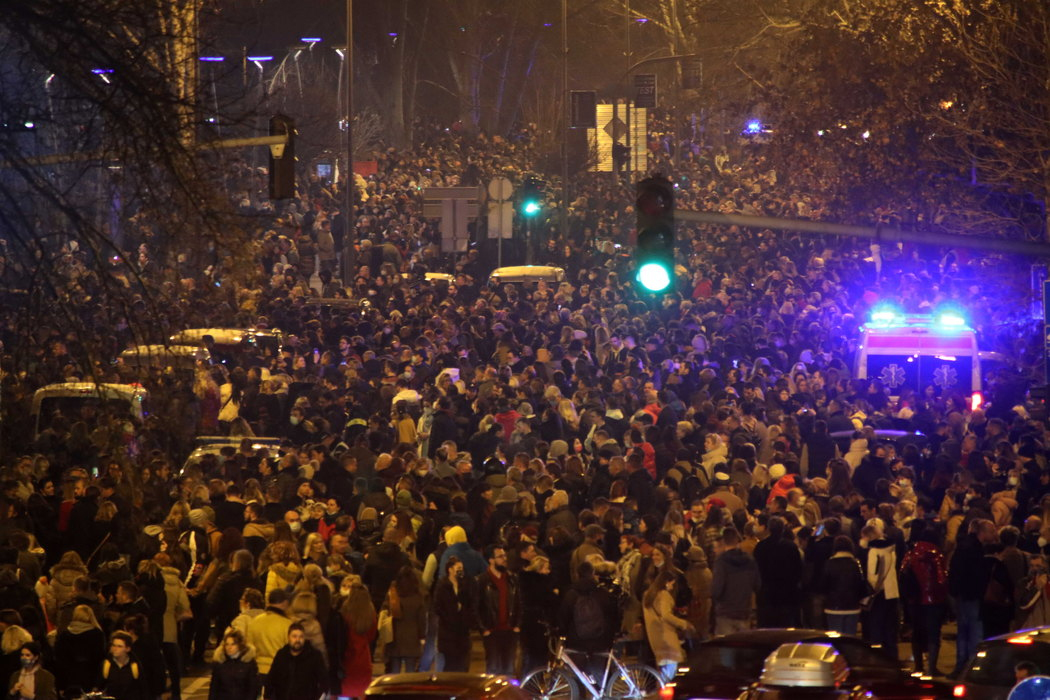
The people of all the former Yugoslavian republics went on to their streets and town squares and river banks, and started singing, and did so for days. Huddled around millions of candles, old and young, idealists and pragmatists, people of all religions and nationalities brought back his lyrics, and his dreams. Flags went down to half-mast. Men were not ashamed to cry.
He was that beloved.
Citizens of Novi Sad after learning of Balasevic’s death. 20 February 2021 (Jaroslav Pap for Radio-Televizija Vojvodone)
And yet there was something else in that frozen air that was augmenting this outpouring of sadness. It was this understanding that it was not only Balašević who died that cold February evening. That day, to so many of us, it felt that the Yugoslavian Dream finally died. Yes, the political entity died many times and through many rushed acts of the 1990s and 2000s, but so many of us held on to the Dream. With Balašević leaving, we knew deep inside that the Dream had left too, for the last time.
As someone said in Serbia, how many times can a country die? It is a finite number, it turns out.
How does it feel when the country, and the dream, of your birth die? It is unbearable sometimes.
Watch: An excellent summary (in English) of what Balasevic meant to the people of Yugoslavia:
And that is something I would like to talk to you about, dear South Africa, right now.
This home of mine for so many years is a country that was dying for centuries before it even had a chance to live. With the arrival of democracy, it received a current of life and hope that rivalled the dream of all southern Slavs living together.
But South Africa has died so many times since.
When the proponents of the old regime kept refusing to accept that something so fundamentally and disturbingly bad was actually wrong, our reservoirs of goodwill get poisoned.
When the miners in Marikana were massacred and their ravaged community brutalised for months with a viciousness rarely seen before, a big part of the South African spirit of togetherness died.
When Andries Tatane was killed in front of his community while protesting against the non-delivery of water, a large chunk of our ideals was carved off.
When Anene Booysen, and a thousand more women and children, were brutalised across the land, the dream of our common humanity waned.
When Jacob Zuma grasped power with his cold hands and, armed with an army of little and big parasitic helpers, proceeded to drain the country’s reserves of money, talent and goodwill … for ten years we lurched towards the abyss, together.
There are just too many moments in time and space when the country of South Africa has suffered, losing a cat-like list of lives. As the pandemic is extending its stay like a very unwanted guest, we are now at the edge of everything: our energy, patience, staying power, conviction, commitment to what is good and righteous. It is a moment fraught with peril.
And yet, a great part of our political sphere is now so deeply enmeshed in the existential fight for power (and for most, the power to pillage), that they forget South Africa in not an indestructible toy. No country in the world is – any history book can teach that.
As you read this, many of Zuma and his merry band’s stormtroopers are doing their utmost best to make South Africa ungovernable and stir upheaval so vast that it could, in theory, enable their return to power.
What they do not perhaps understand, and certainly do not care about, is that a return to the State Capture days would render this country a failed state. Zuma(s), Ace Magashule, Julius Malema and their cohorts are but the thinnest of layers of South African people, and yet they wreaked untold damage. After so many years, our infrastructure is in ruins, people are uncared for, big tracts of our land are free of any government services. The coffers are bare, for all to see.
They mismanaged, shouted, screamed and conned this country into an existential crisis that has infected us at every level.
South Africa is a bruised and battered nation on the brink, struggling for air after so many years of choking. The people are hungry, and people are angry. All you need to do is look.
It will take a miracle, a lot of goodwill and boundless trust to get us out of this mess.
When you see all of this, I just need to ask you that question, again:
How many times can a country die?
The response is, again, a depressingly finite number of times. Do we need to lose a country first in order to understand how much we loved it?
A forgotten settlement in the Cradle of Humankind adds a note to southern African history
About 50km outside South Africa’s biggest city, Johannesburg, lies one of the most important sites in human prehistory: the Cradle of Humankind. Here, at sites like the Sterkfontein Caves, Swartkrans, Drimolen and Kromdraai, researchers have unearthed amazing fossil evidence from the Plio-Pleistocene (the last five million years). It is especially famous for the discovery of fossilised hominin – ancient human – remains.
But there is a more recent and largely neglected layer to the landscape’s history. My colleagues and I set out to investigate some archaeological traces found in part of the Cradle of Humankind. We focused on a stone-walled structure on a hill known as Driefontein; the name also given to the site we studied.
Our findings suggest that the Driefontein stone-walled structure was a residential area. It appears similar to settlements found elsewhere in South Africa’s North West province and parts of Botswana dating to between AD 1450 and 1700, though certain features possibly suggest a later date. These findings place the settlement’s occupation broadly within the “Tswana” period. This refers to roughly the last 500 years of history when Tswana communities, a southern African ethnic group, arose.
While the prehistoric sequence of the Cradle of Humankind operates at several levels spanning a very long period of time, a disproportionate amount of resources have been allocated to studies concerning human evolution and early stone tool technologies.
While this has global significance, our work is important, too, because it sheds light on heritage traces that reveal much about people’s daily lives. It also helps us understand local, traumatic pasts which involved colonial oppression, land dispossession and racial policies.
Cultural remains such as those found at Driefontein allow archaeology to peel back historical discourse to reveal people’s pasts that are not preserved in any other way.
Mapping the settlement
Our work at the settlement involved an intensive mapping programme conducted over four successive visits. Initially we determined the overall size of the settlement, in order to plan our field programme, and then we examined the layout of the homestead’s dry-packed stone-walled architecture.
To record the site, maps were produced using a combination of handheld GPSs and a Trimble Station; these use satellites to record geo-specific points that can be rendered digitally to resemble the settlement’s structure and features.
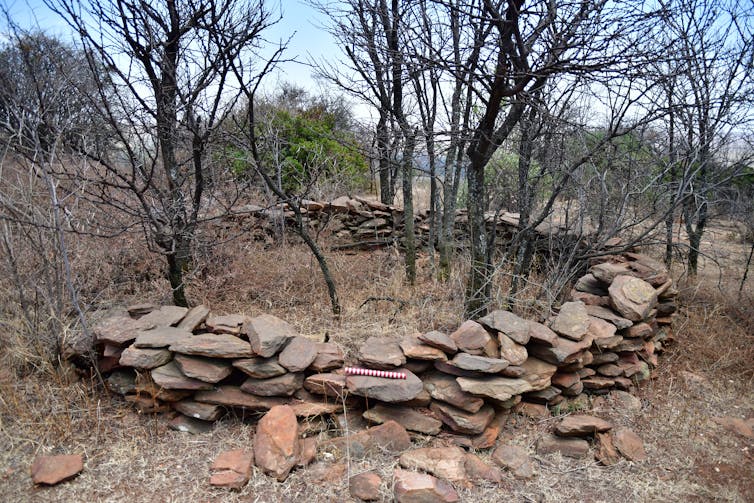
An enclosure inside the western settlement likely used as a kraal for livestock.Tim Forssman
Mapping the site is informative; as building designs today differ between people and over time, so did past stone-walled structures. By studying the layout of the settlement, we can then attempt to determine who occupied the site and when. Archaeologists have been doing this from the 1960s and there is a fairly good record of what the different types of sites look like.
By examining the structure of Driefontein, we could then match its architecture to typologies developed over the past 60 years and determine when it was occupied. We can also infer the use of different areas of the site.
There are other ways of doing this, such as through ceramic analysis or archaeological excavations, but at Driefontein very few items remain on the surface and there is no excavatable deposit.
However, two middens were identified. These were used as dump sites and often contain valuable archaeological material such as ceramic sherds, food waste, and personal ornaments. Unfortunately, at Driefontein this was not the case; this meant that studying the walls’ layout was the only viable way of learning more about the history of the site.
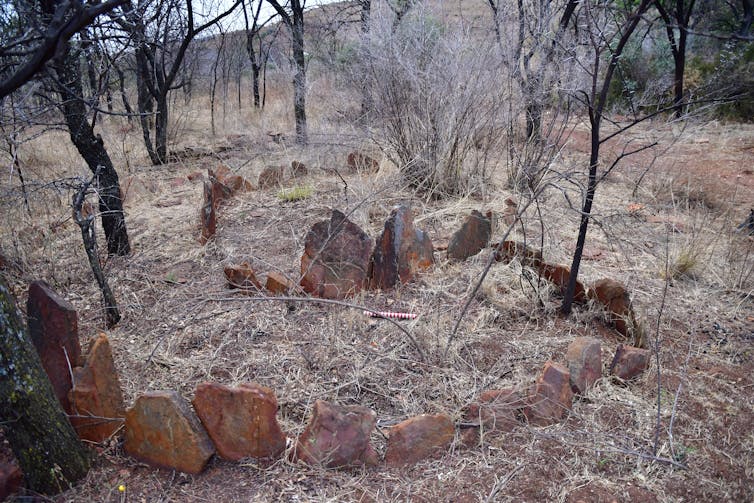
Driefontein includes two distinct areas; what we call west and east. Both have large circular structures outside the main walled area. These may have been kraals (enclosures) for livestock. The main portions of the two areas both have an internal walled area with separate smaller enclosures attached. Around this is a discontinuous and scalloping boundary wall. Between it and the inner enclosure are up to 20 individual huts, including several with outside terraces. These are indicated by upright rocks erected in a circular shape with extensions where terraces exist.
There are also grain bin foundations in the vicinity of several huts, which are similar in construction to the huts but are far smaller.
Upright rocks indicate the presence of a hut, since disappeared, with this one possessing a front terrace.Tim Forssman
Based on the evidence, as well as the middens and a small collection of earthenware ceramics, the Driefontein stone-walled structure was a residential area. The structure appears similar to settlements dating to between AD 1450 and 1700. However, certain features – notably the upright rocks around the huts and lintels in the outside circular structures – have been identified at sites with a later date. This possibly suggests that Driefontein is younger than we may expect.
Though the settlement’s occupation falls within the “Tswana” period, naming the occupants as Tswana is complicated. That’s because Tswana history is not linear or direct. Rather, there are periods of migration, political growth and assimilation. Tswana origins are also unclear. At times, oral histories note multiple lineages and totems with several different groups appearing and blending with others.
When looking back at early archaeological sequences, such as may be the case at Driefontein, identifying “Tswana” groups is, for these reasons, quite challenging. Nonetheless, based on the evidence, we believe Driefontein was likely occupied by Tswana-like groups after about AD 1450.
Complex histories
This project was done with the involvement of the current landowners of the Nirox Sculpture Park and Project 58, where the site is located. Their interest in the site and openness to researchers is what ultimately led to us learning more of the region’s prehistory.
Our work is far from over. Future studies at Driefontein will help to further acknowledge more recent complex histories, identities and pasts that overlay the deep-time sequences preserved in the Cradle of Humankind’s cave systems.
What Madagascar’s amazing mini creatures tell us about evolution
Brookesia tedi, described in 2019, is one of the smallest chameleons, and indeed one of the smallest amniote vertebrates, on earth.
Madagascar has many “mini” creatures. These include a recently discovered group of miniaturised frogs as well as the discovery earlier this year of the smallest reptile on earth – the Brookesia nana, or nano-chameleon, which is the size of a paperclip. Moina Spooner, from The Conversation Africa, asked Dr Mark D. Scherz, an amphibian and reptile specialist who focuses on Madagascar, to explain what causes these animals to miniaturise.
Which miniaturised species have been discovered recently?
Madagascar is famous for its small animals; the mouse lemurs, the smallest primates on earth, for instance, are widely known. There’s also growing awareness that Madagascar is home to a variety of other uniquely miniaturised animals, especially chameleons and frogs. In those groups, researchers have discovered large numbers of tiny species in recent years.
In 2017, researchers described 26 species of Stumpffia – a group of frogs – the smallest of which is not even 1cm long at adult body size. It is one of the smallest frogs in the world.
Stumpffia yanniki, a moderately small narrow-mouthed frog species from northern Madagascar, described in 2017.Mark D. Scherz
Then, in 2019, my colleagues and I showed that several different groups of cophyline microhylids – a group of narrow-mouthed frogs that are only found in Madagascar – have become miniaturised independently. One group of these was an entirely new genus. We gave them the fitting name “Mini”, with the three species Mini mum, Mini scule, and Mini ature.
We have also found some new tiny chameleons. In 2019, we described Brookesia tedi, a chameleon that reaches a total length of just 32mm. And then in early 2021, we described Brookesia nana, the smallest chameleon, which has adult males of just 21.6mm total length, and females 28.9mm.
Why have they evolved to be so small?
There are probably many different reasons why these animals have evolved to be so small. For instance, it might be possible for them to exploit new resources that weren’t previously available to them. This may be new food sources, or exploring the space between leaves and tree roots that is inaccessible to larger animals.
Stumpffia madagascariensis is a tiny leaf-litter dwelling frog from northern Madagascar.Mark D. Scherz
It could also be driven by competition with other, similar species. Species may diverge into different size categories to partition their resources and avoid direct competition.
In many cases, there may be no strong or single selective force that is driving the miniaturisation at all, but instead it could simply be a process of random change in the population, which occurs in all organisms over time. This is further driven by population bottlenecks as the smaller and smaller animals get cut off from other populations.
The simple answer is that we just don’t know yet in any of the cases, and it is likely that in most it is a combination of factors. We are much better able to say what the correlates of miniaturisation are – that is, the suite of features, behaviours, and ecologies that accompany miniaturisation – than the causes.
Does Madagascar have an unusually high number of mini creatures?
Speaking only of reptiles and amphibians, maybe, but it is hard to say for sure. South-East Asia has a massive diversity of miniaturised frogs, for instance, but whether the number of major miniaturisation events in that region is greater or less than in Madagascar is difficult to say for sure.
The same goes for Central and South America, where there are plenty of tiny amphibians and reptiles, including salamanders, frogs and lizards.
Ultimately, even though Madagascar may not be the world champion in terms of the number of miniaturised reptiles and amphibians, I think it does stand out as an exceptionally interesting place in which to study their evolution, and we are only just starting to scratch the surface of this.
What does their tiny size tell us about evolutionary processes?
This is the question I find the most exciting. From miniaturisation we can learn all kinds of interesting things about physiology, evolution and biomechanics – how organisms move and function.
For instance, there appears to be a pattern where the evolution of miniaturisation is associated with changes in ecology. Almost all miniaturised frogs in Madagascar are terrestrial, irrespective of whether their ancestors were terrestrial arboreal (living in trees). The only conditions under which miniaturised frogs have remained arboreal throughout miniaturisation has been when they reproduce in the water cavities at the base of certain plants’ leaves, such as the Pandanus plant.
We have also learned that the microhylid frogs of Madagascar have mostly miniaturised by retaining juvenile-like characteristics, known as paedomorphosis. For instance, they all have relatively large heads and eyes for their body sizes.
But one species, Rhombophryne proportionalis, has apparently miniaturised by proportional dwarfism. It has the approximate proportions of a non-miniaturised Rhombophryne. So, although paedomorphosis may be the typical way that Malagasy frogs miniaturise, it is by no means the only way that they can miniaturise.
Another particularly interesting finding is that miniaturisation has apparently evolved again and again in different lineages. This was already evident in frogs at the global scale (there are miniaturised frog lineages throughout the tropics). But one group of frogs in Madagascar has done this five or more times alone. This tells us that the evolution of miniaturisation can occur frequently and may be advantageous under certain circumstances.
Brookesia tuberculata from northern Madagascar was for some time held to be the smallest species of chameleon, but has been repeatedly upstaged. Its real claim to fame, however, is that it has by far the largest hemipenis relative to its body length of any chameleon.Mark D. Scherz
From our work on miniaturised chameleons, we have also found that, as these lizards shrink, their genitals increase in relative size. We think that this is because the females are larger than the males. Because the male genitals must couple with those of the females for successful reproduction, and because the female is not as small as the male, the male’s genitals are constrained to remain proportional to the size of the female, even while his body size evolves to be smaller.
There are hundreds of open questions in the field of tiny vertebrate studies. We are just beginning to understand how widespread and common this trait is, how many species have done it, and how many miniaturised species remain undescribed. There is a whole miniature frontier of interesting research to be had among these tiny vertebrates, and I, for one, am excited to see what we discover next.