Thursday, 6 October 2022

Russian troops flying a white flag from their tank turret surrender to Ukraine

Astonishing moment Russian troops flying a white flag from their tank turret surrender to Ukraine

  • Russian troops surrendering to Ukrainians in Kherson, in the south 
  • BMP-2 vehicle drives out with a white flag tied to the turret
  • Three Russians get out with hands up in what seems to be arranged surrender 
  • Comes after Ukraine said 2,000 Russian soldiers have called surrender hotline 

This is the astonishing moment a squad of Russian soldiers flying a white flag from the turret of their tank surrendered in Ukraine. 

In Kherson, in the south of Ukraine, a Russian BMP-2 drives out from behind a set of trees and stops in front of Ukrainian troops before three crew get out with their hands raised.

The Ukrainians then move in, strip the soldiers of their weapons and take them as POWs in what appears to be a pre-arranged operation.

Ukraine's military intelligence branch said more than 2,000 Russian soldiers had called a hotline asking how to give themselves up rather than risk being killed on the battlefield.

Astonishing footage has revealed the crew of a Russian BMP-2 fighting vehicle surrendering to Ukrainian forces in the south of the country

the crew of a Russian BMP-2 fighting vehicle surrendering to Ukrainian forces in the south of the country

Video captures the Russians driving out from behind a set of trees with a white flag tied to their turret before getting out of the vehicle with their hands raised

the Russians drive out from behind a set of trees with a white flag tied to their turret before getting out of the vehicle with their hands raised

Andriy Yusov, spokesman for military intelligence, said calls had come from troops inside Ukraine, those who had been recently conscripted in Russia, and some who had not yet been drafted but feared getting the order.

It also comes amid Ukrainian counter-attacks both in Kherson, in the south, and near Kharkiv, in the north, which have inflicted heavy casualties on Russia and returned swathes of territory to Kyiv's control. 

Ukrainian troops have been attacking in Kherson for more than two months but, until recently, had achieved only slow progress.

However, in the last few days the Russian frontline dramatically collapsed - allowing Kyiv's men to rush forward more than 10 miles in just a few hours.

President Zelensky has said 'dozens' of villages were liberated in the operation, which aims to re-take the city of Kherson itself.

Meanwhile, hundreds of miles away to the north, Ukrainian troops have also liberated thousands of square miles of territory near the city of Kharkiv.

Almost the entire Kharkiv region has been returned to their control, and units are now pushing into neighbouring Donetsk and Luhansk province

Ukrainian soldiers move in to strip the Russians of their weapons and take them as POWs in what appears to be an operation that was organised ahead of time

Ukrainian soldiers move in to strip the Russians of their weapons and take them as POWs in what appears to be an operation that was organised ahead of time

Surrender video emerged as Ukraine said more than 2,000 Russian troops have called a hotline where they can arrange to give themselves up to Kyiv's forces

Ukraine said more than 2,000 Russian troops have called a hotline where they can arrange to give themselves up to Kyiv's forces

The footage was filmed in Kherson, where Ukrainian forces have made rapid advances in recent days after months of hard fighting

Kherson, where Ukrainian forces have made rapid advances in recent days after months of hard fighting

The city of Lyman, a key transport node, fell at the weekend and troops have been mopping up in small villages along the nearby Oskil River in recent days.

A senior US officer told The Telegraph that Russia's faltering war effort could mean 'the recapture of Crimea by Ukraine is now a distinct possibility and can no longer be discounted'.

The official added: 'It is clear that Russia no longer has the ability or willpower to defend key positions, and if the Ukrainians succeed in recapturing Kherson, then there is a very real possibility that it will ultimately be able to recapture Crimea.'

Russia is suffering heavy losses trying to hold territory it has gained in seven months of war, as Ukraine re-takes territory in the north and south (pictured, a destroyed tank in the north)

Russia is suffering heavy losses trying to hold territory it has gained in seven months of war, as Ukraine re-takes territory in the north and south (pictured, a destroyed tank in the north)

The remains of a Russian column that attempted to escape from the city of Lyman despite being surrounded by Ukrainian troops, and was destroyed

The remains of a Russian column that attempted to escape from the city of Lyman despite being surrounded by Ukrainian troops, and was destroyed
Wednesday, 5 October 2022

Horseracing Tip: The Older the Parents, the Slower the Horse

Having a flutter on a horse? Better check how old its parents are! Thoroughbreds sired by old stallions are less likely to win races than those from young studs, study finds

  • Speed of thoroughbred horses can be affected by the age of their parents
  • The older the parents at the point of conception, the slower the racehorse 
  • Researchers claim findings should be of interest to the horseracing industry

If you're thinking of putting a bet on a horse this weekend, you might want to check how old its parents are.

That's because a new study by the University of Exeter has shown that the speed of thoroughbred horses can be affected by the age of their parents at the point of conception.

The older the parents, the slower the racehorse - with the age of both the mother and father playing a significant role in the overall speed, according to researchers.

That means thoroughbreds sired by old stallions are less likely to win races than those from young studs.

'The fact that parental age affects racehorse speed should be of interest to the horseracing industry,' said Dr Patrick Sharman from the Centre for Ecology and Conservation at the University of Exeter's Penryn Campus in Cornwall.

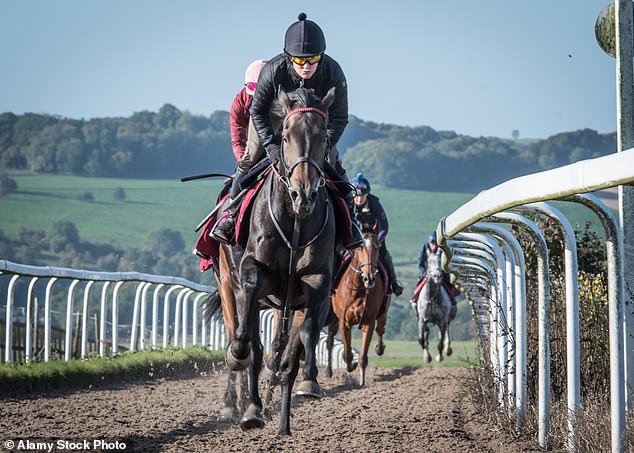
The older the parents, the slower the racehorse - with the age of both the mother and father playing a significant role in the overall speed

The older the parents, the slower the racehorse - with the age of both the mother and father playing a significant role in the overall speed 

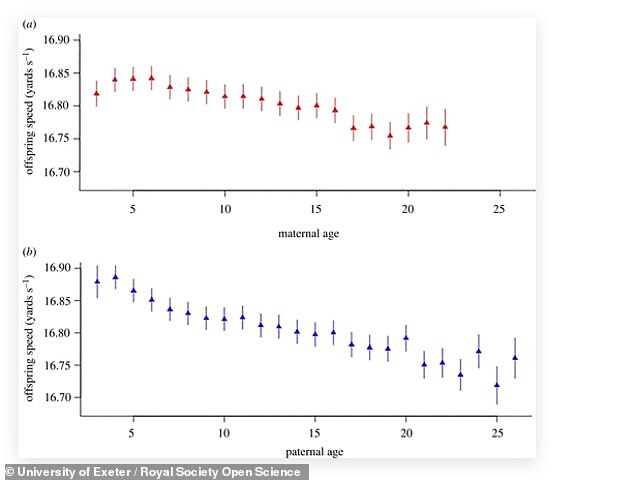
Predicted horse (offspring) speed by (a) maternal and (b) paternal age in years. The researchers analysed data from almost 25 years of racing results across Great Britain - from 1996 to 2019

Predicted horse (offspring) speed by (a) maternal and (b) paternal age in years. The researchers analysed data from almost 25 years of racing results across Great Britain - from 1996 to 2019

Horses with high levels of inbreeding are less likely to race

Horses have been bred for hundreds of years in order to produce champion racers, but a new study finds those with higher levels of inbreeding may never step foot on a track.

A team of scientists, led by the University College Dublin, identified a single genetic marker that drops a horse's probability of racing by nearly a third.

The genetic marker negatively impacts how the animal's bones develop and repair and inheriting the marker from both parents, drops the probability of racing to 32 percent.

Approximately one in six stallions are carriers, along with more than 10 percent of all thoroughbreds.

 Read more

The researchers were inspired by a previous small-scale study, which reported on the breeding success of the great stallion Sadler's Wells, who sired 2,259 foals, including 73 Group or Grade 1 winners.

That study found that most of his most successful offspring - including Monjeu, Galileo and High Chaparral - appeared in the first half of his stud career, while only 10 of the 73 were born in the latter 40 per cent.

The University of Exeter researchers built on this by analysing data from almost 25 years of racing results across Great Britain - from 1996 to 2019 - comprising over 900,000 performances from more than 100,000 horses.

The data included the offspring of 41,107 mothers and 2,887 fathers. 

They found that maternal age had a 'significant effect' on speed, with each additional year of age at conception decreasing the offspring speed by 0.017 yards per second.

While this may sound modest, it actually converts into a predicted difference of approximately one second over a race of one mile between a horse with a five-year-old and one with a 15-year-old mother. 

In a sport where the finest of margins can determine the winner, the study suggests that parental age can be a determining factor in which horse is first past the post. 

Intriguingly, the paternal age also showed a decrease of 0.011 yards per second for every increasing year in stallion age.

This is a particularly noteworthy finding, as thoroughbred stallions play no active involvement in parental care.

Intriguingly, the paternal age also showed a decrease of 0.011 yards per second for every increasing year in stallion age

Intriguingly, the paternal age also showed a decrease of 0.011 yards per second for every increasing year in stallion age 

'It is perhaps not surprising that offspring speed declines with increasing maternal age,' said Dr Sharman.

'It is the dams, after all, who care for the foal, first in utero, and then through to around 6 months of age.

'What I find fascinating, though, is that increasing paternal age also causes a significant decline in racehorse speed. 

'Thoroughbred stallions play no part whatsoever is raising a foal, so what is behind this decline in speed?'

The study adds to a growing body of evidence that parental 'state' at the time of conception can affect offspring characteristics. 

For example, previous studies have suggested that first-born foals tend to be lighter and perform less well than subsequent offspring from the same mother.

The researchers believe their study could play a pivotal part not only in optimising racehorse breeding, but also better understanding the impact of parental age on offspring phenotype.

'This would have implications well beyond racehorses and the horseracing industry,' said Dr Sharman.

The study has been published in Royal Society Open Science.

RACEHORSES ARE GETTING FASTER 

Among lovers of the Sport of Kings, racehorses had been thought to have reached perfection.

Unlike humans – who keep smashing running records at the Olympics – a widespread view was that horse race times are stagnating.

Breeders and jockeys believed that their thoroughbreds simply could not gallop any faster.

But after conducting an exhaustive study of flat races, researchers at the University of Exeter found that horses are still speeding up.

To test the theory they analysed 616,084 races run by 70,388 horses from the mid-1800s until 2012.

And contrary to expectations, horses have been getting faster since 1997.

This is despite increases in handicap weight – with the greatest increases seen in sprinters, especially at the elite level.