Thursday, 24 October 2019

In hungry Venezuela, food producers step up exports to survive

OCTOBER 23, 2019 , Mayela Armas, Corina Pons


A man works on an artificial lake at a shrimp farm near Maracaibo, Venezuela August 1, 2019. Picture taken August 1, 2019. REUTERS/Manaure Quintero


MARACAIBO, Venezuela, (Reuters) - Shrimp farming is booming in this western Venezuelan city, but little of the shellfish is destined for tables in this malnourished nation.

About 90% of this shrimp is headed for Europe and Asia - with the blessing of President Nicolas Maduro.

Venezuela’s leader has lauded food exports on television as a way to raise hard currency to stabilize an economy in crisis. And he is paving the way for more foreign sales. His administration has loosened restrictions to allow more production to go abroad, 10 food industry entrepreneurs and executives told Reuters.

In addition to seafood, Venezuelan cheese, avocados, citrus, breakfast cereal and candy are finding international buyers.

These new foreign sales are tiny, with most companies billing less than $1 million per year. Venezuela remains almost entirely dependent on oil exports, which amounted to $29 billion last year.

Still, the numbers signal a shift for a government that has long blamed the private sector for shortages of basic goods. Maduro and his predecessor, Hugo Chavez, for years accused food companies of hoarding and profiteering. Business leaders say empty shelves were the result of state policies such as price and currency controls and the nationalization of farms and factories.

Since 2017, 140 Venezuelan businesses have begun exporting for the first time, half of them selling food products, according to data provided by Scottsdale, Arizona-based advisory firm Import Genius, which collects customs data for the import-export industry.

Some veteran exporters, meanwhile, are leaning more heavily than ever on foreign sales as Venezuela’s currency has collapsed. Fernando Villamizar, the head of a Venezuelan shrimp industry association, said the withering of consumer spending power at home has forced producers to look abroad for growth.

On a recent morning at a facility owned by a member of the trade group, dozens of workers in baggy smocks, plastic gloves and face masks cleaned shellfish and put them in boxes to be frozen. An order that day was bound for France. The plant also ships to Spain and Vietnam.

“We have to sell outside the country” to survive, Villamizar said.

Venezuelan companies sold $81 million worth of shrimp abroad last year, up from $54 million in 2016, making it the country’s 4th-largest non-oil export, according to figures from the Venezuelan Association of Exporters.
CHEESE SPREAD CROSSES BORDERS

Maduro’s enthusiasm for non-oil exports comes as U.S. sanctions have hurt Venezuela’s petroleum sales. To earn hard currency, his government is scrambling for alternatives.

In July, Maduro toured a factory outside Caracas that ships chocolate to Japan, television cameras in tow. He said the goal of these and other exports was to generate “euros, rubles, yuan and cryptocurrencies.”

Food producers looking to export need to obtain a variety of government permits. Under Chavez, the state frequently denied those permissions, delayed them or never acted on them, the food industry entrepreneurs and executives told Reuters. They said Maduro’s administration is now granting more permits, allowing them room to maneuver.

The Information Ministry did not respond to requests for comment on Maduro’s exports strategy.

The government this year has also largely given up controlling prices, three of the food industry executives said. More goods have returned to Venezuelan stores.

But even with more products available, Venezuela’s hyperinflation means few can afford to buy. Compared to five years ago, the daily calories now consumed by the average citizen have fallen 56% to 1,600 calories, according to Caracas-based Citizenry in Action, a nutrition-focused nonprofit. That is well below the 2,000 to 2,500 calories per day recommended by the World Health Organization. Millions depend on government food handouts and subsidized staples.

Lack of demand has spurred two large Venezuelan food companies - Empresas Polar and rival General de Alimentos Nisa CA, or Genica - to export products that until now had only been sold in Venezuela, said two people involved in those operations and a third with knowledge of them.

The two companies last year exported a combined $59,000 worth of merchandise, mainly to Argentina and Chile. Among the items headed abroad was a once-popular melted cheese spread made by Polar.

Genica told Reuters it was entering new markets, but would not elaborate. Polar did not respond to requests for comment.

The Venezuelan unit of another major firm, Nestle SA, as of June had exported 18 tonnes of instant cereal worth $18,600 to the United States, according to port records.

Convenience foods are now beyond the reach of Venezuelan shoppers such as Doris Molina, a 28-year-old accountant.

“I don’t give my son cereal anymore because it’s so expensive,” she said, walking with her four-year-old at a Caracas mall. The local price of Nestle’s instant cereal has increased around 3,400% since last year.

Nestle said in a statement that its exports generate foreign exchange it needs to acquire raw materials, and that these sales comply with Venezuelan law.

Such sales do not violate U.S. sanctions, which forbid American firms from doing business with Venezuela’s government or state-run companies such as oil giant Petroleos de Venezuela SA. Venezuela’s private sector companies are free to sell to U.S. buyers.

Attorney Daniel Sanchez opened a fish farm in central Venezuela three years ago to raise tilapia, which is largely unknown in Venezuela. He has buyers in Colombia and is eyeing the United States.

Showing off outdoor tanks teaming with fish, Sanchez said he sells tilapia for $2 a kilogram. That’s the equivalent of more than a week’s pay for Venezuelans earning the minimum wage.

“The idea is to produce for export,” Sanchez said.

Ramon Goyo, head of the Venezuela Association of Exporters, said a new company joins his trade group almost weekly to seek advice on how to sell abroad.

“They’re looking for hope,” Goyo said. “There’s no (way to make it) in Venezuela’s hyperinflation. There’s no spending power.”

Exports by Venezuela’s private sector companies increased by 26% in the first quarter of 2019 versus the same period a year ago, even as the economy contracted by 27%, according to the most recent central bank statistics.
BLACKOUTS, TAXES AND FEES

Despite Maduro’s public praise of exporters and loosening of export restrictions, the people interviewed by Reuters say his government still doesn’t make it easy.

They said needed permits still can be inexplicably denied from one month to the next, while the export of staples such as corn flour and rice remain prohibited.

Businesses say cash-strapped city and state governments have hiked taxes aimed at exporters, while state-run ports have raised fees.

Local officials in Maracaibo, Venezuela’s second-largest city, have targeted exporters for bribes, according to three people who told Reuters they have been asked for such payments.

State port agency Bolipuertos did not respond to a request for comment. The city of Maracaibo and the state of Zulia, where Maracaibo is located, did not answer emails seeking comment.

Some companies have snagged foreign customers, only to lose them to the vagaries of Venezuela’s precarious business climate.

Fruit processor Venezolana de Frutas C.A., known as Venfruca, three years ago began exporting orange and passion fruit pulp to the Netherlands after Venezuelan demand slumped. The Dutch sales quickly became a crucial source of revenue, according to manager Karolis Laguna, who said the firm has sent 49 container-loads to Europe since 2016.

But Venfruca this year has struggled to find enough fruit. The Venezuelan farmers it buys from have also figured out exports are profitable; they’re increasingly selling in neighboring Colombia, Laguna said. An outbreak of mold in Venezuela’s orchards has worsened the shortage, she said.

“We have purchase orders open because we don’t have raw materials,” Laguna said. She said frequent blackouts at Venfruca’s facility in the western Venezuelan city of Barquisimeto haven’t helped.

Dairy firm Bufalinda began selling its mozzarella cheese - made from water buffalo milk - in Florida last year out of an “urgent” need to shore up its finances, said Alberto Duhau, founder of the eastern Venezuela firm.

He said his air freight costs soared 60% this year after U.S. sanctions blocked direct flights between Venezuela and the United States.

Still, Duhau said his U.S. sales are profitable and he hopes to keep expanding there.

“This is an endurance race,” Duhau said. “You can only stay in it if you have a big tank of oxygen.”


Reporting by Mayela Armas and Corina Pons; Additional reporting by Shaylim Castro; Editing by Brian Ellsworth and Marla Dickerson


Recommend this post and follow TCW

Recipes - Made In Minutes Tomato & Fennel Soup

Made In Minutes Tomato & Fennel Soup 


recipe courtesy of Lisa Starr 


Ingredients 
2 tablespoons olive oil 
2 bulbs of fennel, sliced including tops
2 teaspoons crushed garlic 
1 large (800 gram) can chopped tomatoes 
6 cups beef stock*
1 - 2 tablespoons sugar (or to taste)
Salt and coarse black pepper
* Use 6 teaspoons of parve Ina Paarman beef stock to 6 cups of water OR an alternative stock flavor.
This is what Fennel looks like. Cut off the very woody base but use the rest of the bulb including the feathery leaves. 

Preparation Instructions

1: Heat the oil and fry the fennel and garlic for 3 minutes. 
2: Add the tomatoes, stock, sugar, salt and pepper and simmer for 12 minutes. 
3: Process till smooth and serve as is or top with a generous tablespoon of grated Parmesan cheese.

🌽🍆🍅🍍🍠🍤🍗🧀🍔🍟🍕 🍏🍎🍐🍊Please recommend this page & be sure to follow the Coconut Whisperer which continues the traditions of Cheese the top Food and Recipe channel on Disqus 2017-2019 🌽🍆🍅🍍🍠🍤🍗🧀🍔🍟🍕🍏🍎🍐🍊

Terrorists Call for Killing Jews...

Terrorists Call for Killing Jews 

-- from UN HQ in Gaza

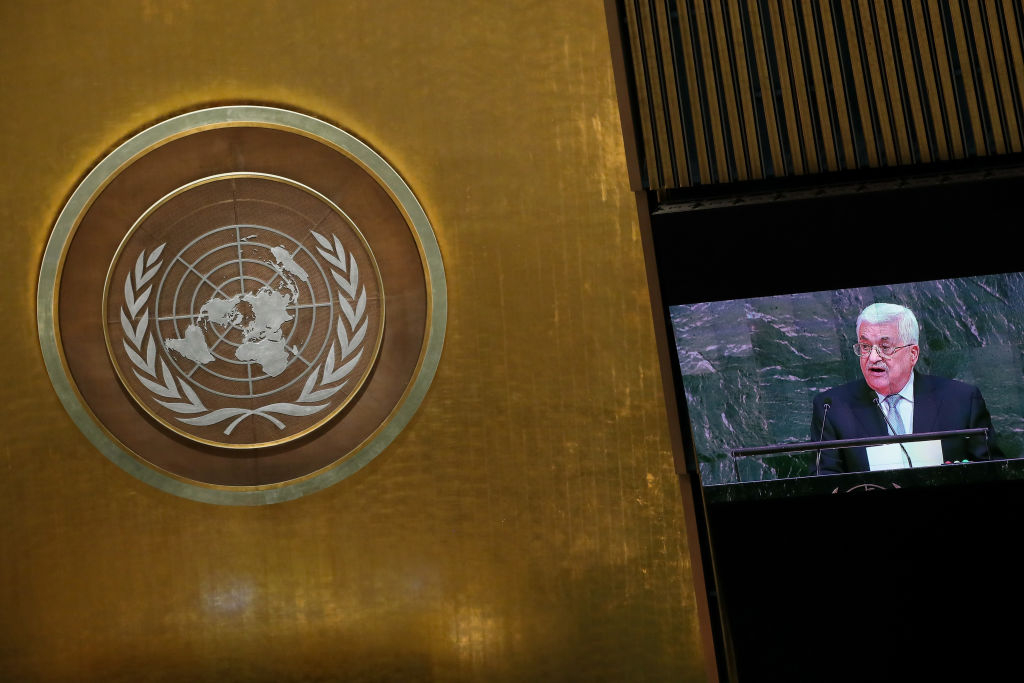
Perhaps it is time to call out the UN for the racism it not only embodies but also perpetuates. Perhaps it is time for all nations, especially the United States which shoulders so much of the UN's bill, finally to pay only for what they want and to get what they pay for. (Photo by Drew Angerer/Getty Images)

Leaders of several Palestinian factions are again calling for stepping up terrorist attacks against Jews. The difference is that this time, the calls were made during a sit-down strike held by Palestinians outside the offices of the United Nations in the Gaza Strip.

The leaders of the Palestinian factions chose to issue their calls for killing Jews in front of the UN offices in the Gaza Strip. It is as if they are asking the UN to approve their continual terrorist attacks against Israel.

What is clear -- and disturbing -- is that the UN officials in the Gaza Strip choose to remain silent when the Palestinian leaders came to their offices to incite their people to step up their terrorist attacks.

The sit-down strike was organized by the "Jerusalem Department" of Hamas, the terrorist group that has been ruling the Gaza Strip since the summer of 2007. The purpose of the sit-down strike was, according to Hamas, to protest visits by Jews to the Temple Mount, or Haram Al-Sharif -- a site in Jerusalem sacred to both Muslims and Jews.

Hamas, which governs the Gaza Strip near Egypt, and the Palestinian Authority (PA), which governs the West Bank near Jordan, as well as other Palestinian factions have long been waging a vicious campaign of incitement against the decision by Israeli authorities to allow Jews to tour the Temple Mount compound.

The Palestinians are opposed to the presence of Jews on the Temple Mount -- whether as visitors or worshippers. Jewish prayer on the Temple Mount is completely forbidden by the Israeli police, and Jewish visitors are forbidden from singing, whispering, praying or making any kind of religious displays. Still, the Palestinians continue to incite against the Jewish tours, ignoring the fact that the Israeli authorities do not allow Jews to pray on the Temple Mount.

The PA and Hamas officials and media outlets regularly describe the peaceful visits by Jews as "violent invasions by extremist Jewish settlers into the Al-Aqsa Mosque."

Needless to say, the Jewish visitors never set foot inside the mosque that is located in part of the Temple Mount compound. That, however, has not stopped Palestinian leaders from lying to their people and the rest of the world by claiming that "Jews are desecrating our mosque."

Again, the UN officials in the Gaza Strip who heard these lies during the sit-down strike did not bother to respond to the false claims. The silence of the UN officials speaks volumes about their attitude toward anti-Israel incitement and blood libels against Jews, all of which have become an integral part of both the UN's and the Palestinians' culture.

Not that anyone was expecting the UN and its senior officials truly to confront the leaders of the terrorists in the Gaza Strip. Yet, the UN ought at least to have issued a statement condemning the leaders who come to its offices in the Gaza Strip to spread lies and blood libels and call for violence against Jews.

Sadly, that did not happen, thereby paving the way for Palestinian leaders to believe that they have a green light from the international agency to pursue their murderous plans.
The UN's Human Rights Council, in fact, has a "Special Rapporteur," whose mandate is to "identify existing and emerging obstacles to the enjoyment of the right to freedom of religion or belief and present recommendations on ways and means to overcome such obstacles."

That mandate, however, evidently does not include the right of Jews to ascend the Temple Mount, seen as the holiest site also for Jewish believers. Parts of the four retaining walls surrounding the Temple Mount date back to the time of the Second Jewish Temple, first century BCE. The walls were built around the summit of Mount Moriah where, biblically, Abraham offered his son, Isaac, as a sacrifice.

During the protest in front of the UN offices, Mushir al-Masri, a senior Hamas official, called on Palestinians to carry out stabbing, shooting and car-ramming attacks against Jews for their officially agreed-upon visits to the Temple Mount, this time during Jewish holidays. Al-Masri urged the PA to allow Palestinians living under its rule in the West Bank to "take action by launching attacks with knives, bullets and vehicles against Jews. "Let the Zionist enemy realize that as long as the Al-Aqsa Mosque is not living in safety under the rule of Muslims, the Zionists will not live in security on the land of Palestine," al-Masri said.

The Hamas official further urged the Arab residents of Jerusalem to "revolt against the desecration of Al-Aqsa Mosque by herds of settlers." Increasingly, however, all Israelis are being called "settlers," whether they are or not. It possibly seems another easy way, for public consumption, to demonize the Jews both locally and internationally. To Palestinians, all of Israel is one big settlement that needs to be displaced.

Al-Masri also lashed out at Arab countries for purportedly engaging in normalization with Israel. "The normalization of some Arab regimes with the Zionist enemy is a poisoned dagger in the back of Jerusalem and Al-Aqsa Mosque," he added. "This has allowed the Zionists to continue desecrating Al-Aqsa and Judaizing Jerusalem."

Al-Masri and the leaders of the Palestinian factions who participated in the protest in front of the UN offices are openly saying that they want Palestinians to resume the "Knife Intifada" that took place between 2015 and 2016. During that year-long "uprising," Palestinians carried out morethan 400 stabbings and shootings, as well as more than 75 vehicular attacks, killing a total of 85 Israelis and wounding more than 1,400.

It is notable that the wave of terrorism erupted shortly after PA President Mahmoud Abbas accused Jews of "desecrating with their filthy feet" the Al-Aqsa Mosque -- a lie originated 90 years ago by the then-Grand Mufti of Jerusalem, Haj Amin al-Husseini. Abbas's September 16, 2015 modern-day lie was code for Palestinians to take to the streets and stab, shoot and ram Jews with cars.

Abbas also promised that any Palestinian killed while carrying out a terrorist attack "will reach Paradise." His exact words were:
"We will not allow Jews to defile Al-Aqsa Mosque and Jerusalem. The Al-Aqsa [Mosque] is ours and they have no right to defile it with their filthy feet. We bless every drop of blood that has been spilled for Jerusalem, which is clean and pure blood, blood spilled for Allah, Allah willing. Every martyr will reach paradise, and everyone wounded will be rewarded by Allah."
Hamas and the Palestinian factions are now calling on Abbas to fulfill his pledge once again and permit Palestinians to resume the "Knife Intifada." The factions are saying that Abbas's security forces in the West Bank should not stop terrorists from renewing their killing spree of Jews.


Talal Abu Tharifeh, another Palestinian terrorist leader who participated in the sit-in strike in front of the UN offices, seized the opportunity to call for a "mass uprising" against Israel, also to protest the Jewish visits to the Temple Mount. Abu Tharifeh, one of the leaders of the PLO's terrorist group, the Democratic Front for the Liberation of Palestine (DFLP), made it clear that he was not referring to peaceful protests:
"We want a mass Intifada that would be able to affect the balance of power on the ground in order to confront Israeli measures. It is time to turn the rhetorical engagement into a clash [with Israel] on the ground."

Both al-Masri and Abu Tharifeh stated that their messages of launching terrorist attacks against Jews were being made on behalf of several "national and Islamic factions" in both the West Bank and Gaza Strip. To be clear: the two men were saying that their call for killing Jews is not a private initiative, but one endorsed by a number of groups that represent hundreds of thousands of Palestinians.

Abbas's PA in the West Bank, meanwhile, seems to approve of the new threats made by the Palestinian terrorist groups. The PA-controlled media, specifically the official Palestinian news agency Wafa, continues to incitePalestinians against the Jewish tours of the Temple Mount on an almost daily basis.
In an October 10 dispatch, Wafa used Hamas's terminology to report incorrectly on the tours:
"189 [Jewish] settlers stormed the compound of Al-Aqsa Mosque under strict protection of the Israeli occupation police. The settlers carried out provocative tours of the site."
It appears that the UN and the rest of the international community have no problem with the continued incitement and lies by the Palestinians against the Jews.

By allowing Hamas and other terrorist leaders to urge Palestinians to stab and shoot Jews, the UN is again exposing its true colors -- bias in favor of the terrorists and a violation of its human rights convention regarding freedom of worship and access to holy sites. One can only imagine the uproar had Jews stood in front of the UN offices and called for launching a wave of terrorist attacks against Arabs or Muslims.

If the UN was really interested in contributing to peace in the Middle East, it would be castigating Palestinian leaders for using its premises to call for killing Jews. Providing jobs and food to Palestinians is a nice thing the UN is doing in the Gaza Strip. However, turning a blind eye to incitement and blood libels, especially when they are issued from your own premises, only emboldens the terrorists and inspires more bloodshed -- that of Jews.

Perhaps it is time to call out the UN for the racism it not only embodies but also perpetuates. Perhaps it is time for all nations, especially the United States which shoulders so much of the UN's bill, finally to pay only for what they want and to get what they pay for.
Bassam Tawil is a Muslim Arab based in the Middle East.

The State Department’s War on Trump

Townhall

The State Department's War on Trump

The opinions expressed by columnists are their own and do not represent the views of Townhall.com.
The State Department's War on Trump
Source: AP Photo/Andrew Harnik
House Democrats are grilling a stream of disgruntled career diplomats in a basement hearing room of the Capitol. The hearings are supposed to be secret, but -- no surprise -- Democrats leak snippets of the testimony daily. They're hoping it will add up to a case for impeaching President Donald Trump.

So far, all the testimony actually proves is that these State Department diplomats think they -- not President Trump -- ought to be running the nation's foreign policy.

Never mind executive privilege or impeachment. The most pressing constitutional issue at hand is who decides the nation's foreign policy: the president or the permanent bureaucracy.

House Democrats are accusing Trump of offering Ukrainian President Volodymyr Zelensky a quid pro quo: dirt on former Vice President Joe Biden in exchange for nearly $400 million in aid. Trump's July 25 phone call with Zelensky is the subject of the hearings, but these witnesses have no firsthand knowledge of the call.

Instead, they're whimpering about being sidelined by the Trump administration and objecting that top ambassadorial appointments are going to Trump's friends instead of to them. They're seething with disdain for the president.

For example, a deputy assistant secretary named George Kent, who testified on Oct. 15, complained he was cut out of important decisions. Boohoo. Rep. Gerald Connolly, D-Va., leaked Kent's testimony, saying "here is a senior state department official responsible for six countries" being ignored, while he watches Trump's appointees "undermining 28 years of U.S. policy."

William Taylor, acting Ukrainian ambassador who testified Tuesday, seethed with indignation that Trump went "outside regular State Department channels."

Trump's chief of staff, Mick Mulvaney, described what's happening: "A group of mostly career bureaucrats" refuse to accept that "elections have consequences. And foreign policy is going to change from the Obama administration to the Trump administration."

The State Department insurrection spans embassies across the globe.

On Aug. 8, Chuck Park, a 10-year foreign service officer stationed in Mexico, penned a vitriolic public resignation for The Washington Post, condemning Trump for carrying out "mass deportations," failing "dreamers" and pursuing a "toxic agenda around the world." He publicly accused the president of "naked cruelty."

Two weeks later, Bethany Milton, a pro-immigration advocate and state department official stationed in Rwanda, announced her resignation in The New York Times, scathingly labeling Trump's foreign policy "small-minded chauvinism."

Good riddance to Milton and Park. Resigning is what diplomats should do when they are fundamentally at odds with the administration's foreign policy approach. Taxpayers should not have to foot the bill for bureaucrats intent on sabotaging the president. No one elected them.

Predictably, the foreign policy establishment disagrees. William J. Burns, who capped his career as deputy secretary of state for President Barack Obama, argues that State Department careerists should be in charge, not the president and his appointees.

But these career diplomats favor globalism, open borders and huge American handouts to multinational organizations and third-world nations. The public elected Trump to implement the opposite -- an America First agenda. Trump must wrest control to achieve that.

Fifty years ago, Henry Kissinger understood that the diplomatic bureaucracy was biased against President Richard Nixon's foreign policy goals. As national security adviser, Kissinger pulled control of diplomacy into the White House, inciting resentment and pushback from the State Department.

Again, in 2003, Newt Gingrich warned that State Department bureaucrats were engaging in "a deliberate and systematic effort" to undermine President George W. Bush.

It's happening again. The bureaucrats are slithering up to Capitol Hill to complain about President Trump. History reminds us what's actually going on here.

On Monday evening, House Speaker Nancy Pelosi issued a "fact sheet" about Trump's alleged impeachable offense. It provides no damning evidence, just speculation.

On Tuesday, Taylor told the hearing that another diplomat, Gordon Sondland, had informed him there was a price for military aid. But Sondland denies that, insisting the president made it clear there was no quid pro quo.

Too bad for the impeachment-hungry Dems and their sympathetic allies from the State Department.

Disagreeing with the foreign-policy elites is not an impeachable offense. In fact, millions of Americans are cheering Trump on.

Netanyahu, the Media and..

Front Page Magazine

Netanyahu, the Media and the Fate of Israeli Democracy


The Israeli establishment has long sought to destroy Israel's PM - who never sought their approval.

The ongoing criminal probes against Israel’s Prime Minister Benjamin Netanyhahu are reaching their climax. After conducting a marathon four-day pre-indictment hearing for Netanyahu earlier this month, Israel’s Attorney General Avichai Mandelblit reportedly intends to complete his review of the state prosecution’s cases and decide whether to indict Israel’s longest-serving prime minister by the end of next month. The main charges against Netanyahu relate to his associations with media owners.

For three years, illegal leaks from the investigations have dominated the news. The key question – indeed, just about the only question – that has been endlessly discussed is whether or not Mandelblit will end Netanyahu’s political career by indicting him on corruption charges.

The importance of this question is self-evident. On the one hand we have a democratically elected leader. On the other hand, we have unelected state prosecutors who wish to oust him from power by indicting him.

For nearly a year, Israeli politics have been in a state of chaos because of the criminal probes. The probes played a central role in the April Knesset elections and arguably were the primary reason that Netanyahu failed to form a coalition despite his electoral victory. Today the probes and Mandelblit’s deliberations are the primary reason that no one can form a government in the wake of last month’s repeat elections. If Israel holds a third election in the coming months, the probes will again be the central issue determining both the result and the ability of whoever wins to form a government. The center-left Blue and White party is using the probes as an excuse to refuse to join a coalition government with Netanyahu.

While the probes’ impact on Netanyahu’s political future is a key question, and on the composition of the next government is certainly a big deal, neither of these issues is the central matter than hangs in the balance as Mandelblit holds his deliberations.

If Israel’s Attorney General relies on these probes as a means to end Netanyahu’s career, he will do far more than overthrow a political leader. He will embrace a legal doctrine that rejects the very essence of democracy.

This truth has been largely ignored in both the popular and the legal discourse regarding the Netanyahu investigations. It was only sounded in a significant way during the final half hour of Netanyahu’s four-day, 15-hour a day hearing two weeks ago.

During the final half hour of Netanyahu’s hearing, Mandelblit approved his attorneys’ request to permit two senior American jurists – legendary litigator Nathan Lewin and Professor Avi Bell from University of San Diego and Bar Ilan University law schools address him. The two presented the main points raised in a brief they authored with their colleagues Prof. Alan Dershowitz and attorneys Richard Heideman and Joseph Tipograph. Netanyahu’s lawyers submitted their brief to Mandelblit the previous week.

Netanyahu’s lawyers asked that Mandelblit permit the jurists to address him orally at the outset of the premier’s hearing. But he refused. As the hearing’s final day drew to a close, Mandelblit changed his mind. Lewin and Bell were rushed into the hearing room just before it adjourned.

The American lawyers did not address the specific details of the probes against Netanyahu either in their oral or written arguments. Their brief focuses solely on the question at the heart of the two main investigations: Is it permissible to define the provision of positive news coverage to a politician by a news organization as a form of bribery?

Their answer is an unequivocal no. The American jurists warned that if Mandelblit chooses to bow to the position of his prosecutors and accepts that it is permissible to define the provision of positive coverage to a politician by a media organization as bribery, the Attorney General will bring about Israel’s legal isolation throughout the free world.

In their brief, the American legal scholars examined court judgments and legal studies from the United States, Britain, Australia and across Europe. The central issue in all of them was whether it is possible to limit – much less criminalize – relations between media agents and politicians. In all of the judgments and opinions, the answer was the same.

From Oslo to London to Sidney to Washington, the position of courts and senior jurists is that it is not permissible to criminalize, or even to set limits on such relations. This is true in cases where the relations are characterized by quid pro quos and in relations in which no give and take is present.

For instance, in 2010-2011, British Justice Sir Brian Leveson presided over a public inquiry into the practices of the British media in the wake of the News of the World hacking scandal. Among other things, Leveson investigated media mogul Rupert Murdoch’s ties to British prime ministers Margaret Thatcher and Tony Blair as well as to two Australian prime ministers.

The Leveson Report was published in 2012. It spans 2000 pages. As the American jurists noted, the Leveson Report documents instances in which political leaders in both countries agreed to grant regulatory breaks and adopt policies that advanced Murdoch’s interests in exchange for positive coverage during elections. The report, they note includes an “extensive legal analysis” of Murdoch’s relations with politicians.

And yet, the American jurists explained to Mandelblit, the report, “never suggests that Murdoch’s flattering and hostile coverage could be deemed a ‘bribe’” to the British leaders.

The same was the case in Australia.

“Nor have Australia’s prosecutors opened investigations of the relations” between Murdoch and Australian political leaders with whom Murdoch traded horses, the American lawyers wrote.

Bell, Lewin and their colleagues cautioned Mandelblit that the reason the idea of criminalizing ties between politicians and media owners has been rejected is because the action threatens the foundations of democratic societies.

“Prosecution of the Netanyahu case would signal to journalists and media executives that favorable or damaging publicity about a candidate may be investigated by the police and by prosecutors to determine whether the publicity was a quid exchanged for the quo of official action. If the police and prosecutors are empowered to probe the mixed motives of journalists and politicians, they can exercise arbitrary control over essential institutions of democracy,” they warned.

In Israel, and throughout the free world, all politicians and all media organs maintain ties with one another as a matter of course. If Mandelblit accepts State Prosecutor’s position and indicts Netanyahu, practically speaking, he will render all politicians and media outlets in Israel hostage to state prosecutors. At their pleasure, the prosecutors can criminalize their routine practice of politics and journalism. They can investigate anyone, at any time. They can destroy reputations, squeeze politicians and media outlets financially by saddling them with legal fees, and even send them to prison.

And at their pleasure, prosecutors can decide not to investigate politicians and media outlets, and so leave them free to attack their less fortunate colleagues as “criminal suspects,” and “alleged felons.”

Some observers in Israel and worldwide may respond to this state of affairs with a shrug of their shoulders. The prosecutors, after all, say they don’t intend to abuse the power they are seizing. The only thing that concerns them, the prosecutors insist, is protecting the public from politicians and media moguls who reach back room deals on the public’s back.

This attitude of faith in the good will and objectivity of prosecutors is riddled with both substantive and normative drawbacks. Substantively, in democratic societies, the public doesn’t need prosecutors to decide its interests. For that they have the ballot box. If politicians don’t advance their interests as the public defines them, the public elects other politicians to advance those interests.

At the core of the state prosecutors’ desire to arrogate the power to criminalize politics stands a rejection of the democratic principle that the public is the sovereign and the source of political power, and an ambition to replace the public as the sovereign.

The normative drawbacks of the prosecution’s claim to serve as a surrogate for the public have been evident throughout Netanyahu’s investigation. Prosecutors and police investigators have provided anti-Netanyahu reporters with a steady flow of prejudicial leaks from interrogation rooms and from the prosecutions’ internal deliberations.

As these leaks have been broadcast, the public has also been subjected to case after case in which other politicians have made deals with media owners that are substantively identical, and in some cases for more problematic than those Netanyahu is accused of having negotiated. But in all of these instances, police investigators and state prosecutors have stubbornly refused to open investigations.

One of the key claims that state prosecutors have raised throughout their investigations of Netanyahu has been the claim that media owners do not have a legal right to set editorial policy in their publications. In their view, if a media owner blocks the publication of articles that adversely affect their editorial line, the owner is wrongly constraining his writers’ freedom of expression.

The prosecution’s position, which has been rejected by Israeli labor courts, contradicts the right to own private property that stands at the heart of liberal democracy. Just as the owner of a shoe factory has the right to decide what sort of shoes his workers will make, so a media owner has the right to decide the editorial policy of his media outlet.

When Bell and Lewin noted this basic turth in the hearing, one of the prosecutors in the room was annoyed.

“That’s a capitalist position,” she said.

It is certainly legitimate to oppose free market economics. Many members of Israel’s elite look back with longing to the days when socialist and communist newspapers set the tone of the public discourse. But a person who longs for socialism in the name of equality is not more objective than someone who prefers capitalism in the name of freedom and liberty. The prosecutor who rejects the property rights of media owners is not more representative of the public’s interest than the politicians the public elects.

The Israeli establishment has long sought to destroy Netanyahu, the only political leader in Israeli history who was never a member of their club and never sought their approval. They haven’t been able to defeat him at the ballot box and now they have placed their hopes in the politicized state prosecution. If Mandelblit chooses to make their dream a reality, he will not merely get rid of Netanyahu. He will criminalize routine politics and so end Israeli democracy while replacing our political leaders with unelected prosecutors who have richly demonstrated their lack of objectivity and contempt for the public.

Caroline Glick, Center for Security Policy, is deputy managing editor of the Jerusalem Post.

Wednesday, 23 October 2019

US Politics - Democratic leaders anxious over lack of viable 2020 candidates: report

Democratic leaders anxious over lack of viable 2020 candidates: report


By Ben Feuerherd , New York Post, October 23, 2019

Joe Biden, Elizabeth Warren and Bernie Sanders. photo by Getty Images

Democratic Party leaders have reportedly been struck by anxiety as the 2020 election approaches — and some fear they have no viable candidate to back.
Leaders and activists in the party are wary that all their top contenders have major weaknesses and are urging other possible candidates to get in the race, The Washington Post and The New York Times reported Tuesday.
“You can imagine much stronger candidates,” Democratic National Committee member Elaine Kamarck told The Washington Post.
Kamarck would back Sen. Sherrod Brown or retired Navy Adm. William H. McRaven if either could be convinced to throw their hat in the ring, according to the report.
Both papers reported that party figures worry Sens. Bernie Sanders and Elizabeth Warren could be considered too liberal in a general election, while Joe Biden’s fundraising lag may prove to be an Achilles heel for the one-time clear front-runner.
The troubled position of the Dems became apparent for many of the party leaders after last week’s debate.
“Since the last debate, just anecdotally, I’ve had five or six people ask me: ‘Is there anybody else?’ ” Democrat Leah Daughtry told the Times.
“There’s more anxiety than ever,” journalist Connie Schultz, who is married to Sen. Brown, added to the Times.
The missteps and faults of the candidates have lead to speculation about whether Hillary Clinton may consider entering the race and kicking off a potential 2016 rematch between her and President Trump.
A source close to Clinton told The Washington Post it’s unlikely she’ll run — but it’s not completely out of the picture.
“Ultimately, it’s unlikely she would do it,” the source said. “But put it this way: It ain’t zero. And does she think about it all the time? Absolutely.”
Another Clinton insider told the newspaper, “Her view is: I ran against this guy, I know how to do this.”
“She has battle scars to prove it,” the source added.

Recipes - Moroccan Chicken & Potato Salad Recipe

Moroccan Chicken & Potato Salad Recipe
courtesy of World Market & Allrecipes.com
https://www.worldmarket.com/inspirations/recipes/mains/moroccan-chicken-and-potato-salad.do


4 Servings

Ingredients 
1 1/2 lbs. boiling potatoes (about 5)
1 1/2 tbsp lemon juice
1 tsp ground cumin
1 tsp paprika
1 tsp salt
Fresh-ground black pepper
1/4 tsp ground ginger
1/4 tsp dried oregano
7 tbsp olive oil
1 lb boneless, skinless chicken breasts (about 3)
1/2 red onion, chopped fine
1/3 cup black olives, such as Kalamata, halved and pitted
1/2 cup chopped parsley

Directions 
Put potatoes in a medium saucepan with salted water. Cover and bring to a boil. Reduce heat and cook at a gentle boil until tender, about 25 minutes. Drain potatoes. When they are cool enough to handle, peel the potatoes and cut into 1/4-inch slices.

In a small glass or stainless-steel bowl, whisk together the lemon juice, cumin, paprika, 3/4 teaspoon of the salt, 1/4 teaspoon pepper, the ginger and the oregano. Whisk in 6 tablespoons of the oil.

Heat a grill pan or a heavy frying pan over moderate heat. For the grill pan, coat the chicken with the remaining 1 tablespoon oil; sprinkle with the remaining 1/4 teaspoon salt and 1/8 teaspoon pepper. Cook chicken for 5 minutes. Turn and cook until browned and just done, about 4 minutes longer. Remove, and when cool enough to handle, cut the chicken into 1/4-inch slices. For the frying pan, heat the oil in the pan and then season, cook and slice the chicken in the same way.

In a large bowl, combine the warm potatoes with half of the dressing. Add the chicken, onion, olives, parsley and the remaining dressing and toss.


🌽🍆🍅🍍🍠🍤🍗🧀🍔🍟🍕 🍏🍎🍐🍊Please recommend this page & be sure to follow the Coconut Whisperer which continues the traditions of Cheese the top Food and Recipe channel on Disqus 2017-2019 🌽🍆🍅🍍🍠🍤🍗🧀🍔🍟🍕🍏🍎🍐🍊

https://disqus.com/home/forum/the-coconut-whisperer/

For more directions see video on featured post bellow