Sunday, 1 November 2026

How Turkey’s submarine-hunting drones could challenge the Israeli Navy

An Israeli Navy submarine sails off the coast of Haifa, as seen from the Haifa beachSharon Label/Flash90


A Turkish naval exercise in September revealed a new military capability that could threaten Israel’s submarine fleet

What really happened during Turkey’s naval exercises, and why is Ankara’s growing naval power causing increasing concern in Israel? To understand the picture, we must first look at one of the Israeli military’s most expensive, secret and sensitive assets, now making headlines: the new submarine INS Drakon, alongside the rest of the Dolphin-class fleet.

Latest crackdown: Turkey halts live broadcast of Halk TV, an opposition channel

https://snippet.univtec.com/share/4c1abf6db2 

The fleet’s entire security concept rests on one absolute principle: silence. Once a submarine descends into the depths, no one is supposed to know where it is. But what happens when Israel’s large northern neighbor finds an inexpensive, robotic way to challenge that silence directly from the sky?

The answer emerged on September 22 during the Turkish Navy’s Sea Wolf exercise: an independently conducted national maneuver involving around 100 vessels, 50 aircraft and 14,000 personnel across several maritime theaters simultaneously.

At the center of the test was the amphibious assault ship Anadolu, adapted to operate drones after the United States blocked a deal for F-35B fighter jets. Taking off from its short deck was the Bayraktar TB3, a naval drone with folding wings and a domestically produced turbo-diesel engine, capable of launching from a ski-jump ramp and remaining airborne for more than 24 hours.


The drone did something that caught the attention of intelligence specialists: it dropped two acoustic buoys, known as sonobuoys, into the eastern Mediterranean. These lower underwater microphones deep into the sea to pick up acoustic signals. The key innovation was a data-processing computer installed directly on the drone: the TB3 analyzed the signals in real time while airborne, integrating them with data from buoys dropped by a crewed maritime patrol aircraft operating alongside it.

Put simply, Turkey demonstrated how an inexpensive drone could become a flying acoustic laboratory, listening for submarines from above.

The point here is economic asymmetry: just as cheap drones have challenged heavy tanks on land, Turkey is trying to build an inexpensive robotic sensing network to counter hugely expensive strategic submarines.


Still, the limitations matter. The announcement described only the deployment of buoys and the processing of data. The TB3’s payload is limited to 280 kilograms, no torpedo attack on a submarine from the drone was reported, and two buoys provide only localized coverage. Nor were any data released that would allow an assessment of the system’s performance against an advanced submarine under operational conditions.

So if the drone does not carry out attacks itself, why is this test considered a milestone that concerns naval commanders across the region?
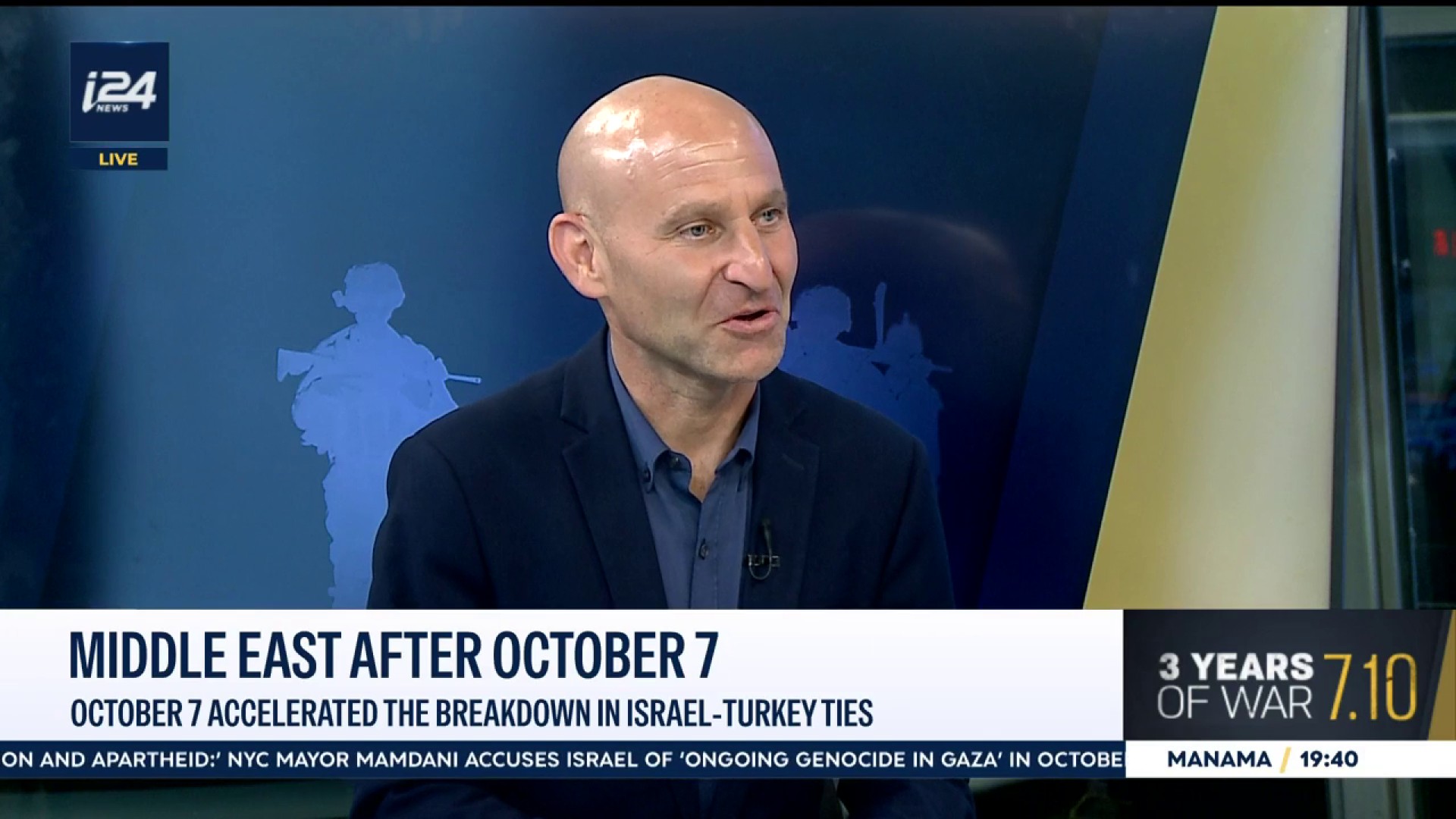
October 7th accelerates breakdown of Israel-Turkey relations

https://snippet.univtec.com/share/1f1732a2da                  

The answer lies in a combat concept that is changing naval warfare. In Turkish doctrine, the TB3 was never intended to operate alone. Its role is to serve as an inexpensive sensor that stays airborne for a full day, monitoring the waters below. Once the drone’s computer picks up a suspicious signal, the data are transmitted in real time to crewed patrol aircraft and warships in the area, which carry the weapons needed to engage the target.

To understand the lethal firepower waiting at the other end of this network, we need to return to an earlier phase of the exercise, held in June. There, Turkey demonstrated AKYA, its first domestically developed heavyweight torpedo. The Sakarya, a German-designed submarine upgraded with a Turkish combat management system called MÜREN, fired the torpedo at the target ship Sokullu Mehmet Paşa.


An underwater explosion beneath a ship’s hull creates a shock wave and an enormous gas bubble that expands and contracts, producing extreme bending forces capable of breaking the ship’s steel keel in two without penetrating the hull. An ATMACA sea-skimming anti-ship cruise missile was also fired during the same event, striking a target 102 kilometers away.

Together, these capabilities — September’s airborne sonar test and the firepower demonstrated in June — illustrate the underlying concern: a shift from traditional, cumbersome naval warfare toward a distributed network of inexpensive robotic sensors connected to domestically produced weapons.

For Israel’s submarine fleet, whose strength rests on remaining undetected, the message from Sea Wolf 2026 is a stark reminder: the depths may still offer concealment, but the surrounding sea is becoming an increasingly networked, technological battlefield, where robotic ears in the sky and heavy weapons in the water can challenge even the most closely guarded assets.

www.i24news.tv/en/news/israel/defense/artc-how-turkey-s-submarine-hunting-drones-could-challenge-the-israeli-navy

‘Go floppy’ if arrested, Palestine Action tells supporters in London


“All those intending on coming to this event know that supporting a proscribed organization is unlawful,” the Met Police said.


The Metropolitan Police in London said that it plans to arrest anyone who participates in a march supporting Palestine Action, a banned terrorist group, slated for Saturday near the U.S. embassy.

“All those intending on coming to this event know that supporting a proscribed organization is unlawful,” Adam Slonecki, a Met Police commander, told JNS. “They are essentially meeting to purposefully commit a crime.”

“I want to be clear. It is not just those who hold up placards who should expect to be arrested,” Slonecki said. “Anyone officers consider to be playing a key role in organizing the event, giving instructions to others and/or providing logistical support will very likely be committing an offense and face enforcement action.”

According to the Met Police, supporting Palestine Action—which was founded in the United Kingdom in July 2020 and designated a terrorist organization in July 2025—is an offense under the Terrorism Act.

The U.S. embassy in London warned U.S. citizens in the city to “avoid demonstrations and exercise caution if inadvertently near a demonstration.”

Defend the Jury, which plans to organize the protest, described it as a “sign-holding action.” It encouraged participants to sit on public land, not U.S. embassy property, and to hold signs that read, “I oppose genocide. I support Palestine Action.”

“Read this document carefully,” organizers advised. “Particularly the legal sections. It does involve flirting with the law a little, which can have serious consequences.”

At 12:30 p.m. on Saturday, demonstrators are scheduled to arrive at the location with blank signs. “Do not write the words on your sign beforehand, just in case you get stopped on your way by police,” organizers advised. “At 1 p.m. sit down and write, ‘I oppose genocide. I support Palestine Action’ on your sign.”

They recommended that participants bring a “burner” phone and leave their regular phone behind so that police officers won’t seize it. They are advised to sit “in silent contemplation” for an hour “until arrested.”

Organizers advised demonstrators that it will likely be cold and windy, and if they are arrested, they should “go floppy” to make officers’ jobs more difficult.

The phrase appears to recommend that protesters go limp, so that police officers will have to carry or drag them.

The organizers’ briefing document acknowledges that “taking part in this action requires a preparedness to be arrested, charged and taken to court under section 13 of the Terrorism Act 2000.”

“Finally, if convicted, you will be sentenced,” the document states. “S13 technically carries a sentence of up to six months in prison, but every indication from the government, court and lawyers has emphatically said that nobody should have any expectations whatsoever of getting any prison time.”

Organizers stated they are targeting the U.S. embassy in London because U.S. President Donald Trump “pushed the UK government to proscribe Palestine Action in early 2025.”

www.jns.org/news/world/go-floppy-if-arrested-palestine-action-tells-supporters-in-london


Arabs Stole Election

https://www.dailymail.com/news/article-16251625/Netanyahus-party-ramps-claims-Arab-parties-stole-election-warn-Israels-Islamisation-failing-win-majority.html

Netanyahu's party claims Arab parties stole the election and warns of 'Israel's Islamisation'

Supporters applaud Arab-led Joint List political alliance candidates in northern Israel

Supporters applaud Arab-led Joint List political alliance candidates in northern Israel

Israeli Prime Minister Benjamin Netanyahu's party amplified allegations that Arab-led parties had stolen the election.

The head of Israel's election committee, Supreme Court Justice Noam Sohlberg, said that 'serious suspicions' of foreign interference had been brought before him.

In a letter to the Shin Bet security agency, Mr Sohlberg said, given their serious nature, he asked the agency to investigate.

Mr Netanyahu's party responded: 'The elections in Israel have been stolen!'

The election interference was 'aimed at facilitating a foreign takeover of the Knesset, the Islamisation of Israel and toppling of the Right-wing government'.

Israeli media reported that members of Mr Netanyahu's party were accusing Qatar – a country that is a patron of Hamas, the Gaza-based militant group.

The election commission said the investigation was based on classified intelligence. 

Mr Netanyahu's main rival, former military chief Gadi Eisenkot, said: 'I welcome the fact that Netanyahu is condemning Qatari involvement in the State of Israel.'

Mr Netanyahu.has suggested that it would be treasonous for Mr Eisenkot to join with Arab parties to give him the backing he needs to oust Mr Netanyahu.

Netanyahu and Likud painted the Arab-led parties as a danger to Israel.

Arab citizens of Palestinian descent make up 20 per cent of the population and are viewed with suspicion because of their sympathies with other Palestinians.

President Isaac Herzog called for a full investigation. 

Ahmad Tibi, leader of the Ta'al (Arab Movement for Change) party and candidate for the Joint List alliance, casts his ballot

Ahmad Tibi, leader of the Ta'al (Arab Movement for Change) party and candidate for the Joint List alliance, casts his ballot

Arab-led Joint List political alliance candidates Mr Tibi (centre right), Yousef Jabareen (centre), and Sami Abu Shehadeh (centre left) attend a meeting of the Arab-led Joint List party

Arab-led Joint List political alliance candidates Mr Tibi (centre right), Yousef Jabareen (centre), and Sami Abu Shehadeh (centre left) attend a meeting of the Arab-led Joint List party

Mr Eisenkot has indicated he is open to joining forces with the Arab-led parties. 

Ahmad Tibi, second on the Arab-led Joint List, told Army Radio the opposition bloc reached out to him to discuss replacing the Knesset speaker, and he told them the party would support the bloc's candidate.

https://www.dailymail.com/news/article-16251625/Netanyahus-party-ramps-claims-Arab-parties-stole-election-warn-Israels-Islamisation-failing-win-majority.html

Home security agency Shin Bet is investigating whether they received illegal funding from Qatar and Turkey.

The two Arab party lists - The Joint List and the Ra'am - won a record 19 seats in the 120-seat Knesset following a surge in turnout among Arab voters.

That positions them as potential kingmakers, with Netanyahu's bloc winning 53 seats and his rival Gadi Eisenkot's bloc securing 48.


Likud alleged that voters had been bribed to vote for Arab parties.


EPA Yousef Jabareen and others celebrateEPA
Arab-led Joint List is headed by Yousef Jabareen (C) 


High Arab turnout is an emergency and a matter of life or death for the Israeli right. 


On Wednesday, Prime Minister Netanyahu wrote on X that Israel’s election had been “stolen by Arab parties that support terrorism and the elimination of the Jewish state,” alleging serious criminal offenses, including bribery, threats, violence, forgery and the use of prohibited software to mobilize voters.

“The Likud party is transferring to the police, the Shin Bet, and the Central Elections Committee hundreds of testimonies and pieces of evidence regarding election theft in many Arab polling stations,” he wrote.

He cited allegations of thousands of envelopes containing cash and Ra’am ballot slips, threats and violence against polling station staff, multiple votes cast behind the voting curtain, voting under multiple identities, discrepancies between the number of ballot envelopes and the number of voters, the use of prohibited voter-mobilization software and other offenses.

“We demand from the police and the Shin Bet a thorough investigation into the election theft by the Arab parties and the full prosecution of the criminals. We demand from the Central Elections Committee an immediate response to investigate these criminal offenses that have severely damaged the integrity of the elections in Israel and the election results,” he added. 

A government dependent on Arab parties’ support, would lead to the establishment of a Palestinian state that would become a terror state and ultimately bring about Israel’s destruction.

"Between 85% and 90% of Arab voters support Arab parties. This is the main reason for their political strength.”

In September, the Central Elections Committee (CEC) voted to disqualify the Joint List and the United Arab list from competing in the Oct. 27 elections. On Oct. 2, Israel’s Supreme Court overturned the CEC’s decisions against both parties.


Martin Sherman, founder and executive director of the Israel Institute for Strategic Studies, told Fox News Digital that Arab parties in Israel are essentially illegal and should be barred from participating in elections.

“On the political level, they all oppose Israel as the nation-state of the Jewish people. One can only hope that politicians in Israel will realize that,” he said.

Section 7A of the Basic Law: The Knesset bars candidates who deny Israel’s existence as a Jewish and democratic state, or support the armed struggle of an enemy state or terrorist organization against Israel, from participating in Knesset elections.

A Joint Arab List MK received hundreds of thousands of shekels in cash


A Knesset member from the Joint List received hundreds of thousands of shekels in cash, raising suspicions of bribery and money laundering.


A Knesset member from the Joint List received hundreds of thousands of shekels in cash in a case that has raised suspicions of bribery and money laundering, i24NEWS reported on Sunday.

The report comes against the backdrop of two separate investigations involving suspicions of improper influence on the recent elections.

The first case concerns suspicions of election bribery within the Bedouin community in the Negev, involving activists affiliated with the Ra'am Party. The allegations include claims that fuel cards and other benefits were distributed, allegedly in an effort to influence how citizens voted.

The second case concerns suspected foreign interference in the election campaign, which is being investigated by the Shin Bet.

Last Thursday, Central Elections Committee Chairman Justice Noam Sohlberg contacted Shin Bet Director David Zini following intelligence indicating suspected foreign funding intended to improperly influence the elections, and asked him to investigate the allegations.

Initially, reports focused on suspicions that money had been transferred from Qatar to individuals working to increase voter turnout in the Arab community.

Subsequent reports indicated that the Shin Bet was also examining the possible involvement of additional countries and that the Mossad was assisting with aspects of the investigation concerning the activities of foreign states.

According to the reports, the Shin Bet received the initial intelligence before the elections, and a covert investigation was launched under the supervision of the Attorney General.

At a later stage, as the intelligence picture became clearer, the Prime Minister and the chairman of the Central Elections Committee were also briefed.

https://www.israelnationalnews.com/news/435460