Thursday, 28 August 2025

"Migrants" Riot in Switzerland


Dramatic riots have erupted in a Swiss city after a migrant teen was killed in a scooter crash while fleeing the police.

Riot cops clashed with protesters who hurled Molotov cocktails in Lausanne as officials desperately tried to put a lid on escalating violence. 

Marvin M, a 17-year-old Swiss resident of Lausanne, was fleeing police on a stolen scooter, when he hit a garage wall and died at around 3.45am Sunday, despite resuscitation attempts by emergency services.

The public prosecutor of the canton of Vaud has launched a criminal investigation into the circumstances of the accident. 

It was the third death in less than three months in Lausanne during a police intervention. There have been seven such deaths in the city and the wider Vaud region since 2016. Five involved men of African origin.

On Sunday night, 'around 100 young people, wearing balaclavas' gathered in the Prélaz neighborhood from 9.30pm, throwing fireworks at police, burning trash cans and damaging a bus belonging to the Lausanne transport company.

The following night, 150 to 200 people set up roadblocks using trash containers, setting them on fire, police said. Some 140 cops clashed with the rioters, who torched buses and pelted them with stones. Police also responded to the riots using tear gas and rubber bullets.

A person sets a traffic cone on fire as burning containers block the street during the third night of riots in Lausanne, Switzerland, Tuesday August 26, 2025

A person sets a traffic cone on fire as burning containers block the street during the third night of riots in Lausanne, Switzerland

Burning containers block the street during the third night of riots in Lausanne, Switzerland, Tuesday August 26, 2025

Burning containers block the street during the third night of riots in Lausanne, Switzerland

Lausanne authorities sought to head off a third night of violence in the Swiss city

Lausanne authorities sought to head off a third night of violence in the Swiss city

Marvin M, (pictured) a 17-year-old Swiss resident of Lausanne, was fleeing police on a stolen scooter when he hit a garage wall and died at around 3:45am Sunday, despite resuscitation attempts by emergency services

Marvin M, (pictured) a 17-year-old Swiss resident of Lausanne, was fleeing police on a stolen scooter when he hit a garage wall and died, despite resuscitation attempts by emergency services

Police used 54 tear gas grenades and made seven arrests.

'Pyrotechnic devices were used against the police; it's scandalous,' Lausanne city's security councillor Pierre-Antoine Hildbrand told the Keystone-ATS news agency.

'We are facing a movement that has nothing to do with the death of this youth, but which is using it as an excuse to attack law enforcement. It's disgraceful.'

Lausanne authorities sought Tuesday to head off a third night of violence in the Swiss city. 

Police have acknowledged that a car was following the teenager who died early Sunday. But the Vaud public prosecutors' office issued a statement 'with the aim of clarifying and calming the situation'.

It said two motorists approached the teenager before police arrived at the crash site. This tended to confirm there was a 'significant distance' between the scooter and the pursuing police vehicle and 'no contact' between them, the statement added.

Officers confirmed police had been following Marvin before the crash but claimed he lost control at high speed in a 18mph zone.

Thibault Schaller, a local councillor for the Conservative anti-immigration Swiss People's Party (SVP), confirmed the account having been at the scene. 

Claiming he was attacked, he said on X that a group of about 10 to 15 people surrounded him on all sides and struck him.

'Buses and trash cans set on fire in Prélaz (Lausanne) in reaction to the death of the 17-year-old youth who died Sunday morning while fleeing the police on a stolen scooter,' he tweeted. 

'Unaware of what it's about, I head to the scene. Some antifa recognise me, three surround me, back against the wall, and they order me to leave.'

'I refuse and ask what's happening. One pushes me, I push him back then step back, someone shouts something, and ten, fifteen people come running at me from everywhere,' he continued. 

A young person walks past fires in a street, in Lausanne, on August 25, 2025, during a second night of rioting following the death of a teenager who tried to escape local police while driving a stolen scooter

A young person walks past fires in a street, in Lausanne, during a second night of rioting following the death of a teenager who tried to escape local police while driving a stolen scooter

Police officers intervene during the second night of riots following the fatal accident involving a minor on a scooter in Lausanne, Switzerland, 25 August 2025

Police officers intervene during the second night of riots following the fatal accident involving a minor on a scooter in Lausanne, Switzerland

Containers burn during the second night of riots following the fatal accident involving a minor on a scooter in Lausanne, Switzerland, 25 August 2025

Containers burn during the second night of riots following the fatal accident involving a minor on a scooter in Lausanne, Switzerland

Fireworks explode near police officers in riot gear in Lausanne, on August 25, 2025

Fireworks explode near police officers in riot gear in Lausanne

The unrest comes with the Olympic capital's police in the spotlight after four officers were suspended Monday following the unearthing of racist, sexist and discriminatory messages in private WhatsApp groups

'I run away, take hits, they block my path, I fall, protect myself, I pick up while one or two people tell me to leave. I get up, run, get surrounded again against a wall, blows, then I manage to get away by running,' he said.

Lausanne - run by a left-wing coalition of Socialists and Greens - has become the latest flashpoint following the death of the teen.

For years, the city's authorities have championed progressive policies, embracing diversity drives and refugee settlement schemes. 

But critics say the reality on the ground tells a very different story.

Over the past decade, Switzerland has taken in more than 200,000 refugees - many from Eritrea, Somalia, Syria and Afghanistan, alongside arrivals from other African and Muslim-majority countries.

What was once hailed as a model of compassion has instead fuelled mounting tensions, with simmering unease now spilling onto the streets.

Police officers intervene during the second night of riots following the fatal accident involving a minor on a scooter in Lausanne, Switzerland, 25 August 2025

Police officers intervene during the second night of riots following the fatal accident involving a minor on a scooter in Lausanne, Switzerland

A 17-year-old Swiss resident of Lausanne fleeing police on a scooter reported stolen on Saturday, hit a wall and died early Sunday, despite resuscitation attempts by emergency services

A 17-year-old Swiss resident of Lausanne fleeing police on a scooter reported stolen on Saturday, hit a wall and died early Sunday, despite resuscitation attempts by emergency services

It was the third death in less than three months in Lausanne during a police intervention

It was the third death in less than three months in Lausanne during a police intervention

On Sunday night, 'around 100 young people, wearing balaclavas' set fire to several containers and damaged a bus, police said

On Sunday night, 'around 100 young people, wearing balaclavas' set fire to several containers and damaged a bus, police said

Critics argue the focus on policing is little more than a distraction – a way to dodge questions over Switzerland's failing immigration policies. 

For decades, Switzerland quietly watched as France, Britain and Germany wrestled with unrest linked to immigration and integration. 

Now, the same scenes of anger and division are playing out on Swiss streets too. 

It comes almost a year after Switzerland announced plans to cap its population to ten million as part of an immigration crackdown under plans put forward by the hard-right People's Party.

The Swiss People's Party (SVP) - which is the largest in the ruling coalition of four parties - launched the anti-immigration initiative in 2023, which was signed by more than 115,000 residents and could be on the ballot as soon as 2026. 

The initiative demands that the population of those permanently living in Switzerland doesn't exceed ten million before 2050 after the country first recorded nearly 9 million residents in 2023. 

As soon as population numbers reach nine and a half million, the initiative demands that 'temporarily admitted persons [foreigners] shall not receive a residence or settlement permit, Swiss citizenship or any other right of residence.'

After 2050, the initiative demands that the Federal Council sets a new immigration limit based on the excess of births.

In 2023, about 180,000 people immigrated into Switzerland.

More than every fourth resident in Switzerland was a foreigner, which is one of the highest rates in Europe.

https://www.dailymail.co.uk/news/article-15039019/Riots-erupt-Swiss-city-migrant-teen-killed-scooter-crash-fleeing-police.html

The Swiss city of Lausanne was rocked this week by youth race riots after a migrant from Gambia died while fleeing from police on a motorbike.

The fourth-largest city in Switzerland saw youths rampage and riot, setting fires, throwing molotov cocktails, vandalising buses, building garbage barricades on the streets, while attacking police officers with stones and fireworks.

Police deployed tear gas, rubber bullets, and water cannons to combat the hundreds of youth rioters. Police were also forced to protect firefighters as they attempted to stamp out fires set by the mob in the French-speaking city.

The measure widely known as the 'burqa ban' will take effect in every Swiss canton on January 1 (pictured: a poster calling for the ban prior to the 2021 referendum)

The 'burqa ban' allows fines of 900 pounds for wearing a burqa.


Wednesday, 27 August 2025

8,500 Years Old Sunken Stone Age City Found Off Coast of Denmark


Stone Age 'Atlantis' lost to the sea 8,500 years ago offers new glimpse into prehistoric life

Archaeologists have discovered an underwater city in Denmark's Bay of Aarhus, which is being hailed as the Stone Age Atlantis.

The team uncovered animal bones, stone tools, arrowheads, a seal tooth and a small piece of worked wood, likely a simple tool, which they believe indicates a human presence with structured activities.

The researchers have excavated an area of about 430 square feet at the small settlement. 

The last ice age ended about 8,500 years ago, and massive ice sheets began to melt. 

Sea levels rose rapidly, sometimes by several meters per century, flooding Stone Age settlements and forcing hunter-gatherer communities further inland. 

Rising global sea levels dramatically reshaped coastlines, according to underwater archaeologist Peter Moe Astrup, who is leading the excavations. 

'It is like a time capsule. When the sea level rose, everything was preserved in an oxygen-free environment … time just stops,' he said. 

'We actually have an old coastline. We have a settlement that was positioned directly at the coastline.'

Archaeologists have discovered a lost city below the sea, hailed as the Stone Age Atlantis

Archaeologists have discovered a lost city below the sea, hailed as the Stone Age Atlantis

Underwater archaeologist Peter Moe Astrup inspects a tiny animal bone, unearthed at an 8,500-year-old Stone Age coastal settlement found in the Bay of Aarhus in Aarhus, Denmark

Underwater archaeologist Peter Moe Astrup inspects a tiny animal bone, unearthed at an 8,500-year-old Stone Age coastal settlement found in the Bay of Aarhus in Aarhus, Denmark

This summer, divers carefully descended about 26 feet below the waves near Aarhus, Denmark's second-largest city, using specialized underwater vacuums to collect delicate artifacts without damaging them. 

The team combed the site foot by foot, documenting each find in detail, allowing researchers to reconstruct the layout and daily life of a settlement frozen in time. 

The discovery is part of a $15.5million six-year international project to map parts of the seabed in the Baltic and North Seas. 

Its goal is to explore sunken Northern European landscapes and uncover lost Mesolithic settlements as offshore wind farms and other sea infrastructure expand. 

Most evidence of such settlements has previously been found inland from the Stone Age coast, but the recent discovery is among the first to be uncovered below the sea. 

Moe Astrup said he and his team hope further excavations will find harpoons, fish hooks or traces of fishing structures.

The site offers a rare glimpse into how Mesolithic people interacted with their environment. 

Living directly on the coastline, the inhabitants would have relied heavily on fishing, hunting seals and gathering plants from nearby forests. 

The team found submerged trees on the seabed, allowing them to date the settlement to around 8,500 years old

The team found submerged trees on the seabed, allowing them to date the settlement to around 8,500 years old

The preservation of organic materials such as wood and nuts allows researchers to understand not just what people made and ate, but also how they adapted tools and techniques to survive in a changing landscape. 

Excavations in the relatively calm and shallow Bay of Aarhus and dives off the coast of Germany will be followed by later work at two locations in the more inhospitable North Sea.

Thousands of years ago, the sea-level rise also submerged a vast area known as Doggerland, which connected Britain to continental Europe and now lies beneath the southern North Sea

To track how quickly the waters rose, Danish researchers are using dendrochronology, the study of tree rings. 

Submerged tree stumps preserved in mud and sediment can be dated precisely, revealing when rising tides drowned coastal forests. 

The team uncovered animal bones, stone tools, arrowheads, a seal tooth and a small piece of worked wood, likely a simple tool (pictured)

The team uncovered animal bones, stone tools, arrowheads, a seal tooth and a small piece of worked wood, likely a simple tool (pictured)

'We can say very precisely when these trees died at the coastlines,' Moesgaard Museum dendrochronologist Jonas Ogdal Jensen said as he peered at a section of Stone Age tree trunk through a microscope.

'That tells us something about how the sea level changed through time.'

The researchers hope to shed light on how Stone Age societies adapted to shifting coastlines more than eight millennia ago.

'It´s hard to answer exactly what it meant to people,' Moe Astrup said. 'But it clearly had a huge impact in the long run because it completely changed the landscape.'

https://www.dailymail.co.uk/sciencetech/article-15036575/Stone-Age-Atlantis-prehistoric-life-denmark.html


Bay of Aarhus


Diver's Boat in Bay of Aarhus


Map of Doggerland


Tuesday, 26 August 2025

Genetic Disorders caused by Muslim inbreeding used to create Starvation Hoaxes


Israel Shames UK Daily Mirror over False ‘Starving Child’ Front Page

The Israeli Ministry of Foreign Affairs (MFA) took the UK Daily Mirror to task for featuring a front-page photograph of a “starving” Palestinian child who in fact suffers from a genetic disorder — the latest such case.

As Breitbart News has reported, Israel is pushing back hard against mainstream media reports in the West that have falsely depicted Gazan children (and only children) as “starving” when they have other conditions.

Some of the allegedly starving Palestinian children were, in fact, given medical treatment by Israel, or flown to other countries for such treatment.

In the latest example, the Daily Mirror presented 3-year-old Karim Ali Fouad Abu Mu’amar on its front page Saturday, claiming that he was starving as a result of Israel’s continued fight against the Hamas terrorists who started a war by murdering 1200 Israelis, mostly civilians, on October 7, 2023.

Israel presented Mu’amar’s medical records from several years ago, proving he suffered from a condition that caused malnourishment that had nothing to do with the conflict or access to humanitarian aid in Gaza.

False reports of starvation are driving an apparent surge of anti-Israel sentiment in the West that has prompted several left-wig governments to declare that they will recognize a Palestinian state — without any release of Israeli hostages by Hamas, or any commitment by Palestinian leaders to democratic principles or human rights, much less an end to the use of terrorism and incitement against their Israeli neighbors.

https://www.breitbart.com/the-media/2025/08/25/israel-shames-uk-daily-mirror-over-false-starving-child-front-page/

‘Hamas Propaganda’: Israel Blasts Daily Mirror for Cover Portraying Gaza Child’s Disorder as Starvation

The Israeli Foreign Ministry on Sunday accused the UK’s Daily Mirror of “spreading Hamas propaganda” after the publication featured a Saturday front-page photo under the headline “Stop Starving Gaza’s Kids” showing a Palestinian child who suffers from a rare genetic disorder rather than starvation.

The Daily Mirror’s cover on Saturday displayed a photograph of Kareem Muammar, a three-year-old Gaza boy suffering from Fanconi-Bickel syndrome, a rare genetic condition affecting the liver, kidneys, and intestines that disrupts nutrient absorption. The publication presented the image as evidence of Israeli-induced starvation without disclosing the child’s pre-existing medical condition.

Social media users identified the missing context, prompting X to add a Community Note stating the outlet had “concealed important context from their readers about a child from Gaza.”

The Israel Defense Forces on Sunday afternoon revealed documents showing additional details about the child’s condition. COGAT (Coordinator of Government Activities in the Territories) stated the boy’s full name as Karim Ali Fouad Abu Mu’amar and confirmed he “suffers from a genetic illness – Fanconi syndrome – which led to muscle and urinary tract weakness” and noted it is “a hereditary disease that affected other family members as well.” COGAT further criticized the broader media pattern, stating: “Hamas continues to spread false narratives as part of a deceptive propaganda campaign, while media outlets around the world continue to serve as their platform without any verification.”

The incident follows a documented pattern of major western outlets featuring misleading images of Palestinian children. The New York Times was forced to issue corrections after featuring a front-page photo of an emaciated Palestinian child who suffered from a muscular disorder rather than starvation.

Free Press investigation reported that at least twelve Palestinian children presented as “starving” in viral photos actually had significant pre-existing health problems including cystic fibrosis, rickets, and other serious ailments. These images appeared across outlets including CNNNPR, and the Times without proper medical context.

Israeli Prime Minister Benjamin Netanyahu recently warned he might sue the New York Times for defamation over that front-page photo, calling such narratives “malignant lies that were leveled at the Jewish people in the Middle Ages.”

Hamas has systematically used such imagery for propaganda while blocking food distribution to Palestinian civilians and publishing videos of actually starving Israeli hostages. Meanwhile, Hamas terrorists have been caught feasting underground on lavish meals while exploiting Gaza civilians’ suffering above. Israeli officials have challenged western media to give equal prominence to photographs of emaciated Israeli hostages experiencing genuine starvation in Hamas captivity, but those requests have been largely ignored.

https://www.breitbart.com/politics/2025/08/24/hamas-propaganda-israel-blasts-daily-mirror-for-cover-portraying-gaza-childs-disorder-as-starvation/


Monday, 25 August 2025

Israel Medical News: World's first spinal cord transplant to take place in Israel, could allow patients to walk again


World's first spinal cord transplant to take place in Israel, could allow patients to walk again


Tel Aviv University announced on Wednesday that the surgery will take place in Israel, marking a historic milestone in regenerative medicine.

By Pessach Benson / TPS, Jerusalem Post, August 20, 2025

DTRAX X-ray (photo credit: COURTESY SAMSON ASSUTA ASHDOD MEDICAL CENTER)


Israel is preparing to perform the world’s first-ever human spinal cord implant using a patient’s own cells, a medical breakthrough that could allow paralyzed patients to stand and walk again, Tel Aviv University announced on Wednesday. The surgery, expected in the coming months, will take place in Israel and marks a historic milestone in regenerative medicine.

According to the World Health Organization, over 15 million people worldwide are living with spinal cord injuries, with the majority resulting from traumatic causes such as falls, road traffic accidents, and violence.

Currently, spinal cord injuries cannot be fully cured, so treatment focuses on stabilizing the patient, preventing further damage, and maximizing function. Emergency care often involves immobilizing the spine, reducing inflammation, and sometimes performing surgery to repair fractures or relieve pressure.

Rehabilitation includes physical and occupational therapy, as well as assistive devices like wheelchairs and braces. While experimental therapies—including stem cells and robotic devices—are being explored, no treatment yet reliably restores full spinal cord function.

Spinal cord injuries are one of the few human injuries where the body cannot naturally heal itself, and the tissue is both structurally complex and extremely sensitive.

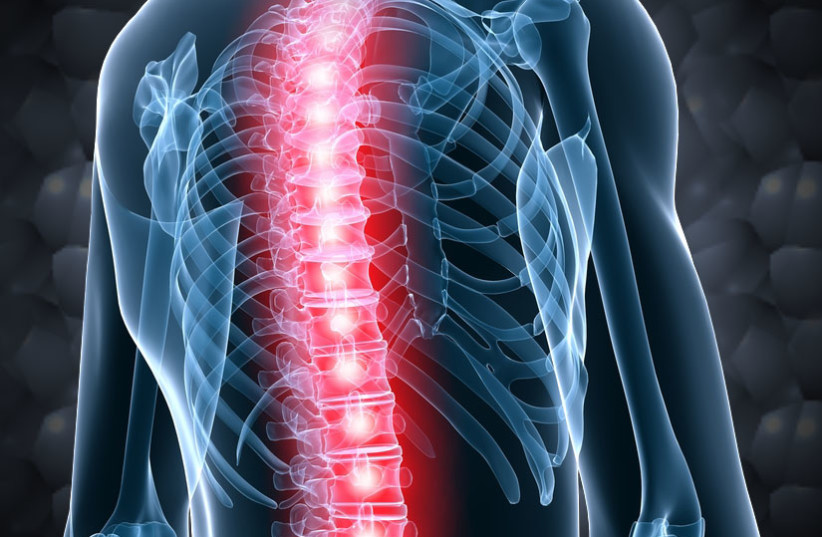
A 3D image of a human spinal cord. (credit: CC BY-NC-SA 2.0)


“The spinal cord transmits electrical signals from the brain to all parts of the body. When it is severed by trauma—such as a car accident, a fall, or a combat injury—the chain is broken. Think of an electrical cable that has been cut: when the two ends no longer touch, the signal cannot pass, and the patient remains paralyzed below the injury,” explained Professor Tal Dvir, head of the Sagol Center for Regenerative Biotechnology and the Nanotechnology Center at Tel Aviv University, who is leading the effort. Dvir is also the chief scientist at Matricelf, the Israeli biotech company commercializing the technology.

Unlike other tissues, spinal cord neurons cannot naturally regenerate, and over time, scar tissue blocks remaining signals. The new procedure aims to replace the damaged section with a lab-grown spinal cord that fuses with healthy tissue above and below the injury. Animal studies in rats have shown remarkable results, with the animals regaining the ability to walk normally.

The innovation began about three years ago, when Dvir’s lab engineered a personalized three-dimensional human spinal cord in the laboratory. The findings, published in the peer-reviewed journal Advanced Science, showed that mice with chronic paralysis regained mobility after receiving the engineered implants.

The procedure begins with blood cells from the patient, which are reprogrammed into stem-cell-like cells capable of becoming any cell type. Fat tissue is also collected to create a custom hydrogel scaffold, into which the stem-like cells develop into a spinal cord structure. This engineered tissue is then implanted, replacing scarred areas and reconnecting the nervous system.

Israel's Helath Ministry approves "compassionate use" trials

A few months ago, Prof. Dvir and his team received preliminary approval from Israel’s Ministry of Health for “compassionate use” trials in eight patients, making Israel the first country to attempt this procedure. “This is undoubtedly a matter of national pride. The technology was developed here in Israel, at Tel Aviv University and at Matricelf, and from the very beginning it was clear to us that the first-ever surgery would be performed in Israel, with an Israeli patient,” Dvir said.

The technology was then commercialized through Matricelf, which was founded in 2019 under a licensing agreement with Tel Aviv University’s technology transfer company, Ramot.

“This milestone marks the shift from pioneering research to patient treatment. Using each patient’s own cells eliminates key safety risks and positions Matricelf at the forefront of regenerative medicine. This first procedure is more than a scientific breakthrough; it is a step toward transforming an area of medicine long considered untreatable,” said Matricelf CEO Gil Hakim.

He added, “If successful, this therapy could define a new standard of care in spinal cord repair, addressing a multi-billion-dollar market with no effective solutions today. We are proud that Israel is leading this global effort and are fully committed to bringing this innovation to patients worldwide.” 

“Our goal is to help paralyzed patients rise from their wheelchairs. The animal model trials showed extraordinary success, and we are hopeful that the results in humans will be just as promising,” Dvir said.


Please Recommend this page and follow us athttps://disqus.com/home/forum/the-coconut-whisperer/