Friday, 22 January 2021

Vaccines may not work as well against the coronavirus variant detected in South Africa, research shows. People may also face a risk of reinfection.

 https://news.yahoo.com/vaccines-may-not-well-against-001116055.html


  • covid vaccine trials south africa

A volunteer receives an injection for a potential COVID-19 vaccine at the Baragwanath Hospital in Soweto, South Africa on June 28, 2020. Felix Dlangamandla/Beeld/Gallo Images via Getty Images

At first, there was little evidence to suggest that COVID-19 vaccines wouldn't work against the mutated, more infectious versions of the virus that have emerged in the last few months.

But preliminary research published this week suggests that a coronavirus variant detected in South Africa in December can partially evade the defenses vaccines build in our bodies' immune 


  • COVID-19 vaccines may be less effective against a more infectious version of the coronavirus first found in South Africa.

  • New research shows the mutated strain can evade the antibodies developed in response to vaccination or infection with the original version of the coronavirus.

  • But Pfizer has said it could update its shots to combat new variants in just six weeks.


At first, there was little evidence to suggest that COVID-19 vaccines wouldn't work against the mutated, more infectious versions of the virus that have emerged in the last few months.

But preliminary research published this week suggests that a coronavirus variant detected in South Africa in December can partially evade the defenses vaccines build in our bodies' immune systems.


The research has not yet been peer-reviewed, but it suggests the variant, known as 501Y.V2, can escape antibodies developed in response to vaccination or infection with the original version of the virus. That may mean existing vaccines won't provide as much protection, and people who have already been infected with the original version of the virus could get reinfected with the new strain.

Penny Moore, a researcher at South Africa's National Institute for Communicable Diseases and co-author of the new study, said during a webinar on Monday that compelling data shows the mutations in 501.Y.V2 to be "problematic."

Her group's research found that in half of samples studied in the lab, antibodies in the blood of people who had recovered from COVID-19 were unable to stop the variant.

"Based on Penny's data, it's likely that the vaccine is going to be somewhat less effective, but how much less effective we don't know," David Montefiori, a virologist at Duke University Medical Center who was not involved in the study, told CNN.

The variant can dodge our body's defenses

convalescent plasma donor
Stephen Craib, who recovered from COVID-19, makes a blood donation in London. Kirsty O'Connor/PA Images/Getty Images

Antibodies are protective proteins that our immune system generates when it senses a foreign substance, or antigen, in the body. These proteins are generated during an infection, and they're what a vaccine prompts the body to build in order to prevent illness.

In general, antibodies fight infection by learning to recognize a virus and signaling to the immune system that it should be destroyed. They do that by binding to the invader until it's wiped out. But if a virus is different enough from others to evade existing antibodies' search-and-destroy mechanisms, it can continue to wreak havoc.

The South African researchers set out to see whether antibodies developed in response to the original version of the coronavirus work to protect people from the new variant. They used blood samples from 44 patients who'd recovered from COVID-19 before the 501.Y.V2 variant was detected.

The scientists exposed the blood to the new variant and found that the antibodies in half of the samples were impotent against the strain. Antibodies in the other half of the samples mounted a weakened response.

These results "may foreshadow reduced efficacy" of existing vaccines, the team wrote. They also warned that people who've gotten the original coronavirus may be at risk of new infections from variants like 501.Y.V2.

Furthermore, Moore's group found that three types of monoclonal antibodies - laboratory-made antibodies designed to target the coronavirus - were ineffective against the variant. Doctors have been using monoclonal antibodies to treat patients; the Food and Drug Administration has authorized two such treatments.

monoclonal antibody factory
Scientists work at a monoclonal antibody laboratory plant in Buenos Aires, Argentina, on August 14, 2020. Juan Mabromata/AFP/Getty Images

Still, Moore said more data is needed to draw firm conclusions about how the variant interacts with antibodies inside the body, especially among people who've been vaccinated. The research also did not look at other elements of the immune system, like B cells, which play a critical role in developing new antibodies.

Nathan Grubaugh, an epidemiologist from the Yale School of Public Health, said it's hard to tell how well laboratory tests translate to reality in the body. A 90% reduction in protection during a lab test "may still mean complete protection in a human," he told Insider.

As the virus mutates, vaccines may need to evolve

pfizer vaccine
A nurse holds a vial of the Pfizer-BioNTech coronavirus vaccine. Vincent Kalut / Photonews via Getty Images

The 501Y.V2 variant has one particular mutation in its spike protein - the part the virus uses to invade cells - that has "been shown to reduce antibody recognition" among people who had a prior infection or vaccination, according to Francois Balloux, the director of the University College London Genetics Institute.

Other mutations in the spike protein contribute to 501.Y.V2's increased infectiousness, the South African researchers said. That could explain why the country has been hit so hard since November. In the last two months, the number of new coronavirus cases per day in South Africa quintupled, from an average of 2,300 to 13,000. It hit a record high of nearly 22,000 cases on January 8, and the country's test-positivity rate doubled in December. By the end of 2020, 501.Y.V2 had replaced almost all other versions of the coronavirus in South Africa.

It has spread to at least 20 countries.

Other variants like the one found in the UK have similar mutations in their spike protein. But a preliminary study from Pfizer-BioNTech found that the company's coronavirus vaccine is effective against that variant.

Jesse Bloom, a biochemist a the Fred Hutch Institute in Seattle, said in a statement that he's "optimistic that current vaccines will remain quite useful," though he added that as the coronavirus continues to evolve, "eventually it may be necessary to update vaccines."

An updated vaccine could be 'rapidly deployed'

Moderna vaccine
Moderna COVID-19 vaccination information kept at the Research Centers of America in Hollywood, Florida. Photo by CHANDAN KHANNA/AFP via Getty Images

All viruses mutate. Most mutations are inconsequential, but occasionally one appears that undermines the immunity people have acquired from a vaccination or prior infection. The flu, for instance, mutates quickly, which is why we have to get a new flu shot every year, and why flu vaccines aren't 100% effective.

Thee coronavirus mutates slower than the flu. That's why Trevor Bedford, a virologist at Fred Hutch, predicted in April that "it will take the virus a few years to mutate enough to significantly hinder a vaccine." But Bedford didn't know at the time how much the virus would proliferate and how high case numbers would climb; the more chances a virus has to spread (and therefore replicate), the more likely mutations become.

On Wednesday, Bedford tweeted that "the emerging situation can be dealt with through a forthcoming vaccine update."

BioNTech, Pfizer's partner, said it could produce a new vaccine for a COVID-19 variant in about six weeks. Tal Zaks, Moderna's chief medical officer, said his company's process would be quick, too.

"I think our technology is very well suited to actually rapidly deploy a vaccine based on the new variant," Zaks said in a recent presentation at the J.P. Morgan Healthcare Conference.

That's because these mRNA vaccines don't contain dead versions of virus, but rather genetic instructions for the body to make one of the virus' signature proteins internally, thereby triggering an immune response. Tweaking those instructions is an easy switch.

The decision to sign off on a modified vaccine would then be up to regulators.

Immunity to a virus isn't all or nothing

Vaccine, US, Kentucky
Nurse Beth Sum receives a COVID-19 vaccination at the University of Louisville Hospital in Kentucky. Jon Cherry/Getty Images

Even if the variant does reduce how well current vaccines work, that doesn't mean protection from infection disappears completely, experts say.

"We often talk about immunity as sort of an all-or-nothing thing, but it's not," Jennie Lavine, a postdoctoral biology researcher at Emory University, told Insider.

The ideal level of protection is sterilizing immunity - when "we have such good immunity in the right places that the virus can't even replicate if it gets in," Lavine said.

But there's plenty of middle ground between that and zero immunity. For example, Lavine said, "the virus might be able to replicate some, maybe causes mild pathology, maybe transmits for a day or two instead of five or six days."

She added: "The chances that the new variant is getting us all the way from sterilizing immunity to no immunity is really unlikely."

It also helps that existing vaccines are highly effective against the original virus.

"The Pfizer and Moderna vaccines are 95% effective - that's an extraordinary level of efficacy," Montefiori told CNN. "If it reduces to 90, 80, 70% effective, that is still very, very good and likely to have a major impact on the pandemic."

Catherine Schuster-Bruce and Aria Bendix contributed reporting to this story.

Read the original article on Business Insider

How African body markings were used to construct the idea of race in colonial Brazil

 How African body markings were used to construct the idea of race in colonial Brazil


In the 1700s, the gold rush in southeast Brazil created a high demand for mining labour. The Minas Gerais region became one of the main destinations for African slaves. For the first half of the century, demand was met by a trade circuit connecting the ports of the Bight of Benin to Salvador in Bahia.

People from those ports acquired a reputation among the Portuguese as the best hands for mining gold.

With time, they created a commercial system of slave classification. Many Africans were grouped with the understanding that they are naturally suited for certain jobs. Slaves were sorted by anatomy and the purported ability to function better in certain climates, resistance to diseases, and life expectancy. Based on this classification, they were either assigned to the fields or less rigorous housework.

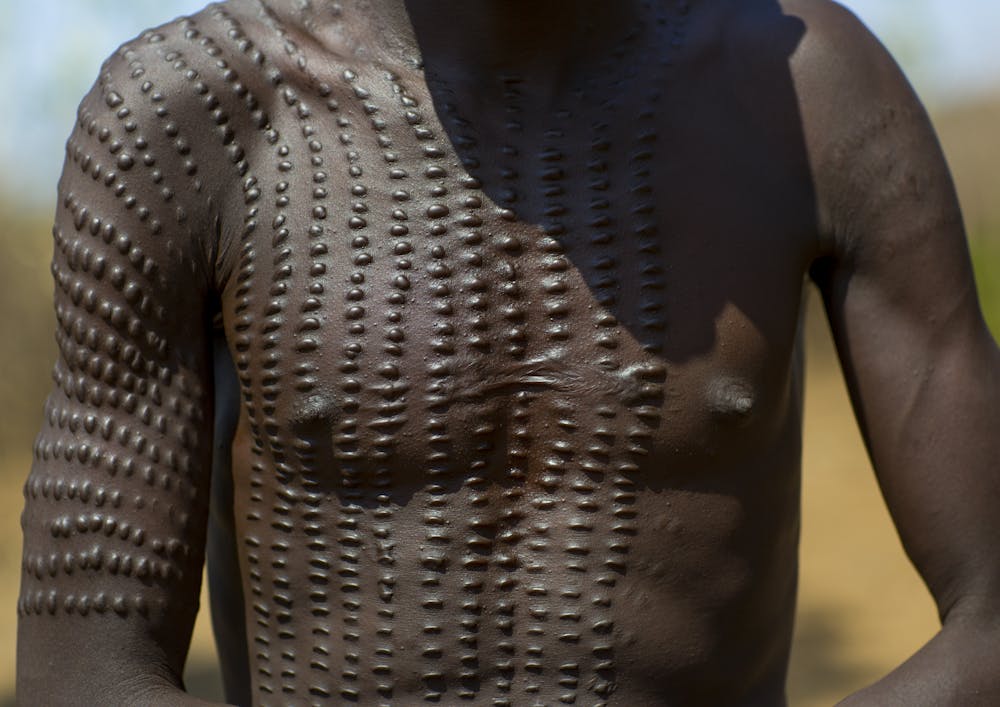
This process of stereotyping was unwittingly aided by many Africans with body markings. The markings represented aspects of their lives. They were commonly scarification marks, tattoos and cuts. These indicated their identities, ethnicity, religious affiliation, life events, accomplishments and social status.

Sometimes they were made to obtain spiritual protection. Others were permanent beauty marks. These meanings were lost to the Portuguese. They used them simply to profile and identify slaves. The markings also helped to recapture escaped slaves and ensure slaveholders paid taxes.

Scarifications on an Ethiopian Topossa man. Eric Lafforgue/Art in All of Us/Corbis/Getty Images

In my study of colonial archives, I researched how physical attributes shaped the way Africans were viewed. Race relations in Brazil are generally thought of in terms of multiple skin colours categories associated with various interethnic relationships. But its largest enslaved population consisted of Africans. So, it is important to understand how colonial society dealt with their diversity of origins to construct blackness.

Slavery in Brazil did not, in fact, automatically erase the diversity of African origins and reduce people to one racial category – ‘Black’. It happened over time.

The slave economy

In the Brazilian regions where gold and diamonds were mined, slave ownership was taxed. The tax office began listing slaves’ Christian names, ages, origins, purchase price and body markings in official registries. They also put this information on the identification cards that slaves had to carry with them. Scarification was then used as a marker of the person’s homeland.

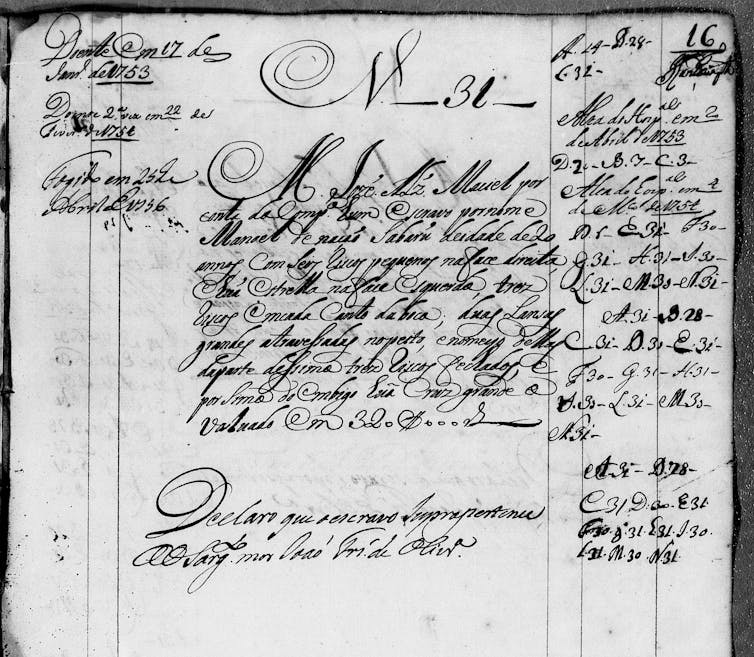
Here’s a description I found from 1752:

“Domingos Sabarú, 20 years old, with smallpox pockmarks, and four small spears on top of his right eyebrow, two circles on top of the left eyebrow, a small grid in the middle of the eyebrows, a star at the temple in the corner of his right eyebrow and the more signs that are on every face of Sabarú, valued at 300 thousand réis”. (Sabarú is currently Savalou, Benin).

A paper with a description of body markings.
A Brazilian colonial record describing African body markings. Arquivo Público Mineiro, Matrícula de escravos.

These colonial interpretations of African scarifications oversimplified their original meanings. In several regions, their meanings went far beyond ethnicity or origin. In West Africa, some skin patterns express religious affiliation with specific entities of the hierarchy of gods and deified ancestors called voduns in the Gbe-speaking area or called orishas in the Yoruba territories. In these cases, marking were acquired as part of the rites of initiation.

Other markings are records of significant events such as a death in the family. They can also symbolise belonging to a complex multi-levelled society. These marks indicated an individual’s age, medical history, and their social, political and gender-related status. Some marks are formed from the injection of medicines and substances believed to offer protection from unseen forces. Some were just creative expressions.

Brazil represented almost half of the entire Atlantic trade. Its 18th century colonial society never saw Africans as homogeneous people. Nor was the African body classified solely on the basis of skin colour. Identity was formed as a combination of body modifications and phenotypical traits, or physical attributes.

African diversity and blackness

The Portuguese colonialists were concerned with commerce and social control. They saw body markings as tools for identification and cataloguing, to increase the economic efficiency of commodified human lives.

In addition to body marks, clerks also habitually described anatomical features. The hair texture, skin tone and nose shape of individual Africans were recorded and contrasted with European features.

In the end, the same gaze that used visual markers to categorise the diversity of African origins eventually lumped them together in a simplified idea of ‘blackness’. But one did not exclude the other. They were two facets of the same process that transformed Africans into ‘Blacks’.

https://theconversation.com/how-african-body-markings-were-used-to-construct-the-idea-of-race-in-colonial-brazil-151509

Hail to the Thief


Hail to the Thief

Democrats celebrate a “victory for democracy” with barbed wire, soldiers, and political terror.


Daniel Greenfield, a Shillman Journalism Fellow at the Freedom Center, is an investigative journalist and writer focusing on the radical Left and Islamic terrorism.

On a cold, windy day with a small group of spectators watching from behind barbed wire,

Joseph Robinette Biden Jr. swore another in a long series of false oaths before his motorcade passed between a long row of soldiers with their backs to him looking outward for threats.

No inauguration has been this empty in a century of American history. And at no inauguration have the spectators been outnumbered by a raw display of armed force. American presidents have been inaugurated in wartime and during actual national emergencies with a better turnout.

Through world wars and wars on terror, Washington D.C. has remained a national capital where the hundreds of millions of taxpayers who labor to pay for its grand edifices, free museums, and lavish lifestyles could briefly come to enjoy a little of the life lived by the ruling class in the Imperial City. Now the ruling class has made it clear that it doesn’t want peasants entering D.C.

Even as Biden’s team prepped the executive orders that would end the national emergency at the border and shut down construction of the wall, new walls topped by razor wire were rising across the imperial city. The new Fortress of Government sealed off two miles of the National Mall and parts of downtown D.C. and filled it with more soldiers than are deployed in Iraq.

The Secret Service designated green and red zones. Some 25,000 National Guard members were dispatched from Vermont, Maine, Louisiana, Wisconsin, Ohio, Minnesota, New Hampshire, Connecticut, Arkansas, Missouri, South Carolina, Rhode Island, Virginia, and Colorado to prepare for a fake invasion that never came. But the armored vehicles and heavy weaponry did come. President Trump had wanted a military parade that would show America’s strength to the world. Biden held his own military parade to intimidate his fellow Americans.

Democrats had deployed more soldiers in D.C. than they had in Iraq and Afghanistan while authorizing them to use lethal force and investigating their politics before the deployment. The radical leftists who had resisted using the military to fight terrorism or secure the border from invasion were eager to deploy the military against the people of the United States of America.

The handfuls of ordinary people who arrived, as Americans always do, to attend the inauguration of a new president were confronted with heavy weapons and barbed wire.

D.C. had become a Baghdad and Berlin of checkpoints, choking off access to much of the city, closing roads, bridges, and metro stations. Soldiers could be seen on every corner, and the 25,000 troops were bolstered by 4,000 Marshalls, and a motley crew of local forces, including 200 members of the NYPD, 40 members of the Chicago police, New Jersey and Maryland state troopers, Miami-Dade cops, and other law enforcement officers who were needed back home.

24 people were shot in Chicago this weekend and murders are already up 125% this year in New York City. Those officers could have done more good at home, but Democrats don’t care about murder victims in urban areas, instead redeploying officers to D.C. in a show of force.

Biden took office in a city under military occupation whose businesses were closed and boarded up. The D.C. government had tried to force hotels to shut down. The hotels didn’t close, but there were hardly any people. Instead the hotels were filled with soldiers tramping through their lobbies. Any tourists that did come found nothing to see except barricades and barbed wire.

Sometimes what you don’t see is more important than what you do see.

Filling D.C. with soldiers meant that no one was going to measure Biden’s crowds. The only crowds were heavily armed and had been ordered to come. The complete lack of enthusiasm for the new one-party state that was getting its Mussolini on was the dog that didn’t bark.

Questioning Biden’s election has been deemed to be incitement. It’s enough to get you censored, deplatformed, and fired by the companies standing behind him. The election challenges have been used as the pretext for a military occupation of Washington D.C. But the cloud of a disputed election, like the winter clouds overhead, still hung over the inauguration.

There were no crowds, just soldiers. After the military and police contingent, the second largest group there for the inauguration weren’t Biden’s civilian supporters, but his propagandists. With few people, the media had to work twice as hard to manufacture the illusion that this was a popular leader taking office instead of a usurper imposed by Amazon, Google, Facebook, and the rest of the political, cultural, and economic oligarchy which owns the media on America.

CNN, a subsidiary of AT&T, had already gushed about, "Joe Biden's arms embracing America". MSNBC, a subsidiary of Comcast, compared Biden to God. "He heals the brokenhearted and binds up their wounds." The only wounds being bound up were those of the ruling class which had temporarily lost electoral power to an army of flyover country workers and peasants, only to reclaim it with sedition, wiretapping, abuse of power, billions of dollars, and soldiers in the street.

Popular leaders, elected or unelected, might have troops in their cities, but they also have adoring crowds to cheer them on. Biden’s only cheers were coming from employees of huge corporations whose jobs depend on praising him as the greatest thing since SuperPACs.

Biden couldn’t manage the cheering crowds that greeted even the most mediocre presidents on their arrival. The band might as well have struck up a rousing chorus of, “Hail to the Thief.”

Jokes like that are all but illegal these days even though they were ubiquitous during the Bush and Trump administrations. But jokes only need to be banned when they’re too close to the truth. The hysterical fascist theater with troops in the streets and fawning praise on the lips of the press are all efforts to overcompensate for the hollow man taking a false oath on a bible.

This isn’t the pageantry of Stalin or Hitler. It’s the weary theater of Brezhnev, a senescent leader of a decaying regime being propped up by desperate threats of force by the nomenklatura. Even though the media has told us more about Biden’s dogs than it has about any of the Americans killed by Islamic terrorists enabled by the open borders that Biden just reinstated, no one cares.

Biden isn’t a charismatic leader. He isn’t moving the cause forward. He’s a placeholder for a ruling class that wants homes in Dupont Circle that it buys by selling out America to China, by ruining our economy with environmental consulting gigs and racial contract quotas, and for all the manifold ways which the swamp is coming back as Biden’s wetlands restoration project.

“Hail to the Thief” is as much their anthem as it is Biden’s. They fought to keep hold of D.C., the center of their power base not because they care about its history or that of this country, but because it’s where they network, collaborate, and do their dirty little deals at our expense.

The troops in the street are their warning to the rest of the country about who is really in charge.

And it isn’t Joe Jr, who, along with his criminal family, will be allowed to dip their beaks in cash and cocaine until they’re sopping wet, along with every aide, staffer, and associate. Biden will be fawned over, his idiot wife will be dubbed a doctor, and the investigations involving his son and brother will be swiftly dropped. And when the time is right, Kamala Harris will step into his place.

When the Soviet Union was entering its last days, one leader quickly made way for another. The parade of old Communist hacks in their dotage became a procession of political funerals. Generations after the revolution and the purges, the only thing anyone in Moscow believed in was the power and decadence of the ruling class. That and the threat America posed to them.

These are still the only three things that Washington D.C.’s ruling class believes in anymore.

Democrats and their media claim that this charade is a “victory for democracy”.

"We’ve seen a force that would shatter our nation rather than share it, would destroy our country if it meant delaying democracy. And this effort very nearly succeeded. But while democracy can be periodically delayed, it can never be permanently defeated," Amanda Gorman, the Harvard youth poetess, sonorously recited her tin-eared Maoist verses at the inauguration.

But where is this democracy? Where are the adoring crowds, the joyous mobs celebrating and the people cheering the tremendous victory of the democracy of Google, Facebook, Amazon, AT&T, Comcast and their D.C. lobbyists and associates over the Rust Belt and the flyovers?

Biden and the Democrats celebrated their democratic victory with barbed wire, troops in the streets, political terror, and the threat of even more political repression to come.

"There is a broader societal issue that is going to take years to detox the disinformation," Ben Rhodes, the Obama adviser who had boasted of creating a media echo chamber, ranted on Comcast's MSNBC. On that same state TV news network, John Brennan warned that "because of this growth of polarization in the United States" members of the Biden team would be "moving in laser-like fashion" to "root out an insidious threat to our democracy".

Democracy is in a state of permanent emergency that requires locking down D.C., filling it with soldiers, walls, and barbed wire, and investigating political crimes. And D.C. will do everything it can to end the threat that Americans pose to democracy even if its ruling class has to live in its green zone surrounded by troops and barbed wire until democracy is saved from Americans.

Biden, we are told by the political interests and corporations advocating this, is incredibly popular. But the crowds of his devotees can’t be allowed to come to Washington D.C. Anyone who doubts that Biden is incredibly popular is inciting violence and will have to be rooted out as an insidious threat to our democracy. The more people doubt Biden’s popularity, the longer D.C. will have to be under military occupation until finally no one doubts his legitimacy in office.

Hail to the Thief.

https://www.frontpagemag.com/fpm/2021/01/hail-thief-daniel-greenfield/

Thursday, 21 January 2021

The Coconuts Recipe Corner: Shortcut To Stuffed Peppers Beef Hotpot

 Shortcut To Stuffed Peppers Beef Hotpot 


Recipe by:  Lisa Starr,  Meatland www.meatland.net


Pepper-haters read on for alternatives.

Ingredients
500 grams ground beef
Olive oil
1 large onion, diced
2 teaspoons crushed garlic
2 - 3 cups beef or onion stock
2 cans tomato sauce (see this week's special)*
1 teaspoon oregano or Italian herbs
1 teaspoon paprika (I love smoked paprika)
2 teaspoons red or white wine vinegar**
Salt and black pepper to taste
2 large peppers, seeded and diced (use both yellow and red for interest)
2 cups cooked rice (see notes)
Chopped parsley to garnish

Directions: 
1: Add a splash of olive oil to a large pot and toss the beef till lightly browned then remove.

2: Add the onions to the same pot and saute well till soft then add the garlic and allow to cook for another minute.

3: Return the ground beef to the pot with the stock, tomato sauce, herbs, spice, vinegar, and salt and pepper to taste. You may want to add a little brown sugar to taste later.

4: Simmer covered on low for about 30 minutes, then add the chopped peppers (if using) and cook another 5 minutes or so until just slightly softened.

5: Spoon the cooked rice into bowls, spoon over the beefy mixture, and garnish.

COOK'S NOTES: More people object to peppers than you may think. Leave these out if preferred or replace with canned red beans for added colour and protein. Replace tomato sauce with crushed tomatoes if desired but you will need to add a little sugar to balance the acidity. Apple cider vinegar or Worcestershire sauce can replace red or white wine vinegar. Increase stock quantities if you would like more of a soupy mixture. Cooked rice can be made without measuring for maximum ease. Simply bring a pot of salted water to the boil, add as much white rice as you think you'll need, and boil for exactly 12 minutes. Drain well, return to the empty hot pot, and cover for 5 minutes to absorb extra liquid. So much easier than the absorption method.