Sunday, 22 March 2026

A-10 Warthogs hunting Iranian suicide speedboats

https://www.breitbart.com/europe/2026/03/20/warthog-versus-the-mosquito-a-10s-hunting-iranian-suicide-boats/

The A-10 Thunderbolt is hunting down Iran’s enormous “mosquito fleet” of manned and drone suicide boats in the Gulf, again apparently proving the utility of a venerable airframe that the U.S. Air Force has been trying to retire for years.

Iran’s fleet of several hundred — perhaps more than a thousand — speedboat-size paramilitary attack boats are being hunted by the United States Air Force in the Gulf, chairman of the Joint Chiefs of Staff General Dan Caine said at a briefing on Thursday. Presenting an update on the status of Operation Epic Fury, General Caine revealed: “the A-10 Warthog is now in the fight across the southern flank, and is hunting and killing fast-attack watercraft in the Straits of Hormuz”.

The A-10 may be especially well suited to the role, given it benefits from a long loiter time and availability of mission-appropriate, highly destructive, and cost-effective munitions for hunting down unarmoured fibreglass boats. Among them is the A-10’s integral 30mm Gatling gun, the GAU-8 Avenger.

Caine said: “we continue to hunt and kill mine storage facilities and naval ammunition depots. We continue to hunt and kill afloat assets including more than 120 vessels and 44 minelayers and the pressure will continue”.
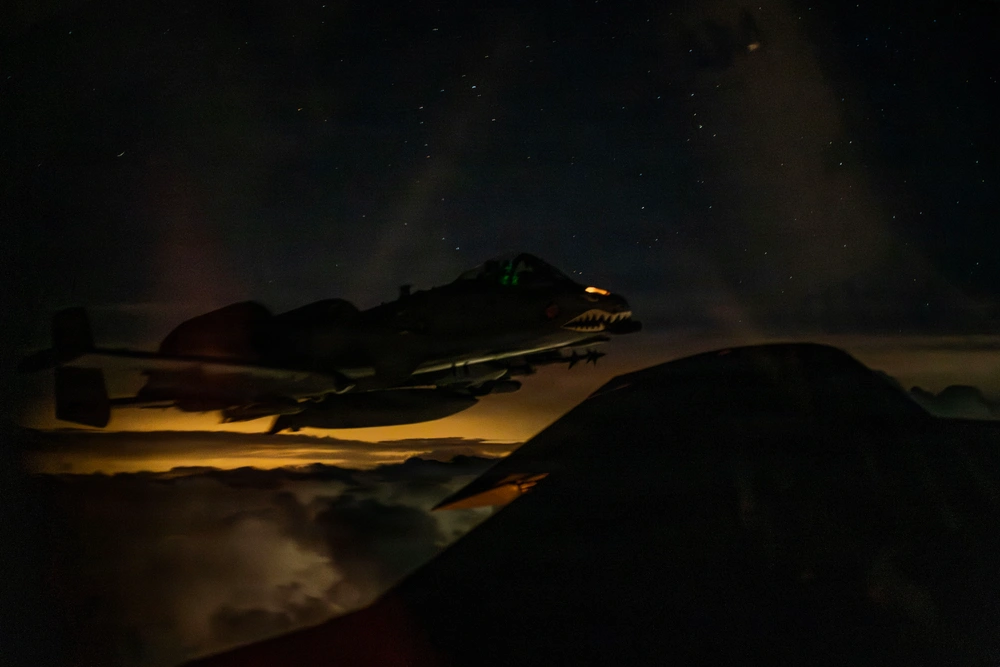
A U.S. Air Force A-10 Thunderbolt II aircraft flies alongside a KC-135 Stratotanker aircraft over the U.S. Central Command area of responsibility during Operation Epic Fury, March 9, 2026. (U.S. Air Force photo)

The so-called “mosquito fleet” is part of a mosaic of capabilities of the Iranian Revolutionary Guard Corps (IRGC), with which it has long held the region to ransom by threatening to shut the Straits of Hormuz. The waterway is one of a handful of particularly vulnerable global maritime chokepoints through which a meaningful proportion of oil the world economy needs daily passes in enormous crude carrier tankers.

As reported earlier this week of these Iranian capabilities which are now being hunted down and destroyed by U.S. forces, among them are the mosquito fleet of suicide boats either carrying massive explosive charges, or Chinese-made anti ship missiles in strapped-on cannisters, sea mines, and ground-based anti-ship missiles (AShMs). One of the earliest targets of U.S. strikes in the course of Operation Epic Fury was Iran’s conventional navy, which has now been largely destroyed.

Secretary of War Pete Hegseth said of this: “we’ve damaged or sunk over 120 of their navy ships with battle damage assessments pending for many more… their surface fleet is no longer a factor, their submarines — they once had 11 — are gone, their military ports are gone”.

While Caine referred to the mosquito fleet being hit “afloat”, FLIR footage released by U.S. Central Command (Centcom) in recent days has shown mosquito boats being hit ashore, too.

Part of Iran’s strategy for preserving its force includes making many of these sea-denial assets highly mobile and easy to hide, including the creation of extensive tunnel networks to hide truck-mounted AShM launchers and even trailered suicide boatsOne such trailered fast attack boat was shown being struck while camouflaged under tree cover, while others in the published footage were taken out at their anchorages.

Those tunnels are no guarantee of survival either, with the USAF dropping latest-generation bunker busters on the coastal hideaways in recent days to take out hidden launchers.

The appearance of the A-10 as an anti-small attack boat platform in the skies over the Persian Gulf is the latest update in a now years-long saga over the future of the aircraft, which has survived multiple attempts by the Air Force to retire it, with the latest bid having intended to eliminate the plane from inventory this year.

Former A-10 pilot Dale Stark reflected on the discourse around these arguments, stating of the announcements A-10s had pivoted to the anti-ship role they’d long trained for, stating: “Shocked, I tell you. I was reliably informed by the Lockheed funded military bloggers that the A-10 was outdated and irrelevant in modern warfare.”

https://www.breitbart.com/europe/2026/03/20/warthog-versus-the-mosquito-a-10s-hunting-iranian-suicide-boats/

American forces have sent low-flying A-10 Warthogs to shoot at Iranian ships and drones

American forces have sent low-flying A-10 Warthogs to shoot at Iranian ships and drones

American forces have sent low-flying A-10 Warthogs and Apache attack helicopters to shoot at Iranian ships and drones. 

Air Force general and Chairman of the Joint Chiefs of Staff Dan 'Raizin' Caine said the mission is taking the attack to ships on the southern Iranian coast.

'The A-10 Warthog is now engaged across the southern flank, targeting fast-attack watercraft in the Strait of Hormuz,' he said.

He added that the Apaches have 'joined the fight on the southern flank'.

Strikes are being conducted against Iranian military targets by US forces

Strikes are being conducted against Iranian military targets by US forces  

Donald Trump has called for US forces to open a new front in Iran as jets pound Iranian ships in an all-out battle to reopen the Strait of Hormuz.  

American forces have sent low-flying A-10 Warthogs and Apache attack helicopters to shoot at Iranian ships and drones.

The Pentagon is trying to nullify danger from Iranian weapons and reopen the strait, which has only seen about 90 ships cross since the war began.

About 90 ships including oil tankers have crossed the Strait of Hormuz since the outset of the war with Iran and it is still exporting millions of barrels of oil at a time when the waterway has been effectively closed, according to maritime and trade data platforms

About 90 ships including oil tankers have crossed the Strait of Hormuz since the outset of the war with Iran and it is still exporting millions of barrels of oil at a time when the waterway has been effectively closed to others.

'The Iranian oil tankers have been getting out, and we've let that happen in order to supply the rest of the world with Iranian oil,' Treasury Secretary Scott Bessent said.

Air Force general and Chairman of the Joint Chiefs of Staff Dan 'Raizin' Caine said the mission is taking the attack to enemy ships to the southern Iranian coast. 

'The A-10 Warthog is now engaged across the southern flank, targeting fast-attack watercraft in the Strait of Hormuz,' he said.

CENTCOM says US is attacking targets that 'threaten international shipping in and near the Strait of Hormuz'

CENTCOM says the US is attacking targets that 'threaten international shipping in and near the Strait of Hormuz'.

The US has been striking Iranian bases and IRGC cruise missile batteries, taking out over 120 of the country's naval ships, Pentagon chief Pete Hegseth said.

Iran has responded by using small, unmanned boats with explosives, projectiles and airborne drones to attack enemy ships

Caine said that Apache helicopters have 'joined the fight on the southern flank' and said that some allies have used them to 'handle one-way attack drones'

Caine said that Apache helicopters have 'joined the fight on the southern flank'.

The secret Iranian armada hell-bent on sinking a US aircraft carrier in Strait of Hormuz: Speedboats armed with torpedoes, explosive drones and a fleet of mini-subs:

Somewhere in the temperate waters of the Strait of Hormuz, small but deadly Iranian submarines lurk patiently – with Donald Trump’s warships in their crosshairs.

Slipping through sonar blind spots, the Ghadir-class mini subs silently shadow their prey, despatch their underwater anti-ship cruise missiles or homing torpedoes, then simply vanish. 

Not for nothing are they known as the ‘Ghosts in the Gulf’. One is said to have photographed an aircraft carrier up close during a surveillance mission before slinking away undetected. 

Tehran has previously claimed that ‘on several occasions’ the submarines ‘caught US Navy vessels off guard by surfacing unexpectedly near them’.

Adapted from a North Korean model, Ghadir inspires pride in Iranians – though submarines are far from the only deadly hardware in their naval arsenal.

From torpedo-firing speedboats and kamikaze drones to mines of every description and unmanned explosive-laden craft disguised as wooden fishing boats... enough fiendish weaponry for a 007 film awaits the US Navy in the world’s busiest oil shipping channel.

Certainly, enough to give the 2,000 marines on board USS Tripoli pause for thought. Next week, the 50,000-ton amphibious assault ship, en route from Japan, will enter the war zone and prepare for a confrontation that may yet decide the conflict’s outcome.

Iranian Revolutionary Guards man their speedboats in the Persian Gulf off the port of Bandar Abbas, during war games dubbed 'Tariq al-Qods' (Way to Jerusalem)

Iranian Revolutionary Guards man their speedboats in the Persian Gulf off the port of Bandar Abbas

Ghadir-class mini subs can silently shadow their prey, despatch their underwater anti-ship cruise missiles or homing torpedoes, then simply vanish

Ghadir-class mini subs can silently shadow their prey, despatch their underwater anti-ship cruise missiles or homing torpedoes, then simply vanish

A boat firing a missile during a military exercise by members of the IRGC and navy in the Gulf

A boat firing a missile during a military exercise by members of the IRGC and navy in the Gulf

While Iran’s regular navy suffered heavy losses in the first wave of US attacks, the country’s second navy run by the Islamic Revolutionary Guards Corps (IRGC), which is responsible for the strait, is thought to be largely intact.

The rugged mountainous coastline to the east of the strait gives the Iranians a key advantage. They can dig into the hills and launch over-the-horizon strikes that are difficult to spot. And drones can be despatched undetected from anywhere.

Some of Iran’s deadly vessels are thought to be hiding in an underground cove on a tiny island in the strait.

The IRGC’s navy specialises in asymmetric warfare: avoiding a more dominant opponent’s strengths and instead focusing on weaknesses using unconventional strategies and tactics.

A 2020 report by Farzin Nadimi, a senior fellow at the Washington Institute, outlined how this might play out in the strait.

It said: ‘Iran could theoretically launch a coordinated attack involving explosives-laden remote-controlled boats and remotely operated underwater vehicles, swarming speedboats, semi-submersible torpedo boats, kamikaze [drones], midget attack submarines, and shore-based antiship missile and artillery fire.’ 

Elsewhere the report says Iran’s network of islands, inlets and coves along the strait provide ‘excellent hiding places’ and allow for ‘staging precision mining operations, sneak missile and swarming attacks’. 

Iran has also bored tunnels into rocky islands ‘from where boats can launch directly into shipping lanes’.

It adds: ‘Speedboats can rush out of covered locks and concrete pens, or can be launched from flatbed trucks under cover of darkness during high tide without any special accommodations. 

'These capabilities can increase surprise and reduce transit time to the points of contact.’

Other firepower at the IRGC’s disposal includes armed replicas of the British-built Bladerunner 51, hailed as among the fastest speedboats in the world.

A senior IRGC commander said when it was launched: ‘The Bladerunner is a British ship that holds the world speed record [80mph]. 

'We got a copy [on which] we made some changes so it can launch missiles and torpedoes.’

The Washington Institute report says such ‘fast-attack craft’ are essential in controlling the strait. ‘The IRGC navy uses these boats for maritime patrol and ultimately swarming and sneaking missile attacks.’

It adds: ‘A key feature of the IRGC’s rocket-firing swarm boats is their survivability, achieved by designing the boats to have a lower profile paired with high speed and manoeuvrability.

‘For a similar reason, Iran has been working on unmanned surface vessels since the late 1980s, specifically through the development and fielding of remote-controlled suicide drone boats packed with explosives.

‘Iran has positioned no fewer than 1,500 of them, each armed with 500kg of explosives, along key Persian Gulf coastal areas. 

'Originally designed to destroy warships, these drone boats have progressively been made more sophisticated with the provision of various sensors and data links.’

The regime is estimated to have 17 submarines garrisoned at Bandar Abbas, which sits on the northern bend. US forces appear to have disabled only one of them since the attacks began last week.

That submarine – a 500-ton Fateh-class vessel with at least four 533mm torpedo tubes – was Iran’s ‘most operational’ sub-surface boat, according to US military officials.

Ryan Ramsey, a former captain of the Royal Navy submarine HMS Turbulent, said: ‘Having operated submarines in the Gulf region, the Iranian submarine force should be taken seriously.’

As well as Ghadir-class, he said Iran also operated Russian-made Kilo-class submarines, which are larger, longer-range boats and have greater firepower. 

‘In the confined waters of the region, even a small number of submarines can create real uncertainty for surface commanders,’ Mr Ramsey added.

‘That said, against capable anti-submarine forces the balance shifts. US submarines and maritime patrol assets are extremely proficient at finding and tracking these boats.’

According to the report, the IRGC considers sea mines essential to what it calls its ‘smart control’ of the Strait of Hormuz. 

To that end, it is said to have acquired some of the world’s deadliest, including ‘influence’ mines which rest on the seabed. Triggered not by physical contact, they instead use sensors to detect when a vessel is nearby.

Magnetic limpet mines are also favoured. The report says they are ‘deployed by speedboats or divers, as demonstrated… in 2019 when just south of the Strait of Hormuz, two transiting tankers were attacked by speeding boats attaching limpet mines to their target hulls’.

Even if the US feels it could counter all Iranian threats, the operation would be enormously complex, expensive and would last as long as Iran chooses to keep threatening ships – something beyond Donald Trump’s control.

Former Air Marshal Martin Sampson says the US appeared unprepared for the large combined land, sea and air operation needed to secure the strait. 

He said the waterway would become ‘a target-rich environment’ for Iranian forces, who could throw everything they’ve got at warships carrying hundreds of sailors.

The Marine Expeditionary Unit on board the USS Tripoli could take part in an invasion of Iran’s Kharg Island, located 15 miles off its mainland. It is the country’s main oil export terminal and critical to its fragile economy.

The Tripoli could be joined by another amphibious assault ship the USS Boxer, which left San Diego earlier last week, bringing the number of marines units in the region to three.

However, such an operation – which would leave US troops exposed to Iranian missiles and drones – would only be launched once Iran’s coastal military capabilities have been further degraded.

‘We need about a month to weaken the Iranians more with strikes, then take the island ’ one source said.

Sascha Bruchmann, a military analyst at the International Institute for Strategic Studies, said US marines could deploy from the Tripoli using Osprey tilt-rotor aircraft, which can transport squads of 20 troops to positions up to 400 miles away. They could land using smaller amphibious assault boats.

Another target is Qeshm Island in the strait. ‘It’s a bit like an unsinkable aircraft carrier,’ Mr Bruchmann told The Times.

‘There’s natural salt caverns and mines, which are used as underground storage facilities for the [drones] that now hold shipping hostage. So marines as fighters and as amphibious raiders, would be the ideal option to… try to neutralise these facilities.’

Other options include seizing the islands of Hormuz or Larak, where US forces could install counter-drone radar systems.


Saturday, 21 March 2026

Cluster Bomb attacks against Israel

https://www.jpost.com/middle-east/iran-news/article-890325

https://www.jpost.com/defense-and-tech/article-890509

https://www.jpost.com/israel-news/defense-news/article-890536

https://www.israelnationalnews.com/news/424314

https://www.israelnationalnews.com/news/424303

https://www.israelnationalnews.com/news/424296

Iranian cluster missile fragments strike central Israel

A cluster missile fired from Iran triggers sirens across central Israel, Jerusalem and surrounding regions. Fragments damage vehicles and strike several sites; no injuries reported.


A cluster missile was fired from Iran towards Israeli territory on Friday evening, triggering sirens in central Israel, Jerusalem, the Shfela, Samaria and Sharon regions.

No injuries were reported, but security forces were summoned to the scene of several impact sites.

In the city of Elad, vehicles were damaged after fragments fell in the courtyard of a residential building, while in Kiryat Ono, an impact was identified in a public garden, causing a crater in the ground.

Fragments also fell on Highway 4, in the area of the Mesubim interchange.

The IDF said that Home Front Command Search and Rescue forces are on their way to the impact sites in central Israel, asking the public to avoid gathering in these areas.

Sirens also sounded several times in northern Israel on Friday evening, due to UAV infiltrations from Lebanon. No reports of impacts or injuries were received.

A serious incident was narrowly avoided earlier on Friday in Rehovot, when a shrapnel fragment struck a soccer field while a children’s practice was taking place.

A siren was sounded during the practice following warnings of rocket launches from Iran. The children and coaches acted quickly, running to a nearby shelter. No one was injured but the field itself sustained a direct hit from the shrapnel.

Also on Friday, interception debris struck the Old City of Jerusalem, not far from the Temple Mount and Al-Aqsa Mosque.

https://www.israelnationalnews.com/news/424314

Miracle in Rehovot: Shrapnel fragment falls on soccer field while children practicing

During a children’s team practice in Rehovot, an alarm sounded following warnings of rocket launches from Iran. The children and coaches rushed to a nearby protected shelter.


A serious incident was narrowly avoided today (Friday) in Rehovot when a shrapnel fragment struck a soccer field in the Sha’arayim neighborhood-while a children’s practice was taking place.

During the practice, an alarm was triggered following warnings of rocket launches from Iran. The children and coaches acted quickly, running to a nearby protected shelter, and miraculously no one was injured.

However, the field itself sustained a direct hit from the shrapnel.

https://www.israelnationalnews.com/news/424303

Report of a shrapnel landing in Jerusalem's Jewish Quarter

Eight waves of Iranian rockets struck across Israel this morning, with debris from interceptions hitting Rehovot and Haifa’s port, as well as the Jewish Quarter in Jerusalem.


Sirens were heard in Jerusalem around 16:00 following an Iranian missile launch toward various locations in Israel.

Magen David Adom reported no injuries, though interception debris struck several locations, including the Jewish Quarter in Jerusalem.

One of the missiles was a fragmentation missile.

In one of the barrages, several buildings in the city of Rehovot were damaged, and two people were lightly injured.

The Mayor of Rehovot commented at the scene of the strike in the city: "An elderly man was in the house, and he doesn't have a protected space. A missile fragment fell and did not hit him. We evacuated him, he is lightly injured. He is a bit confused, but he is okay."

On Friday morning, a home in Rehovot suffered a missile strike, but the residents, who had entered the bomb shelter, were uninjured.

https://www.israelnationalnews.com/news/424296


Israeli medics confront new battlefield: Cluster warheads

Emergency responders describe the operational chaos, toxic hazards, and psychological strain facing civilians and rescuers as Iran’s missile attacks evolve.


"One such missile will give us scenes that will go, in Israeli terms, throughout three or four different cities." With that description, Chaim Rafalowski, disaster management coordinator of Magen David Adom, captured the new operational reality Israeli emergency responders face as Iranian missiles carrying cluster warheads continue to strike the country.

Speaking with The Media Line, Rafalowski explained that the current phase of the war has forced rescue organizations to adapt rapidly to a threat that creates numerous simultaneous emergencies rather than a single blast site.

Living in constant war

Magen David Adom (MDA), Israel’s national emergency medical service, has been operating under wartime conditions for more than two years. The escalation following the latest round of attacks, however, has introduced complications that responders say they have rarely encountered at this scale. "We need to remember that Magen David Adom, as the whole Israeli population, is living a war situation for the last two and a half years," Rafalowski said.

"It’s another wave of increased violence that started on October 7, and we are living in a constant war since October 7."

What makes the current attacks particularly challenging, he said, is the widespread use of cluster munitions. According to Israeli defense assessments cited by Rafalowski, more than half of the missiles fired toward Israel now carry warheads that disperse multiple smaller bombs while still in the air and can cover a large geographical area.

"The missile itself comes with a very large number of smaller bombs," he explained. "It opens somewhere in midair and spreads the smaller bombs. Each and every one of them is around two and a half kilograms."

Instead of responding to one impact site, emergency teams may suddenly face incidents scattered across neighborhoods and towns. "They spread over about 10 kilometers," Rafalowski said. "So one such missile will give us scenes where the cluster bombs landed in many places. We are talking about 10, 12 scenes where the cluster bombs landed and exploded."

For emergency services, that means dividing personnel, ambulances, and equipment across numerous locations at once while still racing to reach victims before additional explosions occur.

The complexity of the response is not only logistical, but also dangerous for the responders themselves. Bomblets that fail to detonate immediately can explode later, turning impact zones into unpredictable environments. "This is a great operational challenge," Rafalowski said. "At the same time, it’s a great safety issue for our personnel because they might step on something that could explode."

Simmy Allen, international spokesperson for United Hatzalah, described a similar evolution in the threats confronting volunteer medics across the country. Speaking with The Media Line, Allen said the change in Iranian missile technology has forced emergency responders to rethink how they approach impact zones.

"We’ve seen the escalation, the difference between the first missiles that came over from Iran to now these cluster bombs, these cluster missiles with multiple detonation warheads that pose a much different threat," he said. "Not only a different threat to property, but also a very different threat to lives because a detonation could be delayed and could cause further damage and loss of life."

United Hatzalah volunteers have responded to impacts across Israel since the first missile launches of the current operation. According to Allen, the scattered nature of cluster warheads creates debris fields that extend across wide areas and can remain dangerous long after the initial explosion. "We’ve seen projectile impacts, what we call shrapnel from the various missiles and from interception debris, falling over very large geographic locations," he said.

The threat does not disappear once the explosions stop. Both emergency organizations say unexploded fragments and missile debris can continue to endanger civilians who approach them. Rafalowski noted that public awareness about these dangers remains limited.

"Unfortunately, people are not well educated," he said. "We have had incidents of the general public picking up those cluster bombs." In one case earlier in the day, he said, a civilian picked up a piece of missile debris and suffered burns. "Luckily, it was a minor injury, but it could have been way, way worse."

'No one knows how dangerous they are'

Allen said United Hatzalah has repeatedly urged the public to stay away from missile fragments and to wait for trained personnel. "No one knows what is inside them. No one knows how dangerous they are," he said. "When people see shrapnel or a projectile, they should keep their distance and alert the authorities."

Alongside the explosives themselves, responders are now facing another unexpected danger: hazardous chemicals released when parts of missiles land intact. One such incident occurred recently in northern Israel when a missile engine fell near the city of Safed.

Rafalowski explained that the fuel used in these missiles can pose a serious toxic threat to anyone nearby. "The fuel of these missiles is highly toxic," he said. "In our terminology, we call this a hazmat incident."

In the incident in Safed, Rafalowski said responders quickly realized they were not dealing only with debris but with a hazardous chemical release from the missile’s engine.

"People who inhale nitric acid fumes will suffer from very severe burns to their airway and lungs," Rafalowski said. "And, of course, there can also be skin irritation."

For medical teams, hazardous material incidents require a completely different operational approach. Instead of rushing directly toward casualties, responders must first identify the chemical risk and coordinate with other emergency agencies.

"The most important thing is to identify it really fast and make sure civilians are away," Rafalowski said. Firefighters typically manage containment of the chemical hazard, while police secure the scene and medical teams treat potential victims.

Despite the scale of the attacks, the number of fatalities remains relatively limited compared with what many analysts initially feared. According to figures cited by Rafalowski, hospitals across Israel have treated more than 3,000 people since the current escalation began. "So far, the Healthy Ministry reports 3,079 people who have been treated at hospitals," he said. "Among them, 16 were killed."

Some of those deaths occurred from direct missile impacts, while others were indirect consequences of the emergency conditions. Rafalowski described one case involving an elderly man who was injured while trying to reach shelter during an alert. "One of them is a 90-year-old gentleman who fell on his way to the shelter, suffered a severe head injury, and died," he said. "Some of them died during car accidents that occurred during the alerts."

Most of the people treated by emergency teams have not suffered life-threatening injuries, Rafalowski said, but the numbers still illustrate the scale of the attacks. Nineteen people were classified as severely injured and 71 as moderately injured, while nearly 3,000 others were treated for minor injuries or anxiety reactions linked to the repeated missile alerts across the country.

Allen said the relatively low number of severe casualties reflects the discipline of the Israeli public in following civil defense guidelines. "The Israeli public, even on day 18 of the war, is holding very strictly to the guidelines of the Home Front Command," he said. "Those guidelines have been proven to literally save lives."

Psychological toll of missile attacks

Yet the psychological toll of living under repeated missile attacks is becoming increasingly visible. Allen said the entire population is operating under constant pressure as sirens interrupt daily life and force people to repeatedly rush to shelters. "The population has been under constant stress," he said. "The entire country is on edge."

That anxiety often manifests itself in medical emergencies, even when missiles do not strike directly. United Hatzalah responders have reported numerous cases of civilians injured while running for shelter. "We’re seeing people falling while rushing to the safe areas," Allen said. "They’re so anxious and so nervous that they’re literally falling over their own feet and suffering fractures and minor injuries."

To address those cases, United Hatzalah has expanded the deployment of its Psychotrauma and Crisis Unit, which provides emotional support and psychological first aid at impact zones and in surrounding communities. "We’ve seen an increased number of anxiety cases," Allen said, noting that the psychological dimension of the war has become an increasingly significant part of emergency response work.

Emergency responders themselves are not immune to exhaustion after years of continuous conflict. Rafalowski said the repeated missile alerts, often occurring throughout the night, are part of a strategy aimed at wearing down the population. "Everyone is tired," he said. "Clearly, the Iranian tactic is to try and exhaust people by not letting you sleep."

He described nights when alarms sound every few hours, forcing families repeatedly into shelters. "When the sirens go off every two hours, people don’t sleep well enough," he said. "Everyone is tired."

Yet for emergency workers, the alarms also trigger a different reaction: a call to action. Rafalowski explained that many MDA volunteers keep ambulances at home and respond directly from their neighborhoods. "When the alarm goes off, they put their family in the shelter, and they tell their family, ‘You stay in the shelter,’" he said. "They put on their helmet, their flak jacket, and wait for the dispatcher to call them."

MDA operates with approximately 4,000 staff members and more than 30,000 volunteers across Israel, forming one of the largest volunteer emergency networks in the world. Because of that network, responders are often able to reach an incident within minutes, even while missile alerts are still active.

Allen said United Hatzalah volunteers are operating under those conditions across the country, including in northern communities that face additional threats from rockets fired from Lebanon. "In fact, in the north, there is no warning," he said. "You hear a boom before the first siren goes off. There is zero time to seek shelter."

That reality has forced many families to alter their daily routines. "Many of them have resolved to just sleep in their safe rooms throughout the night in order to protect themselves," he said.

Despite the dangers and exhaustion, both responders said the resilience of Israeli society has been a crucial factor in preventing a larger humanitarian disaster. Rafalowski described how residents often find ways to support each other while waiting in shelters during missile alerts. "You see people sitting together, singing songs together and playing together," he said. "Sometimes people who never knew each other become friends after some nights in the shelter."

Even as the attacks continue, the ability of communities to follow safety instructions has prevented far higher casualties. "The Israeli public is holding very strictly to the guidelines," Allen said. "And those guidelines have literally saved lives."

https://www.jpost.com/middle-east/iran-news/article-890325

Iranian cluster munitions pose additional challenge for Israel's air defenses

Half of the missiles fired by Iran have been cluster warheads that have about 24 submunitions, each containing approximately 2–5 kg of explosives.

     Iranian missile armed with cluster munitions about to land in Israel

Iran has launched dozens of missiles with cluster munition warheads ​at Israel since the start of the war, posing a challenge for Israel's missile defense shield as they need to be ‌hit before they split and disperse into smaller explosives.

Israel failed to intercept one of the cluster missiles overnight, and its small bomblets scattered into civilian areas in Tel Aviv. A couple in their 70s was killed, and one of Tel Aviv's main train stations suffered damage.

Israeli military spokesperson Lieutenant Colonel Nadav Shoshani told reporters that the couple ​was killed in their apartment by a single, cluster munition bomblet.

"This cluster bomb was fired by the Iranian regime towards a ​center of mass population, firing dozens of rockets towards the civilians, deliberately targeting civilians," he said. "This is a ⁠war crime by the Iranian regime."

Shoshani said the military was doing all it could to intercept these missiles as "high up as possible" to ​minimize damage.

    Impact from a cluster bomb fragment

Munitions banned by more than 100 countries

Cluster munitions open in mid-air and scatter as many as several hundred "bomblets" over a wide area. They ​often fail to explode, creating virtual minefields that can kill or injure anyone who finds them later.

More than 100 countries agreed at an international conference in Dublin in 2008 to ban the use of cluster munitions. However, Israel and Iran have not joined the ban, and neither have major powers including the US, China and Russia.

Israel's ​Home Front Command, which issues safety directives to citizens during wartime, has published videos warning of the dangers of munitions, saying they can "become dangerous ​explosive traps", particularly for small children or pets.

The military has said about half of the missiles fired from Iran since Israel and the US jointly attacked Iran ‌on February ⁠28 have been cluster warheads. They were also fired by Iran during a 12-day Israel-Iran war last June.

An Israeli military official said Iranian cluster warheads have about 24 submunitions, each containing approximately 2–5 kg of explosives. They break apart at an altitude of 7–10 km above the ground, creating dozens of separate impact sites.

"Each submunition can detonate when it hits the ground or another hard surface," the official said. "Its effect is similar ​to the explosion of a grenade - ​relatively limited local damage but highly ⁠dangerous to anyone nearby."

'Must be intercepted above the atmosphere'

Yehoshua Kalisky, a senior researcher at the Institute for National Security Studies at Tel Aviv University, said most missiles are intercepted by Israel's Arrow-3 anti-ballistic missile system.
 
To prevent ​damage, "they must be intercepted above the atmosphere as far as possible from the target area," Kalisky said. "There's ​no other way, ⁠because once the cluster bombs are released (in the atmosphere), you cannot intercept them."

Shoshani said Israel's offensive capabilities were also crucial. Israel says it has bombed hundreds of targets in Iran, including missile launching sites. An estimated 3,000-plus people have been killed in Iran since the start of the war, according to ⁠the US-based ​Iran human rights group HRANA.

"We've been degrading their ability to fire missiles, (along with) active ​defense systems and the passive defense system, sirens and people going to the safe rooms," said Shoshani of efforts to prevent Israeli casualties from Iranian missiles.

"The combination of all that ​has had great success, but is still not perfect."

https://www.jpost.com/defense-and-tech/article-890509

'After the cluster opens, it’s too late:' Israeli expert explains Iranian cluster warhead challenge

Dr. Uzi Rubin tells The Media Line that stopping missiles at high altitude remains the only effective defense once submunitions are released.

     Iranian missile attack against Israel
“After the cluster has opened, it’s too late,” Dr. Uzi Rubin, one of Israel’s leading missile defense experts, told The Media Line.

Rubin’s warning comes as analysts and defense officials examine the use of cluster warheads in missiles launched from Iran during the recent war with Israel. The weapons, which disperse multiple smaller bomblets instead of a single explosive payload, have drawn renewed attention from missile defense specialists.

The core challenge, Rubin said, is simple: A ballistic missile carrying a cluster warhead must be intercepted before the payload opens and releases its submunitions. Once that happens, the missile is no longer a single target, and the chance of stopping its full effect drops sharply.

Rubin, the founding director of Israel’s missile defense program and now a senior fellow at the Jerusalem Institute for Strategy and Security, led Israel’s Missile Defense Organization from 1991 to 1999, overseeing the development and deployment of the Arrow, Israel’s first national missile defense shield. He later served as senior director for proliferation and technology at Israel’s National Security Council, directed major defense programs at Israel Aerospace Industries and the Defense Ministry, and was a visiting scholar at Stanford’s Center for International Security and Arms Control. He received the Israel Defense Prize in 1996 and 2003, as well as the US Missile Defense Agency’s David Israel Prize.

    Fragment of Iranian missile after hitting Israel

What is a cluster warhead?

To explain the weapon, Rubin started with the basic concept. “What is a cluster warhead?” Rubin said. “A cluster warhead is a class of bombs, which were more famously used in the Vietnam War and other wars. It’s a bomb which contains, instead of one big barrel of explosive, it contains a lot of small bomblets.”

He then described what happens as the missile nears its target. “So a cluster warhead for a missile is the same thing,” Rubin said. “The tip of the missile, instead of containing a big barrel of explosives, contains a mechanism which holds on to a lot of small bombs. And when the missile approaches the target, it opens its skin, it peels off, and it spins around, and the bomblets are released and released into space and fall on the ground.”

Iran’s missile program includes a range of ballistic systems developed over decades, and according to Rubin, many of them can carry more than one type of warhead. “Every one of their missiles, and they have several types, heavier ones, smaller ones,” he said. “For each one of them, they have a regular warhead or a cluster warhead.” The number of submunitions varies depending on the missile and payload capacity. “Cluster warheads can contain, let’s say, from 20-30 bomblets to 70-80 bomblets; it depends on the type of the missile.”

From a defensive standpoint, timing is everything. Missile defense systems must destroy the incoming missile while the warhead is still intact. Once the cluster mechanism activates and disperses the bomblets, interception becomes far less effective because the payload has already separated.

“Interception usually is done if it’s successful,” Rubin said. “It’s not always successful. It’s above the altitude where it opens there, and it disperses the cluster, when it’s still held in one piece.”

Technical assessments suggest that the altitude at which cluster warheads disperse their payload is relatively low compared with the height reached by ballistic missiles during flight. “In the papers, they say that the opening altitude of clusters is a dispersed altitude of 7 kilometers,” Rubin said. “Seven kilometers is pretty low. Most of the interception is done above that.”

In Rubin’s view, cluster warheads do not fundamentally alter the defensive equation. The strategy remains the same as with conventional ballistic missiles: Destroy the missile as early as possible in its trajectory, well before it reaches the target area. “So, there is no difference in intercepting cluster warheads than the regular warhead,” he said. “You have to intercept them well away from the target.”

Once a missile descends below a certain altitude, interception becomes much more difficult regardless of the warhead type. “After the cluster has opened, it’s too late,” Rubin said. “But anyway, even if there’s not a cluster, a unitary bombhead, a barrel, below a certain altitude, you cannot intercept it anymore. It’s too late.”

That point also helps explain a common misconception about Israel’s missile defense network. Iron Dome is built to stop short-range rockets, while Arrow is designed to intercept long-range ballistic missiles high above Israeli territory. In other words, the system most associated internationally with Israel’s air defense is not the one meant to handle this kind of threat. “The Iron Dome is too low for that,” Rubin said. “The Iron Dome is not designed against that. It’s designed against a short-range rocket.”

Cluster warheads and conventional warheads, Rubin said, are built for different tactical effects. Cluster munitions are meant to spread damage across a wider area, making them more dangerous to exposed troops and unprotected sites. “It depends for what use,” Rubin said. “A cluster warhead is very dangerous against troops in the open, against installations which are not protected.”

By contrast, traditional warheads concentrate their destructive power in a single impact point. “A unitary warhead is more dangerous to, like you saw what happened last night in that village … that was a unitary warhead,” Rubin said.

Each bomblet is relatively small compared with the explosive payload of a ballistic missile, but the cumulative effect can still be deadly. Rubin compared the impact of the submunitions to rockets commonly fired by terrorist groups from Gaza. “No, it’s a small bomb,” he said. “The effect is like a Grad, a rocket that comes from Gaza. It can be fatal.”

Rubin said the cluster warheads used in the conflict are not a new development. Asked whether the versions used in the recent fighting differed from those launched in earlier exchanges between Iran and Israel, he gave a short answer. “Same thing,” he said. “They fired less of them, but it’s the same thing.”

For Rubin, the broader issue is not the novelty of the weapon but the narrow window for stopping it. Missile interception comes down to altitude and seconds. If the missile is destroyed early, the warhead never opens. If it is not, defense gives way to damage control.

https://www.jpost.com/israel-news/defense-news/article-890536

     Impact site in Jerusalem