Saturday, 12 December 2020

Cat scratch’ fever may cause human madness, study says

 https://www.foxnews.com/health/cat-scratch-fever-may-cause-human-madness-study-says

Some of the lyrics from Ted Nugent’s 1977 song 'Cat Scratch Fever' are not medically inaccurate, a new study suggests


“You know you got it when you’re going insane.”


Some of the lyrics from Ted Nugent’s 1977 song “Cat Scratch Fever” are not medically inaccurate, a new study suggests.

In research published this month in the journal Pathogens, authors offer further evidence for the theory that Bartonella bacteria, which can be spread by insect bites and animal scratches — most famously, those of cats — is linked with psychiatric symptoms.

Scientists studied 33 participants, 29 of whom were found to be infected with Bartonella, with 24 reporting the development of stretch-mark-like skin lesions (considered a common sign of the disease) manifesting alongside mental symptoms.


Patients’ neuropsychiatric symptoms were self-reported and included “sleep disorders, mental confusion, irritability/rage, anxiety, depression and headache/migraine.”

It’s unclear exactly how any of the participants were exposed to Bartonella, but the majority reported they’d had close contact with dogs, cats, birds, horses, reptiles and a variety of other animals. Bites from bed bugs, fleas, lice, mosquitoes, scabies mites and spiders are also known to pass along Bartonella bacteria to people.

The study authors are careful not to declare a connection between mental or nervous-system disorders issues and what is formally known as cat-scratch disease, however, writing only that Bartonella “might contribute” to lesions and neuropsychiatric symptoms — but evidence increasingly makes the connection appear accurate.


In 2019, a case study was published in the Journal of Central Nervous System Disease that found that a Midwestern teen’s sudden, rapid mood changes were not the result of puberty or a mental disorder, but a scratch from his cat. The boy began experiencing psychosis-like symptoms, hallucinations, depression and suicidal thoughts. Psychiatrists initially diagnosed him with schizophrenia, but he only got worse after being prescribed a variety of psychotropic medications.

“He developed nonspecific somatic symptoms, including excessive fatigue, daily headaches, chest pains, shortness of breath (possible panic anxiety) and urinary frequency,” the report explains.


When the boy’s parents mentioned the strange “stretch marks” they’d noticed on his thighs and armpits to another physician, however, the doctor determined it was likely CSD.

After taking antibiotics, he made a full recovery.


U.S. Producer Prices Rise Moderately; COVID-19 Seen Taming Inflation

 https://www.oann.com/u-s-producer-prices-increase-slightly-in-november/


December 11, 2020

By Lucia Mutikani

WASHINGTON (Reuters) – U.S. producer prices barely rose in November, supporting views that inflation would remain benign in the near term as a flare-up in new COVID-19 infections restrains the labor market and demand for services.

While other data on Friday showed a surprise improvement in consumer sentiment early in December, that largely reflected increased optimism among Democrats and Independents following Joe Biden’s electoral victory over President Donald Trump.

That is unlikely to translate into robust consumer spending, given business restrictions related to the coronavirus outbreak and the accompanying job losses. Millions of unemployed Americans are set to lose their government-funded benefits on Dec. 26, with Congress struggling to agree on another pandemic relief package.

“We saw a similar partisan boost to confidence following the 2016 election which was not followed by a spike in consumption, so we doubt this apparent rise in confidence signals a jump in spending either,” said Michael Pearce, a senior U.S. economist at Capital Economics in New York.

The producer price index for final demand edged up 0.1% last month after increasing 0.3% in October, the Labor Department said. That was the smallest gain since April.

In the 12 months through November, the PPI advanced 0.8% after increasing 0.5% in October.

A 0.4% increase in the price of goods accounted for the rise in the PPI. Goods increased 0.5% in October. Services were unchanged after rising 0.2% in October. Economists polled by Reuters had forecast the PPI gaining 0.2% in November and rising 0.8% on a year-on-year basis.

The United States is in the midst of a fresh wave of coronavirus infections, pushing the number of confirmed cases to more than 15 million and deaths to over 289,740 since the pandemic started. New strict stay-at-home orders went into effect in California this week. Other states and local governments have also imposed restrictions on businesses.

Applications for unemployment benefits jumped to their highest level in nearly three months last week.

While the coronavirus pandemic has raised prices of some goods because of supply constraints, it has hurt demand for services like travel and dining out, keeping inflation in check. Millions of people are either underemployed or out of work, limiting wage inflation.

In a separate report on Friday, the University of Michigan said its consumer sentiment index increased to 81.4 early this month from a final reading of 76.9 in November. Sentiment remains well below its pre-pandemic level. Economists had forecast the index steady at 76.5.

Graphic: Consumer sentiment – https://graphics.reuters.com/USA-STOCKS/gjnpwkwmgpw/umich.png

Sentiment improved among Democrats and Independents, but fell among Republicans. Consumers expected inflation to moderate significantly in the year ahead. Inflation expectations over the next five years were steady.

“The trend in inflation in the near term is likely to be subdued given ample excess capacity and renewed pressure on demand from new restrictions to contain a resurgence of Covid-19 outbreaks,” said Rubeela Farooqi, chief U.S. economist

at High Frequency Economics in White Plains, New York.

Stocks on Wall Street were trading lower. The dollar gained versus a basket of currencies. U.S. Treasury prices rose.

BELOW TARGET

Other details of the PPI report were also softer. Excluding the volatile food, energy and trade services components, producer prices inched up 0.1%. The so-called core PPI climbed 0.2% in October. In the 12 months through November, the core PPI gained 0.9% after rising 0.8% in October.

Inflation is running below the Federal Reserve’s 2% target, a flexible average. The government reported on Thursday that consumer prices increased 0.2% in November.

“There are no factory inflation pressures building, either due to shortages or to stronger manufacturing demand, that could possibly lead to more inflation at the consumer level,” said Chris Rupkey, chief economist at MUFG in New York.

Despite the soft inflation backdrop, economists do not anticipate a deflation, a decline in the general price level that is harmful during a recession as consumers and businesses may delay purchases in anticipation of lower prices.

Graphic: PPI – https://graphics.reuters.com/USA-STOCKS/jznvnqzrwpl/inflation.png

Wholesale food prices rose 0.5% in November after accelerating 2.4% in October. The cost of residential electricity, natural gas and tobacco products increased. But gasoline prices tumbled 1.9%. There were also decreases in the cost of pharmaceutical preparations.

Core goods prices rose 0.2% after being unchanged in October. Margins for final demand trade services, which measure changes in margins received by wholesalers and retailers, fell 0.3%, helping to restrain services.

Healthcare costs rose 0.2%, while portfolio fees were unchanged. That followed October’s 0.5% increase. Airline tickets decreased 7.1% after increasing 1.2% in October.

Those airline tickets, healthcare and portfolio management costs feed into the core personal consumption expenditures (PCE) price index, the Fed’s preferred inflation measure.

With the relevant CPI and PPI components in hand, economists are predicting the core PCE price index rose 1.3% in November. The core PCE price index increased 1.4% in the 12 months through October. November’s core PCE price index data is scheduled to be released later this month.

Friday, 11 December 2020

China's foreign coal push risks global climate goals

DECEMBER 10, 2020, by Helen Roxburgh With Poornima Weerasekara In Colombo
https://phys.org/news/2020-12-china-foreign-coal-global-climate.html

China has about 96 billion tons of untapped coal reserves

China's plan to fund dozens of foreign coal plants from Zimbabwe to Indonesia is set to produce more emissions than major developed nations, threatening global efforts to fight climate change, environmentalists have warned.

Under the Paris climate deal signed in 2015, China positioned itself as a leader on climate change, and in September President Xi Jinping pledged the country would become carbon neutral by 2060.

But Chinese state-owned firms are investing billions in coal power abroad, which are not counted in the domestic carbon neutral calculations, and which environmentalists say put at risk the Paris accord's goal of keeping global warming to well below 2 degrees Celsius.

"New plants that would potentially be operating for many years beyond 2030 are fundamentally incompatible with global efforts to contain climate change," said Christine Shearer, head of coal research at the Global Energy Monitor.

The new carbon-belching power stations already under construction will produce 19 gigawatts of power and emit 115 million tonnes each year, data from Boston University's Global Development Policy Center showed.

China has nearly three-times more in the pipeline abroad, meaning its overseas plants would emit more than the current emissions of major economies such as Britain, Turkey and Italy, according to figures in British Petroleum's annual review of global energy.

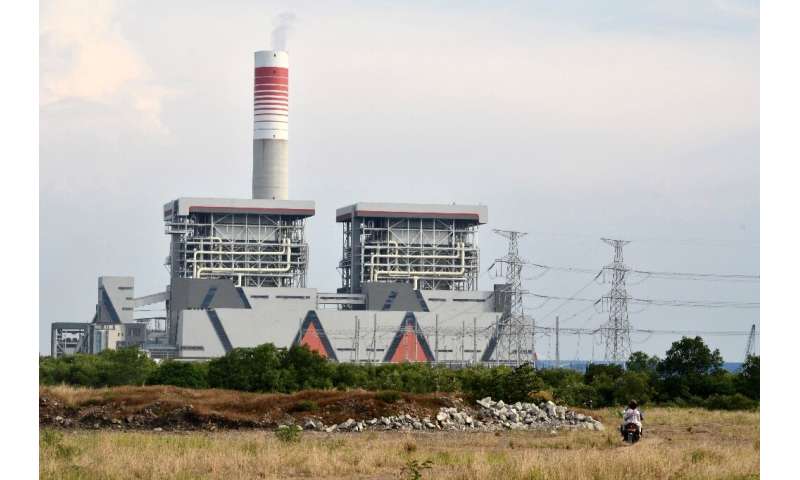
China plans to fund dozens of foreign coal plants, including Indonesia

Each of the dozens of plants are expected to have a lifespan of decades.

If completed and operated for 30 years, these plants would emit the equivalent of almost three years of emissions from all coal-fired power plants in China, according to Lauri Myllyvirta, lead Asia analyst with Helsinki-based Centre for Research on Energy and Clean Air.

China is making the overseas coal play as part of its trillion-dollar Belt and Road Initiative, a plan to fund infrastructure projects and increase its sway overseas.

Xi has promised to "pursue open, green and clean co-operation" under the Belt and Road plan, yet Chinese banks have continued their financing of coal projects regardless.

Between 2000 and 2018, 23.1 percent of the $251 billion invested by China's two biggest policy banks on overseas energy projects was spent on coal projects, according to Boston University's database on China's global energy financing.

The foreign plants the Chinese firms are currently building include the $3 billion Sengwa power plant in Zimbabwe—one of the largest in Africa.

China is advancing plans to build the new carbon-belching power stations abroad as part of its trillion-dollar Belt and Road Initiative

There are also at least eight projects in Pakistan, including a $2 billion plant in the restive region of Balochistan.

The new projects are all in countries that have signed up to the Belt and Road plan, locking them into a coal-consuming energy future.

The flood of coal cash is "hampering efforts by developing nations to switch to cleaner alternatives," said Li Shuo from Greenpeace China, and that risks "derailing the Paris accord".

Home and away

At home, China has about 96 billion tons of untapped coal reserves—the fourth largest in the world.

The surplus has pushed Chinese power companies into energy hungry nations in South and Southeast Asia, Africa and Latin America.

"It is a way to provide markets for companies and services that the country itself increasingly does not need," said Lauri Myllyvirta, China analyst at the Centre for Research on Energy
 and Clean Air (CREA).

There are at least eight projects in Pakistan, including a $2 billion plant in the restive region of Balochistan


However there are some glimmers of hope.

China's environment ministry last month commissioned a report evaluating the environmental impact of China's Belt and Road plan, which proposed a colour-coded classification of Beijing's projects abroad.

If implemented, it would require more stringent financing of coal power plants, which would be flagged as red under the system to signal the potential for irreversible environmental damage.

Several countries subject to Chinese investment in coal plants have also moved to close projects in recent years.

Kenya, Egypt and Bangladesh have all nixed or announced plans to cancel new coal plants due to environmental or economic concerns.

Myllyvirta said that, as more countries announce carbon phase-out plans, only a quarter of China's planned plants would come online.


Recommend this post and follow 
The coconut whisperer


Section 230 Shouldn’t Be Part of the Defense-Bill Debate

 By  

www.nationalreview.com

 President Donald Trump listens to administration officials in the Brady Press Briefing Room at the White House in Washington, D.C., November 20, 2020. (Carlos Barria/Reuters)


President Trump is threatening to veto the latest National Defense Authorization Act unless his preferred reforms to Section 230 of the Communications Decency Act are included. Congress should ignore his threat, and, if necessary, override his veto.


There is nothing intrinsically wrong with hardball negotiations over must-pass spending bills. But procedurally, and on the merits, President Trump is in the wrong here. For a start, Section 230 has nothing whatsoever to do with defense spending or defense policy. On Twitter, President Trump has claimed that Section 230 presents “a serious threat to our National Security.” But there is no more to this claim than there usually is when, struggling to gain traction on a domestic-agenda item, a politician attempts to recast it as a question of security. At various times, we have been told that education, gun control, climate change, and income inequality are “national security” issues. They are not.


There is a clear distinction to be drawn here. The federal government has grown beyond recognition over the last century, but it is still the case that its primary job is the maintenance of a national defense. There are important arguments to be had around the size and scope of the military — and, in particular, around how it ought to be used in the world. Those questions are fair game in a debate over a defense bill. How Twitter is treated in court is not.


We remain of the view that Section 230 is, in fact, not much of a threat to anything; indeed, we consider it a useful legal tool that ensures that lawsuits over online speech target the speaker rather than hosts or platforms. But if there is to be a serious debate around reform — or, in the president’s terms, around “complete termination” — that debate must be had in earnest. The proper allocation of power, liability, and private-public balance in Internet speech is a complex topic, at least if one intends to define it by federal law; a 24-year-old settlement on the issue should not be lightly overturned without a vigorously debated replacement plan.


The United States Congress already has a bad habit of combining unrelated spending decisions into single, must-pass bills. Adding into the mix what would represent one of the most dramatic changes to the way the Internet works since its inception would make this habit worse, not better.


Congress has been supine in recent years, preferring in most cases to outsource its job to the executive branch and to the bureaucracy it contains. This would be a good time for it to remember that it, not the White House, controls the purse strings, and to exercise its prerogatives accordingly.


The Editors comprise the senior editorial staff of the National Review magazine and website.


Thursday, 10 December 2020

The Disgraceful Hunter Biden Cover-Up

 By

www.nationalreview.com 


U.S. presidential nominee Joe Biden, his wife Jill, his son Hunter Biden, and vice-presidential nominee Kamala Harris celebrate at their election rally, Wilmington, Del., November 7, 2020. (Jim Bourg/Reuters)

 It was a ‘conspiracy’ theory shouted down and stifled by the media establishment. Until it wasn’t.


It’s now clear that the Hunter Biden story was real, with Hunter himself acknowledging a federal probe into his taxes — one that reportedly began in 2018. Really, it was always clear. Yet, when the New York Post broke the details, virtually the entire journalistic establishment and left-wing punditsphere defamed the newspaper, claiming it was passing on Russian “disinformation” or partisan fabrications.

The political media quickly began pumping out process stories about the alleged discord in the Post’s newsroom and about the problems with the reporting. In so doing, of course, they did practically no reporting on the substantive allegations that Joe Biden’s family had spent years cashing in on his influence. Tech companies, spurred on by these censorious journalists, shut down the account of one of America’s most-read newspapers to inhibit users from reading the story. It was completely unprecedented.

At the time, I argued that the Post (where I contribute to the editorial page) used the same ethical and journalistic standards that the media have employed for decades. But, in truth, it exercised a higher standard of professionalism than most outlets reporting on the Russia collusion hysteria did for three-plus years. It certainly exhibited a higher ethical standard than Jeffery Goldberg did in his Atlantic piece claiming that Donald Trump had besmirched the American military — which political journalists had no problem sharing as irrefutable and unimpeachable fact.

In October, the New York Times ran with piece headlined, “New York Post Published Hunter Biden Report Amid Newsroom Doubts.” Today, the same Times reports that, “Biden team has rejected some of the claims made in the Post articles, but has not disputed the authenticity of the files upon which they were based.”

The crux of the case against disseminating the Post’s story was that the emails found on his Hunter’s laptop may not be real and that there was no way to authenticate them. Apparently, that wasn’t true. All reporters had to do, it seems, was ask.

 In October, left-wing sites such as the Daily Beast were featuring headlines that read, “Russian State Media Is Desperately Trying to Keep the Hunter Biden Story Alive” and “FBI Examining Hunter’s Laptop As Foreign Op, Contradicting Trump’s Intel Czar.” Today we learn from the same outlet that, “Evidence of [a money laundering] probe [into Hunter Biden] was apparent in the markings on a series of documents that were made public — but went largely unnoticed — in the days leading up to the November election.”

Indeed.

Today, NBC News reported, “Hunter Biden, president-elect’s son, says federal prosecutors probing his taxes.” But in October, NBC News had “reporters” Ben Collins and Brandy Zadrozny producing serious-sounding articles such as, “How a fake persona laid the groundwork for a Hunter Biden conspiracy deluge” and “Inside the campaign to ‘pizzagate’ Hunter Biden” to undercut the Post’s reporting. Ken Dilanian, a leading voice in the debunked Russian collusion coverage, had a mid-October headline that read, “Feds examining whether alleged Hunter Biden emails are linked to a foreign intel operation.”

It’s peculiar that reporters could so easily confirm alleged counterintelligence investigations but not one into the family of the front-running presidential candidate. Then again, you may recall the interview with National Public Radio’s public editor in which Terence Samuel, NPR’s managing editor for news, explained: “We don’t want to waste our time on stories that are not really stories, and we don’t want to waste the listeners’ and readers’ time on stories that are just pure distractions.” It is the default position of many journalists that anything undermining Democrats is by default a distraction.

Another disquieting aspect to this story is how the Department of Justice purportedly participated in burying it. Sources told Fox News, and others, that the DOJ is super sensitive about moving investigations from “covert” to “overt” during an election if they believe it could potentially affect the outcome. Their political sensitivities are irrelevant. We need to know more, but tamping down an investigation to hide it from the public before an election is as bad as accelerating an investigation to smear someone.

Law enforcement is tasked with investigating criminality, not with assessing how their work will shape public perception during an election. Rather than following process, bureaucrats are now making investigatory decisions that could easily be construed as helping politicians who are either their boss, or their future boss.

Moreover, Hunter is not even a candidate for any office. What kind of familial relationships are covered under this friendly DOJ dispensation? Cousins? In-laws? Friends? Anyone with the name Biden? If the DOJ’s argument is that Hunter was so close to Joe that an investigation might have affected his father’s chances, then, well, that’s an important enough relationship that I think voters ought to know about. Shouldn’t they be aware of the prospect of corruption?

It’s certainly clear now that many of the things Tony Bobulinski, one-time Hunter business partner, claimed about the Biden business enterprise are true. The FBI is not only investigating Hunter’s taxes, but reportedly also a money-laundering scheme and his foreign ties to China. Bobulinski had alleged that Biden knew about his family’s operations, and that he benefited from them. If this were said of Donald Trump or Ted Cruz or Marco Rubio, they would be the focus of frenzied coverage. And rightly so.

At some point the media was going to be compelled to deal with the Hunter Biden story. He, after all, is now the focus of an FBI investigation. Now, I’m certainly not convinced coverage of the investigation would have changed the outcome of the presidential election (unless we had learned that Joe was involved or aware, for which there is, incidentally, some circumstantial evidence). I don’t know if Hunter has done anything criminal. But I am convinced that journalists thought the case mattered — and for this reason avoided it. They simply abdicated their professional responsibilities to help Democrats win because many don’t take their craft seriously anymore. That, we will continue to see, is a potential disaster for the nation.


The Dumb Statistical Argument in Texas’s Election Lawsuit

By

 www.nationalreview.com


 Scottscope


These claims rocketed around the Twittersphere yesterday (citations removed):

Expert analysis using a commonly accepted statistical test further raises serious questions as to the integrity of this election.

The probability of former Vice President Biden winning the popular vote in the four Defendant States — Georgia, Michigan, Pennsylvania, and Wisconsin — independently given President Trump’s early lead in those States as of 3 a.m. on November 4, 2020, is less than one in a quadrillion, or 1 in 1,000,000,000,000,000. For former Vice President Biden to win these four States collectively, the odds of  that event happening decrease to less than one in a quadrillion to the fourth power (i.e., 1 in 1,000,000,000,000,000).

The same less than one in a quadrillion statistical improbability of Mr. Biden winning the popular vote in the four Defendant States — Georgia, Michigan, Pennsylvania, and Wisconsin — independently exists when Mr. Biden’s performance in each of those Defendant States is compared to former Secretary of State Hilary Clinton’s [sic] performance in the 2016 general election.

The statistical details are from an expert declaration available here, and they’re about as silly as you would expect.

Basically, the exercises simply assume that different batches of ballots should have similar breakdowns by candidate or party. If Biden got more support than Clinton had, or if late-counted ballots were more heavily Biden-leaning than early ballots, that’s treated as evidence of fraud. And the statistical tests are incredibly emphatic that these differences are real — one a quadrillion! — because of the enormous sample sizes, including millions of ballots.

But you can’t prove that Biden did better than Clinton had because of fraud simply by showing that . . . well, Biden did better than Clinton had . . . and it’s not surprising at all that late-counted (heavily mail-in) ballots were more Democratic than earlier ballots.

You don’t have to take my word for it. The declaration itself describes the hypotheses it’s testing as whether “the percentages of the votes Clinton and Biden achieved in the respective elections are similar” and whether “the reported tabulations in the early and subsequent periods” could plausibly be “random samples from the same population of all Georgia ballots tabulated.” (The declaration starts with Georgia and then repeats the process for the other states.)

The two candidates obviously did not perform similarly; one won and one lost. Early and late ballots are not simply random draws from the overall collection of ballots. And that implies nothing about fraud.

South Africa: Double farm murder: Husband (66) and wife (56) gunned down, Cala


South Africa: Double farm murder Husband (66) and wife (56) gunned down, Cala

South African Police Service


Double farm murder: Husband (66) and wife (56) gunned down, Cala

Cala Detectives are appealing for community assistance to solve the double murder case reported at a farm, near Cala on 4 December 2020. According to information at police’s disposal, two unknown men entered the farm pretending to be looking for their sheep. While the owner of the farm was responding, one of the suspects drew a firearm and started shooting. Both the husband and wife, 66 and 56 years were fatally wounded and the suspects fled on foot.

Two murder cases were opened for investigation. The motive for the murders has not yet been established and police will not speculate as this forms part of the investigation.

South Africa Today – South Africa News

https://southafricatoday.net/south-africa-news/eastern-cape/double-farm-murder-husband-66-and-wife-56-gunned-down-cala/